

Smokingpipes.com Updates
Radio Talk Show
 Pipes Magazine Radio Show Episode 606
Welcome to The Pipes Magazine Radio Show Episode 606. Our featured interview tonight is with Per George Jensen. Most pipe enthusiasts know Per as the longtime Mac Baren Tobacco Company spokesman. Last year he made some changes in his life. He got married, moved to Germany and parted ways with Mac Baren, but not with the tobacco business. He is consulting with Sutliff Tobacco Co., and he created the popular and unique signature tobacco series, “Pipe Force”. Tonight’s discussion will include details on Per’s line of blending tobacco, which has something for everyone. You can smoke them straight, but if you want to blend tobaccos, we will have some good advice on this episode. At the top of the show, since it’s springtime, Brian will discuss seasonal tobaccos and answer two questions that come up often.
 Pipes Magazine Radio Show Episode 605
Welcome to The Pipes Magazine Radio Show Episode 605. Our featured interview tonight is with Pete Prevost. Pete is a pipe maker and the President of the BriarWorks pipe factory in Columbia Tennessee. BriarWorks is a a pipe maker co-op with several other pipe makers, including Todd Johnson, who co-founded it with Pete. Brian and Pete will be talking about what’s new at BriarWorks, and how they are getting ready to attend the Chicago pipe show. (This was recorded before the show that took place last weekend.) At the top of the show, Brian will give his report of his travels and what happened at the Chicago show.
 Pipes Magazine Radio Show Episode 604
Welcome to The Pipes Magazine Radio Show Episode 604. Our featured interview tonight is with Jon David Cole. JD is the Owner/Tobacconist at The Country Squire in Jackson, MS, and he is the former co-host of the podcast, Country Squire Radio, which ended their 10-year run last year. We’ll have JD with the “From the Country Squire” segment talking about all the new things happening at the store and in the business in general. At the top of the show, we’ll continue our audio tour of Brian’s pipe collection.
Tobacco Reviews
 Sutliff – Pipe Force Episode I Tobacco Review
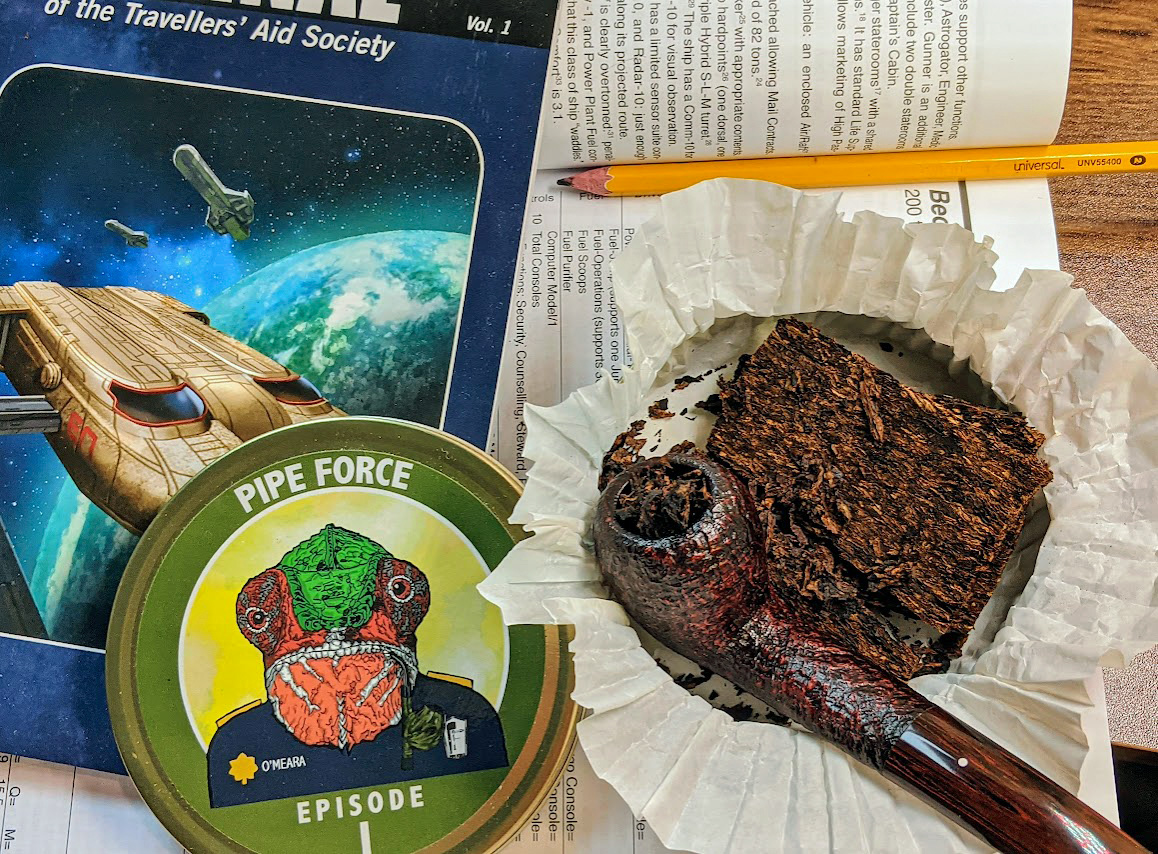
Before we begin, I should tell you: this tobacco review is being written by an A.I. Not the fancy new GPTs or their ilk; no, this is last century’s meat-and-bone, all-organic model. To be fair, a large part of what we call knowledge is merely the accumulated perceptions and impressions gathered from a life wandered through, synthesized into a spongy mass of what-it-is-that-we-think-that-we-know. The algorithm for this prompt is simple enough: pump thousands of bowls of smoldering plant matter into a gaping maw, cross-reference the chemical sensations with all other matter previously ingested or inhaled, sieve it all through the diffuse and fractal twin lens of memory and emotion, and churn out a panoply of adjectives that attempts to convey the sensations to someone who hasn’t experienced it yet. Odds are that a diligently trained monkey could succeed half the time; if this reviewer nears fifty-one percent then that would qualify as an unrivaled success. There must have been some similar musings perambulating through the mind of Per Jensen when he began his mad scientist routine at Sutliff with the Pipe Force project, which brings us to the current mixture under the microscope—Sutliff’s Pipe Force: Episode I. Here again are the unusual ingredients that engendered the series, with the stoved Rustica being the defining voice in this composition. From the tin: The Latakia-forward English mixture offers plenty of smoky flavor from the fire-cured leaf, which is artfully harmonized with floral, earthy Stoved Rustica. A mixture of high-grade Virginias imparts a natural sweetness. Katerini, the sole Oriental component, offers herb and spice notes bringing complexity and nuance to the flavor profile. It’s certainly Latakia-forward, with the stoved Rustica doubling up on the rhythm section like a second bassist. A first whiff from the tin releases the aromas of shoe leather and hide glue in a base of clay soil with a campfire wafted over it like last night’s beach party. Once it’s been accustomed to oxygen again, subtle hints of sweetness poke through from the Virginias: lemon rind, light milk chocolate, the dregs of a peaty Scotch, and muddled cherry. Old regulars like fresh-sawn oak and tilled earth are there, of course, with distinct notes of truffle, creosote, damp peat, and pine bark mulch. As an aside, I’ve been re-potting my camellias and the similarity of aroma to the ericaceous soil mix is notable; the Katerini really brings the unique depth of its vegetal complexion when supported by the Rustica and afforded more voice in the mix. The smoky Cyprian Latakia, in turn, is backed by equal earthiness from the Rustica, which overall exhibits a profile similar to dark-fired Kentucky; it leans more toward the woody and vegetal end of that spectrum, echoing and amplifying those traits of the other constituents. The tobacco is presented pressed and cut into a couple of thick, hearty flakes in the tin, lightly moist and easily crumbled to prepare—I prefer mine with a bit of drying time. The out-of-this-world tin art for this episode in the series is Major O’Meara smoking a cavalier. In the absence of confirmation, I’m going to hazard a guess he’s of the Ithklur species. The first taste from the light is sweet, with hints of that milk chocolate dancing around the edges. The Virginia leads the smoke through the top of the bowl, and orchestrates it well. Thoroughly smoky with lemony, grassy highlights from the Virginia spectrum, it soon segues into the mid-bowl profile: heartier, smokier, with the flavor leaning to the mildly acrid and tangy tinge that is the campfire-esque signature of English blends. Caution advised, it can turn overly bitter if pushed—this is where one’s sipping technique is required to maintain the fullness of flavor through to the heel. I did tend toward a lot of relights, though it may have as much to do with technique as with the blend. Pacing is also important as the nicotine starts to manifest; though the Rustica’s contribution has been tempered well by the stoving, it can certainly upend an empty stomach. At the end of every bowl, the mouthfeel somehow gets better. The balance of sugars in the tobaccos would seem to be spot-on in this regard. I started out my tasting in cobs, then cut short an unpleasant bowl in a meer, and finally landed on my best instrument with the lovely Dunhill 4427 pictured, a quaint group 4 shell briar with a gentle curve and Cumberland stem supporting a perfectly executed acorn bowl. It surprised me here, as I’ve learned through the years that I generally have the best experience with English blends in large, wide bowls. With this blend it seems that to get the best out of the Katerini’s somewhat diaphanous influence the smaller bowl fared much better. Room note is very English, so the company you keep will either love it or hate it, and it doesn’t linger too much. I find it paired best with a strong coffee; Sumatran beans complement the flavors well, as do Ethiopian if a lighter brew is preferred. Overall impressions of the blend are that it’s a curiously interesting take on the English genre, almost a reductive reconstruction of the theme using the unique components. This blend, if nothing else, expanded my vocabulary of sense perceptions with the uniquely treated leaf. While the average human can distinguish approximately one trillion (1,000,000,000,000!) different aromas, multiplied by seven basic tastes, and wholly dependent on variables from body chemistry to atmospheric conditions, our overworked and underpaid simian brains can’t effectively catalog them all. Our pet adding machines are exceedingly good at this, however, and someday soon they’ll be the ultimate and unequivocal authority on what something tastes, smells, looks, or even feels like. Until that time, friends, revel in the moments that can be stolen to savor over a bowl of Pipe Force: Episode I.
 McCranie’s Roanoke Tobacco Review
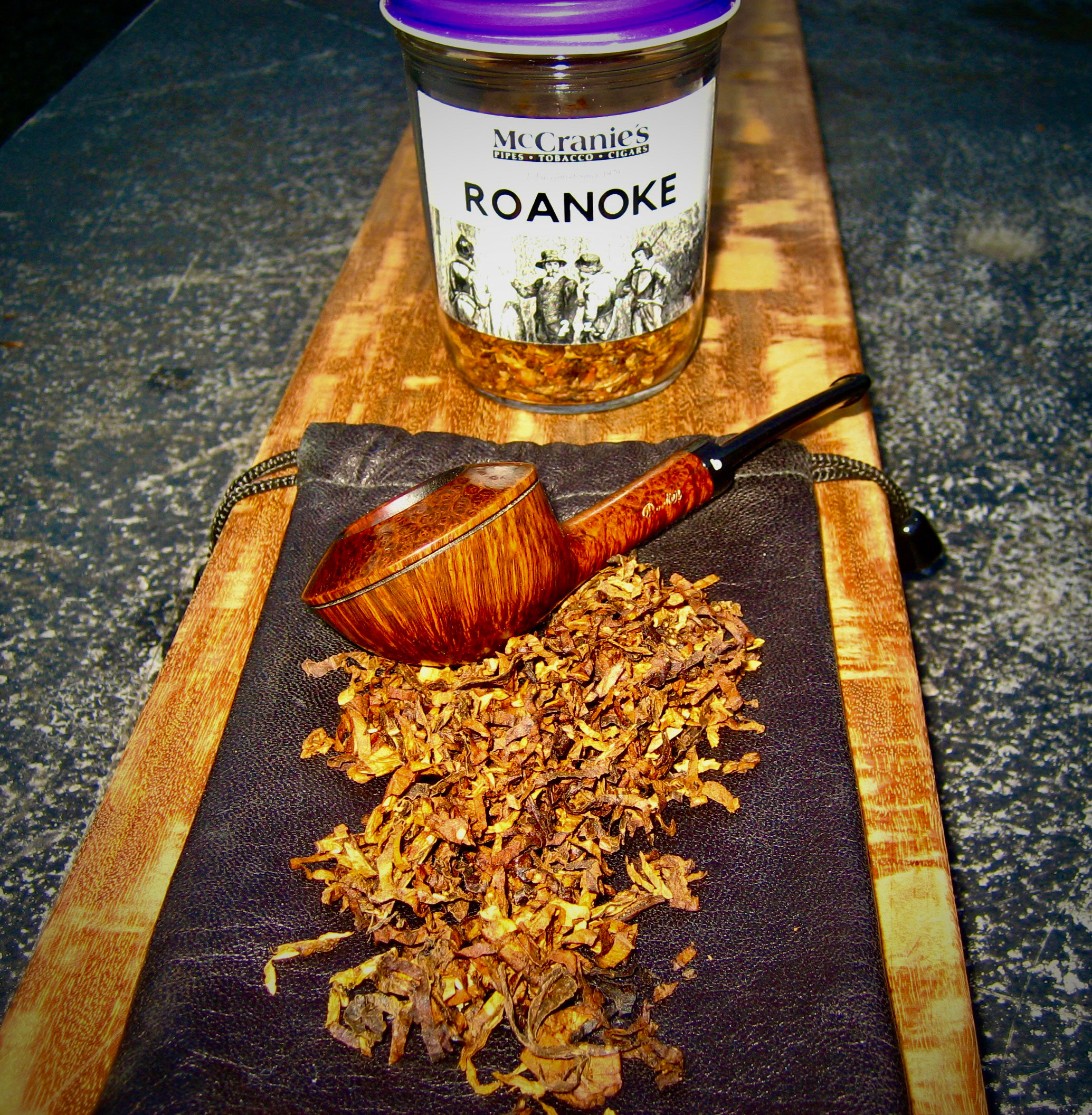
The winter winds are really whipping at the windows here in the northeast, lashing out the last gasps of the season. Not the best weather for outdoor pipes, frankly. Luckily here I am, snuggled tight inside next to a purring cat and a cozy heater, with a mug of warm chai, a book filled with adventures in tropical realms, and a pipe full of the taste of warmer climes. This month the particular blend in question is McCranie’s Roanoke, a delicious two-ounce serving of summertime-in-a-jar. A tobacco house patterned after the classics, McCranie’s is well known locally to Charlottians, and to pipe tobacco aficionados the world over. From its humble beginning as an Edward’s franchise back in 1979, its current incarnation is led by its third-generation namesake Matthew McCranie, who was interviewed by our very own Brian Levine on the PipesMagazine.com radio show not too long ago. (Interview here.) Ask any veteran piper about McCranie’s Red Ribbon or Red Flake and they’ll likely get a wistful, far-away look in their eye as they recall the singular nature of those monumental marques that will unfortunately never be repeated. The McCranie’s story is intricately tied to the McClelland story. McCranie’s landmark blends Red Ribbon and Red Flake, which showcased exceptional single-crop, single-year, local Carolina offerings, were processed and tinned by McClelland, and with the passing of that blending house a vacuum was created that was felt far and wide across the tobacco world. Not to be deterred, Matt McCranie dusted off the family blending cap and set about sourcing leaf and creating a whole new legacy for the brand. So it was that while shopping for review blends I navigated to the McCranie’s website and decided to sample some of their new offerings—and am I ever glad that I did. As I get older I find that it sometimes takes a more conscious effort to break out of habit and routine; I’ve hoarded plenty of Red Ribbon and Flake tins in my own cellar, yet had only tried one other of McCranie’s offerings, the also-erstwhile Murdock’s Pipe (a delightful blend, but not to my general preference). Well, it was high time to rectify that situation. The first thing of note is the presentation: McCranie’s own-label blends are now being offered in glass jars holding a full two ounces of leaf. As a matter of course I generally buy tobacco with the intent to set the majority of it aside to age while I whittle my way through a tin or two, and stocking up with glass jars makes me feel better about that investment in future enjoyments. The jar itself sports a simple label bearing the McCranie’s logo, the name of the blend, and a portion of the William James Linton engraving The Lost Colony, referencing the famous lost colony of Roanoke located in Dare County, on the Outer Banks. From the website we find the description of the blend: McCranie’s Roanoke is a rich and complex blend made of Red, Gold, and Dark Virginias with a helping of Louisiana Perique, perfect for Virginia Perique lovers. The Red Virginia provides a sweet and tangy flavor that complements the bold and spicy notes of the Perique. It’s a tobacco meant to be savored slowly to fully appreciate the flavors that develop throughout the bowl. Simplicity is what McCranie’s does best, and Roanoke is a perfect example of that simplicity in all its glory: a Virginia-Perique blend par excellence. Unscrewing the lid releases a burst of a sweet, tart bouquet that immediately carves out its own place in the genre. Top notes of raspberry jam and buttered toast hint of the tobacco’s sugary richness, and are a tantalizing departure from the more common lemony complexion of most VaPer blends. Some airing time brings mid-tones of driftwood and clay soil—a natural allusion to its namesake—along with more typical VaPer notes of mulled wine, ketchup, stone fruit, milk chocolate, and leather, along with the telltale nose-tingling that accompanies a healthy portion of Perique. The leaf still feels a little young at times, with the tiniest of edges and errant notes on occasion—this does, however, bode well for its future in the cellar, and did not intrude on the smoking experience negatively. The supple, chocolatey ribbons come at a perfect humidity for packing directly or allowing a short drying time, and the jar keeps a clear concentration of the aromas contained like a brandy snifter, without the cardboard or paper wrapper in tins that can color the aromas, if ever so slightly. In the bowl, Roanoke is a midwinter’s dream. Smoking lightly and effortlessly despite its obvious richness and youth, the first ounce disappeared within a week, before I’d even finished my tasting notes. It’s an easy one to recommend as an all-day blend—my own smoking habit has decreased significantly in the past several years and leaves me readily susceptible to a too-sharp Virginia tongue bite, but this never even nipped at the edges. On the contrary, it delivered a rich and colorful smoke bowl after bowl in the same pipe, with a flat-cola mouthfeel and aftertaste better than any blend in recent memory; I’d place it alongside an aged Escudo or Sunday Picnic in a heartbeat. The Perique component is at a good amount, alluringly drawing out the complementary flavors of the variety of Virginias employed and providing a finely nuanced cohesion to the overall. Repeated rations in the same pipe were never an issue, and in fact seemed to improve the flavor of each subsequent helping. For all its flavor it’s notably mild in nicotine, and the room note, though it lacks the richness of the direct smoke, casts a pleasant afterglow that doesn’t linger overlong. This blend certainly tells me that McCranie’s is still a name that carries its weight in the pipe world. Not many tobaccos make me want to plan a pilgrimage to their source. (I wonder what the airfare to Charlotte is this time of year…?) Also a blessing and a curse […]
 Christmas in a Can
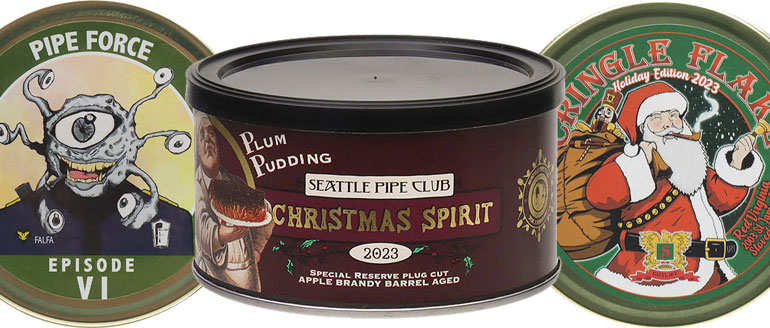
Try as one may, getting caught up in the Dreaded Holiday Rush is inevitable. So many errands to run, plans to be made, commitments to extend, and lots of traveling to do, to and fro; the whooshing sound that deadlines make as they fly by. Fortunately, we pipe smokers have a secret weapon against the onslaught of anxiety that such times can induce: kicking back with a bowl and a favorite blend, and savoring our time. Such it is that I finally get around to this deadline-busting installment of tobacco reviews, discovering three new blends peculiar to the season: Pipe Force Episode VI, Cringle Flake Holiday Edition 2023, and Plum Pudding Christmas Spirit, all brought to us from the house of Sutliffe Tobacco. Santa, eat your heart out. Pipe Force Episode VI A woody, tangy mixture of select Virginia leaf is elevated with Stoved Katerini, adding dark berry and spice. Dark-Fired Kentucky and St. James Perique enrich the base with earthy notes, pepper, and a light smokiness. Episode VI is a savory, vinous evolution from the natural sweetness and dark flavor of the Virginia/Perique genre. Richness with nuance all the way down. A passion project collaboration with Sutliffe, the Pipe Force line of the Per Jensen Signature Series certainly speaks to sci-fi nerds of my ilk, both in concept and execution. Like the Birds of a Feather series preceding it, the conceptualization begins with ‘unique ingredients’ as the canvas on which to build; in this incarnation, a delightfully stoved Katerini is the star of the show, supported by the doo-wop duo of dark-fired and Perique singing backup over the baseline of Virginia. This is Per Jensen freestyling, Jackson Pollock-esque strokes thrown wildly against the canvas. Opening the tin, the bouquet of the tightly-pressed crumble cake is centered on rich fruit and a tart background, with more than a hint of furniture polish—a slightly vinegary, tannic note of light oak overlaid with lemony vanillin edges and beeswax. Once the blend acclimates to its unsealing, the vinegary aldehydes dissipate to leave familiar Virginia fruit-and-leather base notes with top-note aromas straddling sweet and savory. In its place is a rather complex melange of impressions: bitter and powdery baker’s chocolate, green wood, dried apricot, mesquite barbecue. In the smoke, the chocolate fades demurely to the background, upstaged by the tangy dryness in the Katerini and peppery piquancy of the Perique. The stoved Katerini imparts a particular voice as it steers the blend; in turns the meaty sweetness of a Medjool date, or earthy and a tad gamey like seared rabbit tips. It is not the rather floral and bright version of the leaf I am accustomed to, and carries itself differently in the company of the other constituents in this blend. The complexion of the smoke drifts and varies refreshingly—indeed, sometimes erratically—over the course of the bowl, giving it enough interest to recommend as a repeat visit to further explore the nuance of the novel ingredients. Overall the blend is every bit as chaotic and unexpected as the theme and tin art would suggest. As the blends are limited small-batch runs, they’re very much worth the effort to seek out and try. Cringle Flake Holiday Edition 2023 Mark Ryan’s 2003 Vintage Perique leads the way again for this year’s Cringle Flake. Stoved Katerini has been added to the blend combined with decade old Red Virginias to create one of the most unique blends available today. The whole leaf is then pressed and sliced into broken flakes. Continuing with the experimental treatment of the Katerini, Cringle Flake 2023 makes use of it to even greater effect in this year’s holiday release. Revealing the thickly-sliced loose flakes of gingerbread-brown tobacco, the initial bouquet is familiar VaPer territory, with just a little something extra—high dry wine notes, bright tart hops, mild astringent, pine soap, and incense fill out the bouquet. The fruit notes here are more pineberry than the usual stewed plum or raisin, with a light floral lilt that translates deliciously into the smoke. The flakes break effortlessly, and are at perfect straight-from-the-tin humidity. A brief nose of lemon-lime soda on the charring light segues to a bready croissant in the top bowl; the mid-bowl depth emerges with a rich umami, the condimental leafs coaxing sweet spice in the range of nutmeg, orange peel and rose hips that continues to a smooth finish, never getting too heavy. The Katerini is, for me, better expressed here than in the previous blend; in full disclosure of bias, VaPers with Orientals are very much to my smoking preference, and this is easily one of the most intriguing I’ve had the pleasure of packing in a bowl. It smokes clean and light after repeated bowls, almost effervescent; piquant, complex, and full of intrigue, with a wonderful nose on the retrohale and waft from the bowl—and all perfectly tempered from the well-aged constituents. For my money, this is an all-star blend. Seattle Pipe Club Plum Pudding Christmas Spirit Nothing says Christmas Spirit like Plum Pudding. The traditional centerpiece of holiday celebrations since the 17thcentury. America’s most popular Balkan, Christmas Spirit is Joe’s gift to luxury tobacco fans everywhere. Delight in our limited 2023 edition of Plum Pudding Special Reserve aged 30 days in charred oak Apple Brandy barrels, pressed and crumble plug cut. A chunk of the barrel rests in every tin. Merry Christmas from the Seattle Pipe Club. The original Plum Pudding is a towering achievement of a pipe blend, and I would have to agree with the assessment that it’s America’s most popular Balkan. This special holiday presentation, aged in apple brandy casks, manages to make perfection just a little bit better. The familiar is there, along with added highlights: strong oak campfire notes form the backbone, wrapped in parchment, grenache grape, Port wine, Lapsang souchong tea. The plug presentation is not as tightly compressed as others, so cutting portions off to crumble the darkly mottled leaf comes handily. The smoke is much lighter in weight than the […]
Fireside
 Bad Advice?
When I first started with the pipe as a quirky and precocious teen, the only tutelage I had at my disposal were scenes from old movies in which a well dressed chap would stick his pipe into a pouch, scoop tobacco into the bowl and press it down unceremoniously with his thumb. Then, with great flourish, he’d strike a match and light the thing with all manner of cinematic excess, puffing up vast clouds of smoke falling just short of completely obscuring his visage. While it may look good on film, it’s a terrible approach to actually enjoying the thing. Somehow, though, this “technique” seems to have survived in the contemporary vernacular, at least to some extent, even with bit-loads of information handily at our fingertips that should dissuade us from the practice. But, at the time, this misguided approach was all I had; it’s no wonder my early days of puffing were fraught with difficult lighting, harsh, bitter smokes and tongue bite, all culminating in a fireproof mass of ye old soggy dottle in the bottom of the bowl. Ultimately, the resulting frustration made me give up the pipe, at least for a while. While the idea of it was still very appealing, the practice of it was not. It wasn’t until a few years later when, still full of curiosity and romantic notions of pipe smoking, I wandered into a real tobacconist’s shop, and learned my “method” was a long way from the techniques that would bring me to any sort of pipe smoking bliss. So, after my poor start, and under the guidance of someone who actually seemed to know how to do it right, I was given the opportunity to approach the process anew, this time with much greater success. It was only because I was both perseverent, and fortunate to have a local shop staffed with knowledgeable people, that I’ve been able to enjoy the experience ever since. At least mostly… How many fledgeling pipe smokers have simply given up on an enjoyable pastime because of similar early mis-starts? Fortunately, today, it’s not hard to find helpful guidance at the press of a key or ten. But, at the same time, not all roads lead to Valhalla, and sometimes the advice offered might well be labeled with, “Here be dragons.” The other day, I came across a short video on-line in which a well-meaning tobacconist suggested packing a bowl of an “English” mixture “nice and tight.” Perhaps somewhat ironically, I was smoking, or trying to smoke a bowl that I’d filled on auto-pilot, packed too tightly, and not only was having the devil of a time trying to keep it lit, I really wasn’t enjoying the acrid smoke the tobacco issued during the brief periods in which it was actually burning. “No, no, NO!” I found myself muttering at my pipe, and at the figure on the screen, my protests joined by the guttural growling noises that sometimes accompany my discontent. Defiantly, I grabbed a pipe nail, shoveled out the dense, asbestos-like clog from the bowl, swabbed out the shank with a pipe cleaner, more out of habit than need since I hadn’t actually smoked enough of the mass to foul the shank, and started over, this time paying proper attention to what I was doing. (For as long as I’ve been doing this, I still screw it all up sometimes.) Much better. This got me thinking about a couple things that are so important to the maximal enjoyment of our pipes, yet not often enough discussed, namely how different tobaccos respond to variations in filling density, and moisture content; two separate but related parameters. Once I’d been shown the proper way to fill the bowl, or at least a proper way, everything had changed for me. I also began drying my tobacco down as a matter of course. Suddenly, there was greater cooperation between leaf and flame, the smoke was rich and flavorful, and it burned mostly to the bottom of the bowl with few relights. Given that, at the time, I smoked latakia mixtures almost exclusively, there didn’t seem to be a reason to explore beyond my “new” approach. It wasn’t until my attention turned in the direction of Virginia blends that I had to look a bit deeper. The same technique that worked so well for me with latakia mixtures resulted in bland, and often harsh smokes with Virginias. I attributed this to the tobaccos, convincing myself that I just didn’t like the stuff. At one of our pipe club meetings, I was talking with a friend who smoked Three Nuns exclusively. When he offered me a bowl. I thanked him, and told him that I just didn’t seem to get along well with Virginias, that they weren’t for me. “Maybe it’s the way you pack them. Here, let me fill your pipe for you.” I watched as he rubbed out a few coins to fine ribbons, moister than I was then accustomed to, and filled the bowl carefully in stages, pressing it tighter than I would have. Prepared for a nightmare, I was instead treated to a pipe dream. The tobacco smoldered slowly and almost continuously, delivering a rich, cool, sweet and delicious smoke. After that, I spent some time exploring the impact of these two variables, moisture content and packing density, on different mixtures and blends, always with similar results. Latakia mixtures, and to a lesser extent, those with a high percentage of oriental leaf, taste and smoke better when they’re on the dry side and the bowl is filled loosely, while Virginia blends tend to work best with a little more moisture and a denser fill. Burleys seem to work best somewhere in between, except for cube-cuts, which don’t like to be packed with much pressure at all. (Gravity fill, tap the bowl to settle the cubes. Repeat until full.) For such a simple act, pipe smoking is filled with undefined complexities! The point behind all this? Often […]
 FOMO
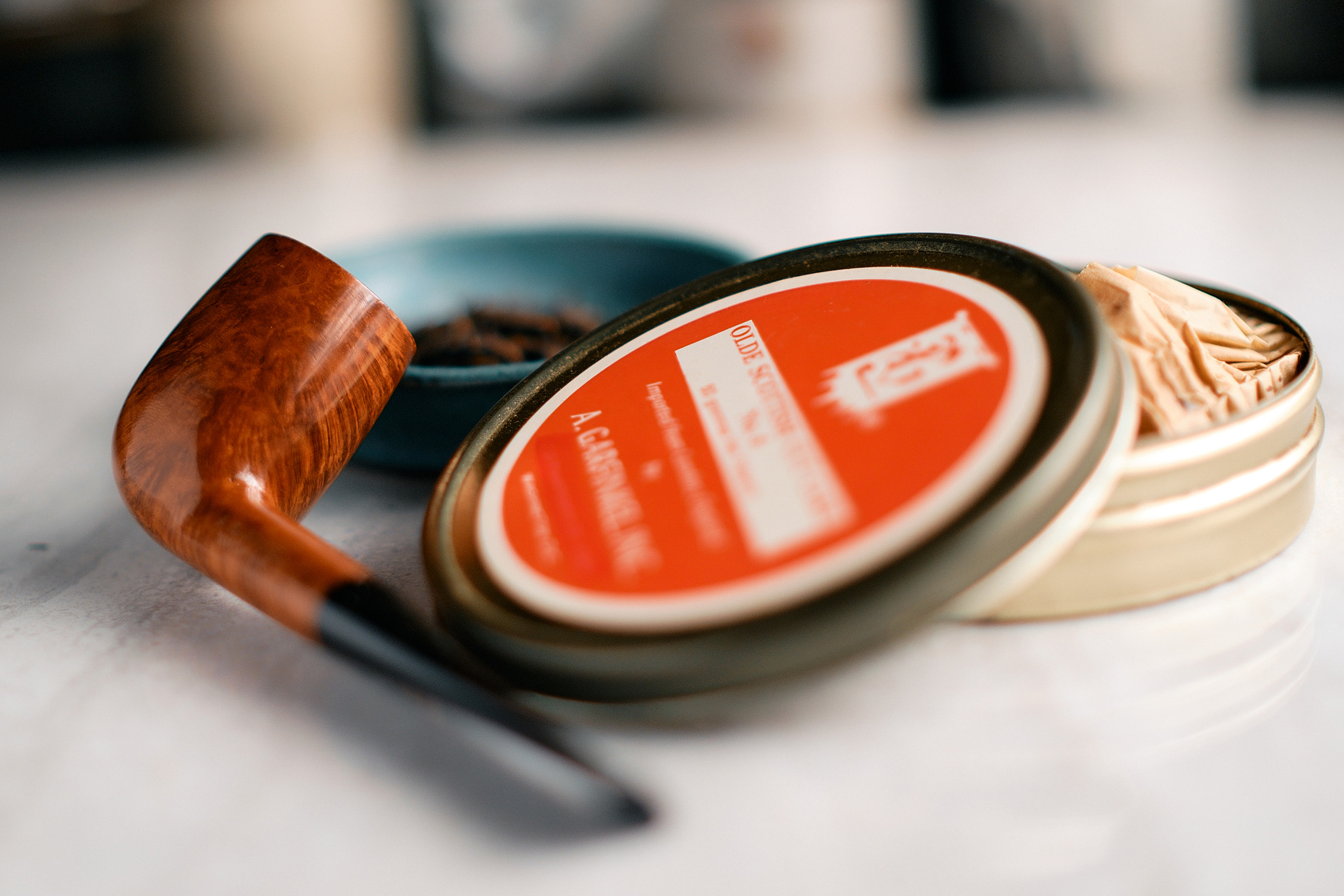
FOMOI confess. I’m a Latakiaphile. Ever since I first smelled the smoke of the dusky leaf, I’ve been in love with it. I know this is no surprise to anyone who has followed any part of my weird journey through pipedom, but I wanted to state it openly, get it off my chest. Mostly, because I seem to have been in something of a weird state of denial about this fact myself for some months. It started innocently enough during the heat of last year’s summer, a time when I find myself feeling the gravitational pull of lighter tobaccos. While winter weather and bigger, bolder Latakia mixtures have always been my ideal companions in the colder, moister clime, they can be a bit overwhelming to me when the mercury rises. While I enjoy the taste and aromas of those first few puffs, as the bowl progresses, my senses soon feel fatigued, overwhelmed, like putting on a comfortable but heavy top coat and wandering out into the blazing sun. In the summer months, I have always turned to “lighter” blends, sometimes with just a whisper of Latakia, more often with none at all. Virginias, with or without the added condiment of perique or oriental leaf are just the ticket when short sleeves and tee shirts are the uniform of the day. Even burley blends tend to feel more apropos then. I know there are many who smoke the same blends year-round, but I’ve never been one of them. If I’m honest, I am a little jealous of those folks. It’s a bit of a curse to have my tastes tied inextricably to uncontrollable forces of nature. (Though, I do recall a rather oddly delightful experience of finding myself, exactly once, smoking a pipe in the shower. Another story. Another time. Maybe.) Last year presented no exception to the rule. Once spring had come and gone, I put away the dark mixtures, and turned to the softer, gentler side of tobacco goodness. I always enjoy this little “reset,” but equally, I look forward to the return of the cooler days and colder nights when I can come back home to the comfort of those mixtures that have always provided me with an indescribable solace. I love fall and winter the most, and not just for smoking. I don’t really hate the sun, but I’ve never thrived in its heat; my constitution prefers cooler weather. I’ve always been a fall and winter lover. But, something strange happened last year. Even when the temperatures dropped, even when the air got misty, the rain began falling, and I traded short sleeves for sweaters, I kept reaching for my summer blends. Occasionally, I might dip into the jar of Westminster, prepare a slice or two of Spark Plug, or reach for one of my vintage tins of Orient Express #11 or Bengal Slices, but I found myself routinely returning to the lighter side of things when it was time to fill my bowl. Nothing about this should be upsetting, of course, but it’s just not who I am. It’s out of character. It’s like I was subconsciously denying something that is fundamental to the very core of my pipe smoking existence. Looking back on it now, it feels like I was in some strange parallel universe, an alternate reality. It strikes me as just plain wrong. It’s an odd thing. For most of my pipe smoking life, I’ve always enjoyed these forays into the lighter side of things, but at the same time, my craving for Latakia forward mixtures has always ruled. I remember when I first began exploring Virginias, I’d reach the end of a bowl, feeling somehow unsatisfied, and would immediately want something else, something smoky to scratch the itch that remained. As I became more familiar with them, that itch gradually subsided, but never fully disappeared. The pull of the dark side remained strong. I’d spend the summer enjoying my Virginias, but always looking forward to the season’s change so I could once again dive happily into the deep, smoky richness of my most favored leaf. Last year, though, I kept on an almost steady diet of Virginias all summer, of course, but also right through the cold and wet months. On a whim one cool, blue day recently, as the sun revealed itself from behind wispy clouds, I pulled an open tin of my beloved OE11 from the Tupperdor in which the open tins reside, savored the aroma for a few minutes, then filled a bowl with those luscious dark ribbons and enjoyed an almost magical smoke, rich, deep, satisfying, the wonderful incense-like scents enveloping me as I puffed in absolute bliss. Then, reality hit me over the head. With spring teasingly peering out from around the corner, last year’s winter having pretty much come and gone, I realized I’d managed to miss out on all those wonderful cold, damp days and the perfect harmony they create when the misty air embraces the leathery, campfire aromas and rich flavors from my beloved mixtures, and I didn’t even notice. It’s not just that the window of opportunity for my yearly Latakia fest was about to be slammed shut, but, worse, it’s that I wasn’t even aware that I was missing it. It’s not that my tastes had changed, or anything so dramatic; I’d simply fallen victim to the power of inertia. I was enjoying what I smoked, and simply, unconsciously paid no attention to the fact that the season was coming to a close. Hot weather is on its way, and if history holds, it’s probably coming fast. Soon it will be time to return full-stop to tee shirts, cold showers and lighter tobacco fare. It feels like I’ve slept through Latakia season, like I’ve missed out, and I’m feeling a little melancholy about that. I’ve got at most a few weeks to catch up, to make up for lost time. Hopefully, we’ll see a few more days of rain before that […]
 Passionalization
“Don’t you have enough pipes? Why do you need another one?” It’s a fair question, though one I’m never happy to hear, especially when it’s coming from a voice in my own noggin. I mean, sure. I have enough pipes. More than enough. By any rational measure, probably far too many. But, pipe collecting isn’t about being rational. Pipe collecting is about passion. When a pipe speaks our name, calls to us through the mists, singing its siren song, how can we mere mortals resist? Unless we’d have to go without eating for a month, or risk losing the roof over our heads, why shouldn’t we buy “just one more?” Maybe the food thing wouldn’t be so bad (I could stand to lose a few pounds), but it’s the middle of winter. It’s been pouring rain for a week, and I’m pretty fond of having a place with a roof to keep me and my pipes dry. Maybe when the weather changes, I could forgo that luxury for a while too, if it meant answering the call when it came. Scratch that. That’s just silly. It is a fact that most of us really don’t need another pipe. Most of us probably don’t need as many as we have. No one needs more than a couple pairs of shoes, either, or a week’s worth of socks. Some laughingly refer to it as Pipe Acquisition Disorder (PAD), making it sound like some sort of affliction, worthy of inclusion in the next revision of the DSM and requiring some sort of therapy, or at least an intervention. I don’t. Even after all these years, and, I still find immense pleasure in the hunt for the next addition to the herd. Getting a new pipe just feels good and makes me happy, and that should be enough. Despite this, I do sometimes find myself going through fits of passionalization. There are times when a pipe acquisition hasn’t quite scratched the itch. I’ve been thinking about this a lot lately as I spy the mad jumble of briars that I loosely refer to as my “collection.” There are many that continue to speak to me, and some have for many years, bringing me a great deal of pleasure when I look at them, hold them, smoke them. Some are pieces of profound artistry and beauty, others, simple, comforting objects of sublime utility. Either way, they’re sources of joy. Why wouldn’t I want another? But, there are more than a few that, instead, make me scratch my head. Confessing this isn’t easy, but there are pipes in my possession that I’ve acquired for entirely the wrong reasons. I have more than once been guilty of getting a pipe because of the “trendiness” of the shape or the maker, because I should like it, not because I do. I’ve smoked them, probably dozens of times, enduring the persistent voice in my head telling me all the reasons I should find it the best pipe ever, that one day, I’ll learn to understand it, acclimate to it, and become one with the kool kids. This rarely goes well. It turns out there’s little traction in getting a pipe in the hopes that one day it will ice pick its way up the ladder to the lofty status of being tolerated. Another side to every coin. There have been times I’ve not bought a pipe that I really liked because silly rationalizations planted themselves firmly in the middle of the road and wouldn’t let me pass. In the very early days of my collecting, a particular shape that I was very much drawn to, and still am, was looked down upon pretty much en masse by many veterans of the pipe community. Though there were a few outliers, and we did talk amongst ourselves about this peculiarity, the majority seemed to meet the shape with abject disdain. I don’t know why and will never understand it; the shape had been around for decades. Why would it continue to be in catalogues if so universally reviled? But, as a young, somewhat insecure newbie angling to be accepted by the old guard, I was afraid to put my own preference ahead of that of the taste-makers, and resisted the urge to acquire certain pipes for fear of having my membership blackballed. Ridiculous? For sure, but it felt pretty real to a pup trying to hang with the old dogs. (We’re lucky to live in more accepting times, I think.) There were times, too, I may have passed on a piece or ten because the brand/maker wasn’t à la mode. “Those pipes are nice looking, sure, but the briar is young and inferior, and they lack the pedigree of the maker having been around since before the Big War, and you’ll never be able to sell or trade it later. What you really want is something from Y. Now THAT’S a good pipe.” (Funnily enough, some of today’s desirable brands were yesterday’s pariahs, trading hands for relative peanuts because they weren’t from the grown-up firms. I wish I’d bought a bushel of them!) One fellow even told me that I should only chase pipes pre-1920 because, I’m not kidding, “The old vulcanite tastes better when it oxidizes than the modern stuff.” That was one tidbit I did not pay much mind to, though it was, and is amusing to think about. Don’t get me wrong; I learned a great deal from my early influences, and I’m grateful for every shred of knowledge they shared with me. Fortunately, now that I’ve become one of the old dogs, I’ve outgrown the need to impress anyone, and chase what I like solely because I like it, ignoring any real or projected judgment from the taste makers. Many good lessons have come along with the ride from there to here, along with, I admit, a whole lot of pipes, good and bad. Maybe, too many. I refuse to count them. Remember the mad jumble […]
The Pipe Pundit
 Huffing and Puffing in the Wildwoods
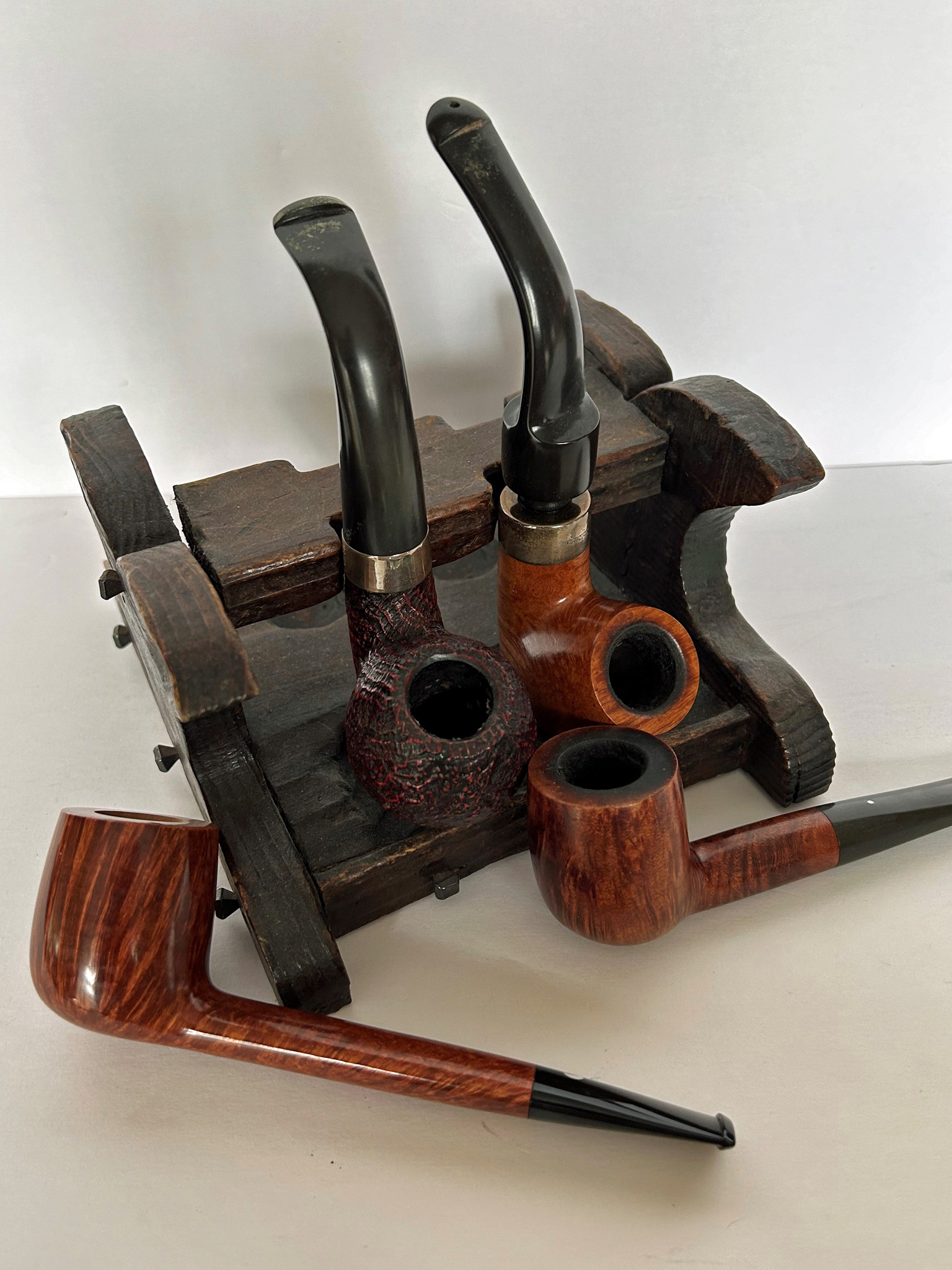
You know the olde saw: April’s showers bring May flowers.” Just to let you know, Pundit is all in on May and the flowers. Not that Pundit is a knowledgeable horticulturist, but walking about the woods on a bright sunny May day with wildflowers blooming and blushing whilst puffing a particular pipe is what spring is all about. So, to properly prepare in April, Pundit begins cleaning up several pipes that will make the wildflower walks this year. And never mind that I receive strange looks and snubs as I lean over to view up close and personal a beautiful wildflower and snap a photo. Pipe firmly clenched, natch. For good reason, spring brings to mind a couple of notable characters. First is the poet Robert Frost and his poem Birches. One could do worse than be a swinger of birches, is the last line of this wonderful poem about young boys climbing birches and bending them down to nearly touching ground. This lovely poem by the four-time Pulitzer Prize winner brings back memories of a crew of ragtag barefoot country boys swinging tall, spindly pine trees to earthly experiences. Yes, and falling from said pines, as well. Now, Pundit is uncertain whether or even if Frost was a pipe smoker. The history of this is a bit confusing. The other great original is one Yogi Berra, the Hall of Fame catcher for the New York Yankees, who played 18 seasons with the Bronx Bombers. He was a 15-time All-Star, a three-time American League MVP Award winner, and a 10-time World Series champion as a player. It is fairly well documented in photos that the great Yogi smoked cigars from time to time. The Baseball Hall of Fame calls Yogi “a cultural icon whose fame transcended the baseball diamond. “Yogi-isms” such as it ain’t over till it’s over and a nickel ain’t worth a dime anymore have found their way into everyday vernacular for baseball fans. This neatly brings us to Pundit’s favorite Yogi quote this time of year: When you come to a fork in the road, take it. Let’s just call Yogi baseball’s Phrase Laureate. I take the forks along the trails, looking for the rarest of wildflowers. Getting lost in the woods away from the madding crowds keeps dirty looks and slights shielded as I walk, huff and puff. That’s precisely what a pipe-puffing Pundit does on his May wildflower walks. You never know where you are likely to wind up, but you will know when you get there. My best Yogism, doncha know. You can thank me later. And the best pipe that takes me along on these nature walks? Why a White Spot, a Northern Briar, an Ashton, or a Cavicchi. At times I also attempt my best Holmesian pipe look with a Peterson Calabash shape with its iconic flared rim. Or all of the above, and then others tossed into the camera bag for good measure. It’s a big camera bag! And now that we have had a nice walk in the woods, it’s time for some Pipe Smokers of the Past. Starting things off is not a personality so far back in the past, J. Robert Oppenheimer, was born April 22, 1904, in New York and died Feb. 18, 1967, in Princeton, N.J. The famed so-called “father of the atomic bomb,” the Oppenheimer movie just walked off with a plane load of Oscars in this year’s tinsel town extravaganza. The biopic won seven, including Best Picture, Best Director for Christopher Nolan, and Best Actor for Cillian Murphy. Oppenheimer, celebrated pipe smoker and theoretical physicist, was director of the Los Alamos Laboratory in the thick of the Manhattan Project in World War II. The atomic bomb was fully enabled by July 1945 and dropped on Japan in August. It was the first nuclear explosion in history, created by bombarding neutrons with plutonium and uranium which resulted in a nuclear fission explosion. Uh, Pundit doesn’t profess to know fission from fizzling. Allegedly, one of Oppenheimer’s most famous quotes, Now I am become death, the destroyer of worlds, was either around the time of the first bomb test in 1945 or shortly after. Another, softer quote from the great scientist, is Genius sees the answer before the question. And finally, author, Gunter Grass, winner of the 1999 Nobel Prize in literature, was born Oct. 16, 1927, in Danzig, now Gdansk, Poland, and died April 13, 2015, in Lubeck, Germany. Grass, also a poet, reportedly smoked Stanwell Extra Fine, an old Danish pipe tobacco popular in Germany, as well as W.O. Larsen Classic, Three Nuns, Mac Baren Navy Flake, and Dunhill Early Morning Pipe. I’m always astonished by a forest. It makes me realize that the fantasy of nature is much larger than my own fantasy. I still have things to learn—Gunter Grass. And a parting shot: Pipe smokers are the mind workers of the world!
 Marching Into Spring
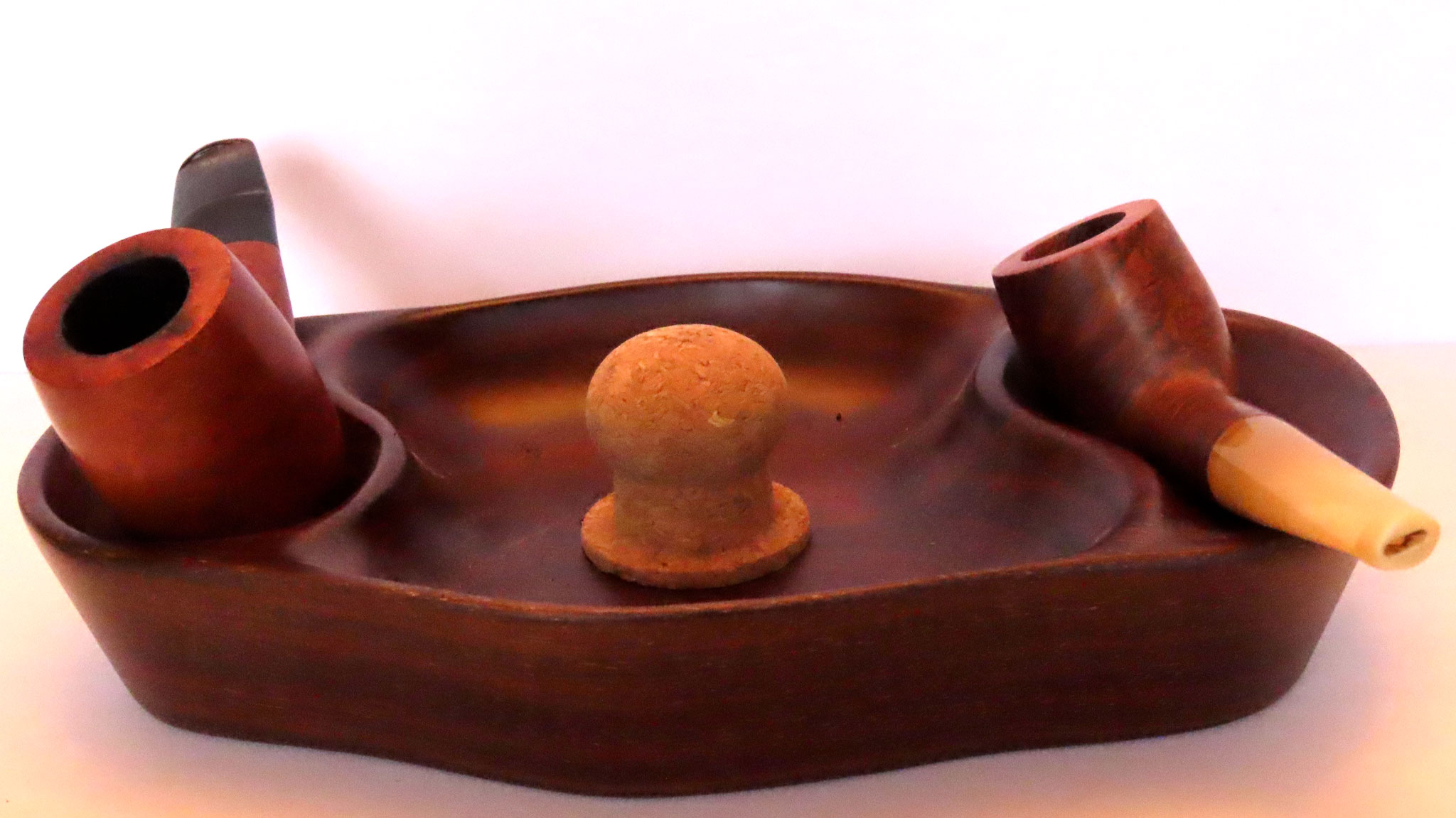
February’s International Pipe-Smoking Day was more than just another moment of relaxation for Pundit. It took me back to a time in Paris when I was wandering somewhere around the 10th Arrondissement of that great city and happened upon a shop with a sign that read: Tabac. I had to go inside and look around and gaze at the goodies. Inside that delightful French pipe shop I had my first encounter with French pipes of any sort. Pundit was enamored of English pipes at the time and was dimly aware of much else. Let alone historic French-made. The shop owner walked us around his charming very French shop, flooding me with his broken English. My college French had lived beyond its best by date. The owner waltzed over to a counter and showed me a Chacom, of the famous Chacom and Comoy family of Saint-Claude, a small town in eastern France, which is the self-described “world capital of (the) pipe.” For good reason as it turns out. A billiard Chacom was purchased immediately. But now sadly, or perhaps inevitably, that particular Chacom pipe from the Paris Tabac shop has been lost to time. Who knows where or how it disappeared? Traded, perhaps? But the time in that tobacco shop was well spent. It was here that I learned something of Saint-Claude and its pipe history, foreign to me up to then. Never mind it was the birthplace of briar pipes. Yes, there are holes in Pundit’s knowledge of pipe history. Briar pipes were born in Saint-Claude, with Chacom. Giving the French pipe bragging rights as offspring originals of pipes we love today. It’s even more remarkable that we can still find pipes that have been seasoning in the historical air of Saint-Claude for years and purchase them at extraordinarily reasonable prices. Many pipe smokers are attracted to the history of pipes, Pundit included. And those made in Saint-Claude are some of the most genuine, historically relevant pipes that any enthusiast can enjoy. While roaming the “Ville lumière,” the City of Light, in the early 2000s, Pundit felt like a foot-loose expat in Paris, say of the 1920s. For Pundit it was something akin to hanging out with the original expats such as Sherwood Anderson, Ezra Pound, Ernest Hemingway, Picasso, F. Scott Fitzgerald, Henry Miller, and James Joyce, just to name a few of the Pundit’s favs. Naturally, a couple of these literary icons smoked pipes: Ezra Pound and James Joyce certainly. Hemingway—however, there are arguments on both sides of “did he or didn’t he?” smoke a pipe. Since Hem was a Pundit “code hero” I favor the “he did,” side of the question. Now before drawing any wild conclusions, this is no manner of imagination means to infer that Pundit is included in the writing circle of the above names. But you get the idea. The expats of the 1920s were singular. I suppose I became overawed when I discovered Hemingway’s Paris apartment and then later enjoyed dinner in the corner booth of the famous literary restaurant Les Deux Magots where Hem and wife Hadley had night-out repasts. You get the notion, I hope, that Paris was special. And the Tabac shop made it even more of an event of a lifetime. And if you need further reading on the birthplace of briar pipes, I suggest you check out Chuck Station in Pipe Line at SmokingPipes.com. His piece on the history of the Comoy and Chapuis pipe families is simply fascinating surrounding the advent of briar for pipes. And now, some pipe smokers of the past. Let’s start with Albert Einstein, the German-born master of theoretical physics. We think of Mr. E=MC2 as the greatest scientist of any generation. He was also famously known for smoking a pipe, mostly Revelation (of course) tobacco. Einstein was born March 14, 1879, in Ulm, Germany, and died April 18, 1955, in Princeton, N.J. By now you are familiar with Einstein’s famous quote about pipes. If not, here it is again: I believe that pipe smoking contributes to a somewhat calm and objective judgment in all human affairs. Next up is Vincent Willem van Gogh, a Dutch Post-Impressionist. In his masterful works, Van Gogh painted self-portraits of himself smoking his pipe. And you can find some shapes named for him in Ser Jacopo’s Picta Picasso Pipes. Van Gogh was born March 30, 1853, in Zundert, Netherlands, and died July 29, 1890, in France. The famed artist demonstrates how much he loved his pipes with this observation: To do good work one must eat well, be well housed, have one’s fling from time to time, smoke one’s pipe, and drink one’s coffee in peace—Vincent Van Gogh. And to finish with a bit of musical flair is Johann Sebastian Bach was a German composer known for orchestral music such as the mighty Brandenburg Concertos. Bach was born March 31, 1685, in Eisenach, Germany, and died July 28, 1750. And as we enter the stretch run into spring, here is a parting shot from one of the most celebrated of pipe smokers: In the Spring, I have counted 136 different kinds of weather inside of 24 hours—Mark Twain.
 Of Dear Friends and Pipes
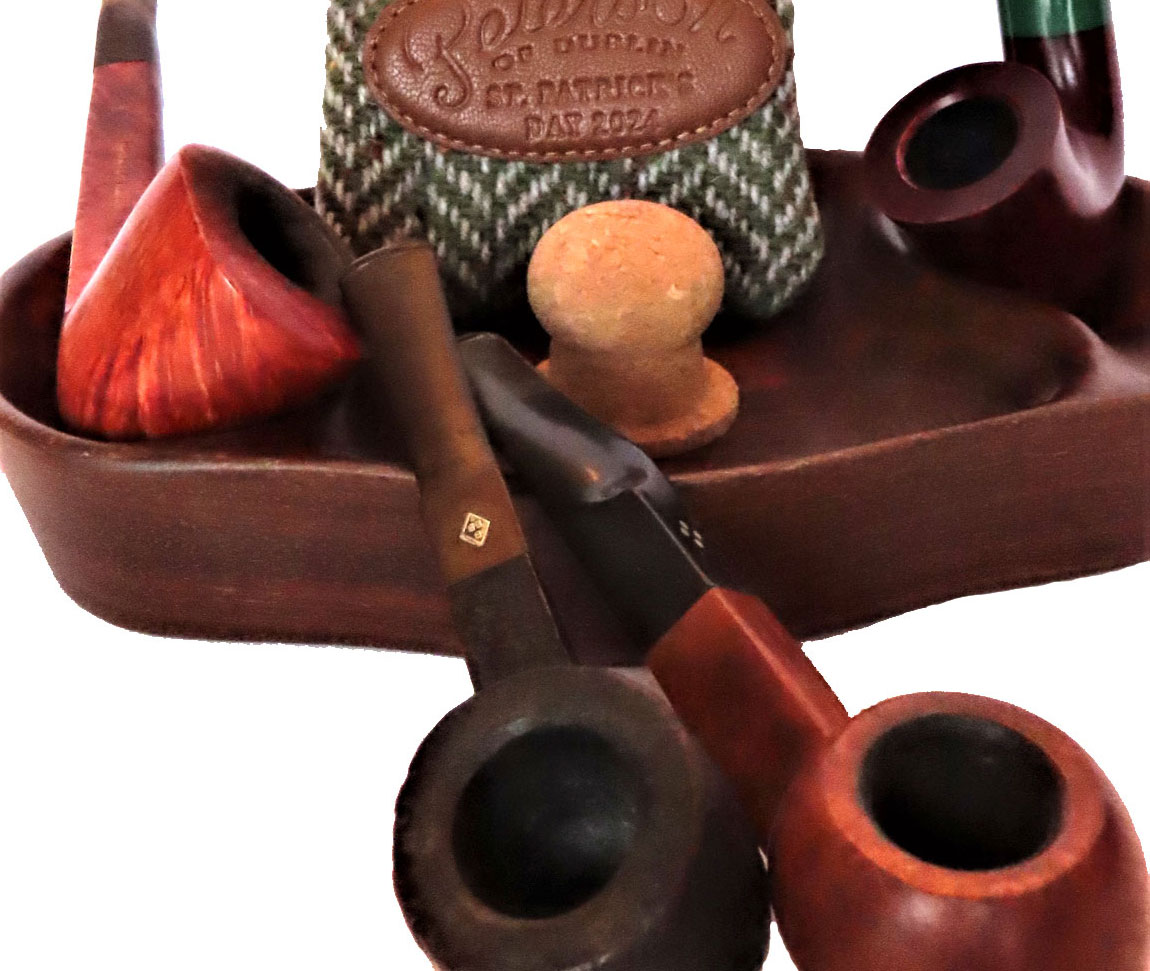
Fair warning: Pundit is coming in lukewarm: There arises a day, methinks, when it’s time in Pipelandia to thin the herd. I always look to February for the thinning stint to begin. Don’t recall why February, but it just seems another gloomy wintry month is as good a time as any. Of course, this is a moment for additions too, doncha know! It’s not possible to conduct one operation without the other. Especially in dark February, which even attracted the Bard of Stratford-upon Avon: Why, what’s the matter that you have such a February face, so full of frost, of storm, and cloudiness?—from “Much Ado About Nothing.” Emptying is not an easy task. Take, for example, the dilemma of a senior member of Pipelandia. Ahem, yours truly, who has imbibed in our lovely hobby for 40-plus years. Over that span, one becomes attached to those beautiful instruments of briar and leaf. Artifacts of art, perhaps? Yes, I realize we are talking four decades in Pundit’s Pipeworld, but it has been a fun and learning experience, bringing relief to stressful moments, and joy of new celebrations in life and job and conquered horizons. Quite naturally, time has loaded spare rooms with pipes and the cellar with luscious aging tobacco blends. Taking a recent accounting was rather startling. Pipes on top of pipes resting in racks across desks and stashed in old shoe boxes. Gee, it has been a long, enlightening trek. As well as confusing at times. Such as, “What was I thinking when I picked up this pipe and that tobacco plug?” That particular strong plug of Virginia just about put Pundit out on the floor! So in Pundit fashion, I began the February process of thinning. But “ay there’s the rub,” says Shakespeare’s Hamlet. I came across some old and dear friends. How does one turn one’s back on those deep-rooted companions, who shared good times and bad with Pundit? Impossible, but necessary. It’s akin to putting a veteran soldier out to pasture. “Old soldiers never die, they just fade away.” A legendary speech by Gen. Douglas MacArthur in his farewell to the U.S. Congress in 1951. And as we know, the general loved his Missouri Meerschaums (cobs). You can read an excellent history of the cob and the general at SmokingPipes.com. Yes, I hear it now about the dilemma of thinning. “Oh, choices can be hard in life.” Erm, yes, true. But we are speaking about old heartthrobs, old loves (talking pipes here, so don’t go making assumptions). The thinning out has always been difficult. Some are in much need of repair and others are still fit for action after deep cleaning. No Dunhills, Petersons, Cavicchis, Ser Jacopos, or Ashtons (William Ashton Taylor era), Savinellis are represented in the thinning group. That collection of pipes is precious and holds a special rank in the herd. You just can’t bid adieu to an Ashton pipe presented to you by the late, great Bill Ashton Taylor, renowned British pipe crafter. His pipes in the Pundit collection are sacrosanct, if not divinely righteous. That leaves, of course, some old lovelies in tucked-away boxes. You get the notion: It is difficult to say goodbye to longstanding allies in life’s many turns. Some in the herd date to earlier days when pipes were not as expensive as today. But economies of time and scale appear to even out over the decades. What seemed rather pricey, say in the 1960s-1980s, would be mega bargains today. I am not fond of this phrase, but it’s all relative. So, the reduction has begun, of course, to make room for more. I know, I am shrinking the assemblage just so I can add more to the crowd. Yeah, that makes sense. Once a pipe collector always a pipe collector, the Pundit says. However, the late Bill Unger (see Kevin Godbee’s Jan. 1, 2013, obituary) said it far better: If you have one pipe, you’re a pipe smoker. If you have two pipes, you’re a collector. Out go some old timers, and in arrive the newcomers. And now time for a pipe smoker from the past: One of my favorite authors, John Steinbeck, novelist, former journalist, and longtime pipe smoker gets the mention this month. And, by the way, there is a first-rate story about the Nobel Prize-winning Steinbeck by Zachary Podl in the Sept. 15, 2023, SmokingPipes.com “Pipe Line.” Steinbeck was born Feb. 27, 1902, in Salinas, Calif., and died Dec. 20, 1968, in New York City. Many of his novels centered on his experiences growing up in Salinas where he worked as a manual laborer in many jobs. What good is the warmth of summer, without the cold of winter to give it sweetness― John Steinbeck, “Travels with Charley: In Search of America” And this from one of his quite different works: Men really do need sea-monsters in their personal oceans― John Steinbeck, “The Log from the Sea of Cortez” But before we go, there is one more pipe smoker of the past who needs to be mentioned here. Robert Oppenheimer, the theoretical physicist, and friend of Mr. MC2 (Albert Einstein, of course, another physicist pipe smoker) was a cigarette and pipe smoker. He is quite often seen in photos with his pipe. And from what I can find, he smoked Walnut in his pipe. Now, if you are wondering why Oppenheimer, well there is a pretty simple answer: The movie, “Oppenheimer,” is about to haul in a load of Academy Awards when the Oscars are handed out in March. And the great scientist who brought us the atomic bomb in the Manhattan Project, died 56 years ago this February. A couple of quotes: Genius sees the answer before the question. Science is not everything, but science is very beautiful. One last huzzah from Pundit: A friend over time is dear. But a pipe is dear every time.