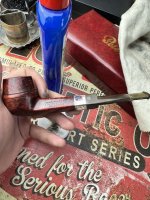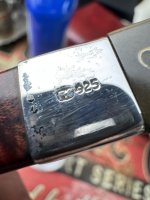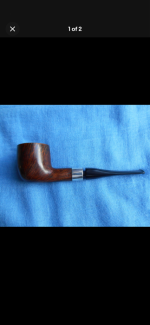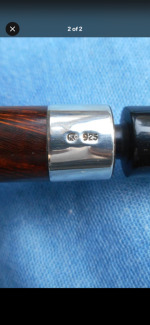





A lot of the examples I saw while researching had a recess, so the band would be flush with the wood and stem. I see this extremely rarely, if ever, done for repair or beauty rings.
The problem with both comments is that they don’t prove anything. Yes, the hallmark law of 1973 did allow for a weight exemption. But these bands could have come from any of the companies that provide we call “findings”, prefabricated parts for being added to a piece of jewelry. I had almost 10 years in the jewelry business, starting with sweeping the floor and becoming a manufacturing jeweler.I did some research because I see way too many silver bands for them to be repair rings or for someone to do it just for the bling factor. I also spoke with a few other restores and collectors from Germany, people with collections/ investories of hundreds of pipes each, the hallmark law apperantly has weight factor to it- until 1975 silver had to be hallmarked only if it weighs more than 1,56g (just the silver part of a product) and after 1975 it changed to 7,78g. Most silver on pipes would fall under this limit, but most companies would choose to hallmark it anyway.
Aditionaly pipes made for export weren't hallmarked as consistently, also smaller productions, like Ferndown(l.Wood) just skipped it completely.
The stamps on these bands are consistent with originating from a provider of findings. The inset could have been done by any competent woodworker. George Dibos, for example, could have done that kind of work.
Does the inset raise the possibility that the work is factory work? Yes, but it doesn’t prove it. Even I could have done it when I was working in the jewelry business when I had the equipment.
At best it’s a possibility, not a surety.
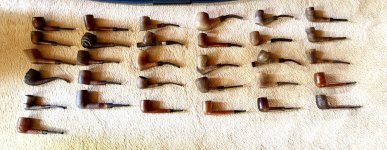
I don’t have hundreds of pipes, though I do have over 100 Barlings ranging from 1882 through the 1970’s, as I don’t need hundreds of pipes. My particular illness is books, and I had thousands of those before I moved to Oregon.






 Also I apologize but I don't proof read my posts, I write most of them wearing you beloved gloves covered in all kinds of nastiness. If my many mistakes bother people, just imagine my posts spoken with a thick Balkan accent and it will help for sure