



Show Off Your Charatans Here!

Log in

SmokingPipes.com Updates

New Accessories
18 Fresh Estate Pipes
12 Fresh Castello Pipes
48 Fresh Savinelli Pipes
11 Fresh Vauen Pipes

PipesMagazine Approved Sponsor

PipesMagazine Approved Sponsor

PipesMagazine Approved Sponsor

PipesMagazine Approved Sponsor

PipesMagazine Approved Sponsor

sablebrush52

The Bard Of Barlings
Jun 15, 2013
22,956
58,307
Southern Oregon
jrs457.wixsite.com
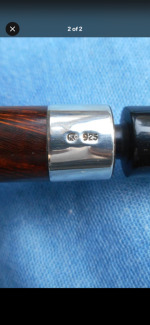
A lot of the examples I saw while researching had a recess, so the band would be flush with the wood and stem. I see this extremely rarely, if ever, done for repair or beauty rings.
I did some research because I see way too many silver bands for them to be repair rings or for someone to do it just for the bling factor. I also spoke with a few other restores and collectors from Germany, people with collections/ investories of hundreds of pipes each, the hallmark law apperantly has weight factor to it- until 1975 silver had to be hallmarked only if it weighs more than 1,56g (just the silver part of a product) and after 1975 it changed to 7,78g. Most silver on pipes would fall under this limit, but most companies would choose to hallmark it anyway.
Aditionaly pipes made for export weren't hallmarked as consistently, also smaller productions, like Ferndown(l.Wood) just skipped it completely.
The problem with both comments is that they don’t prove anything. Yes, the hallmark law of 1973 did allow for a weight exemption. But these bands could have come from any of the companies that provide we call “findings”, prefabricated parts for being added to a piece of jewelry. I had almost 10 years in the jewelry business, starting with sweeping the floor and becoming a manufacturing jeweler.

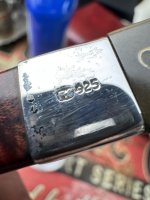
The stamps on these bands are consistent with originating from a provider of findings. The inset could have been done by any competent woodworker. George Dibos, for example, could have done that kind of work.

Does the inset raise the possibility that the work is factory work? Yes, but it doesn’t prove it. Even I could have done it when I was working in the jewelry business when I had the equipment.
At best it’s a possibility, not a surety.

I don’t have hundreds of pipes, though I do have over 100 Barlings ranging from 1882 through the 1970’s, as I don’t need hundreds of pipes. My particular illness is books, and I had thousands of those before I moved to Oregon.
 

Dshift

Lifer
Mar 28, 2025
1,141
5,329
Germany
ebay.us
The problem with both comments is that they don’t prove anything. Yes, the hallmark law of 1973 did allow for a weight exemption. But these bands could have come from any of the companies that provide we call “findings”, prefabricated parts for being added to a piece of jewelry. I had almost 10 years in the jewelry business, starting with sweeping the floor and becoming a manufacturing jeweler.

The stamps on these bands are consistent with originating from a provider of findings. The inset could have been done by any competent woodworker. George Dibos, for example, could have done that kind of work.

Does the inset raise the possibility that the work is factory work? Yes, but it doesn’t prove it. Even I could have done it when I was working in the jewelry business when I had the equipment.
At best it’s a possibility, not a surety.

I don’t have hundreds of pipes, though I do have over 100 Barlings ranging from 1882 through the 1970’s, as I don’t need hundreds of pipes. My particular illness is books, and I had thousands of those before I moved to Oregon.
Yes of course, like almost everything else with pipes if there isn't some hard evidence it's just speculation and if it's just one single pipe I would be on the pessimistic side too. About the argument that people are capable of doing something, although true I don't put much weight on it, since I am sure we have some very talented pipe makers here, who "could" a perfect Dunhill replica, with stamps and all, but I am not going to question every single dunhill I see as a potential fake.
Back in Bulgaria, we used to have a nice saying about that- " To look for a calf under the horse"
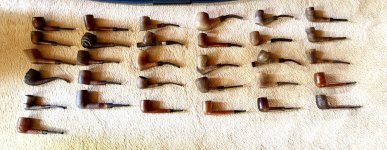
If I see a bunch of charatan's from all over Europe, with simple silver bands and no hallmarks or evidence of repair work, I will stay on the optimistic side, no matter if the pipe was mine or someone else's. 🤷‍♂️
 
  • Like
Reactions: sablebrush52

sablebrush52

The Bard Of Barlings
Jun 15, 2013
22,956
58,307
Southern Oregon
jrs457.wixsite.com
Yes of course, like almost everything else with pipes if there isn't some hard evidence it's just speculation and if it's just one single pipe I would be on the pessimistic side too. About the argument that people are capable of doing something, although true I don't put much weight on it, since I am sure we have some very talented pipe makers here, who "could" a perfect Dunhill replica, with stamps and all, but I am not going to question every single dunhill I see as a potential fake.
Back in Bulgaria, we used to have a nice saying about that- " To look for a calf under the horse"
If I see a bunch of charatan's from all over Europe, with simple silver bands and no hallmarks or evidence of repair work, I will stay on the optimistic side, no matter if the pipe was mine or someone else's. 🤷‍♂️
I don’t think of it as pessimism or optimism, just objectivity, based on experience.

Also, there are well known Dunhill fakes, like the smooth Dunhills with shell stampings, which some people collect. There have been faked Sasieni 8 dots. And there are the various Danish fakes that pop up from time to time, which their respective carvers have repudiated. It’s about return on investment.

A Sam Picasso painting, no matter how fine, won’t get the same amount of money as a Pablo Picasso painting.
 
  • Like
Reactions: Dshift

Dshift

Lifer
Mar 28, 2025
1,141
5,329
Germany
ebay.us
I don’t think of it as pessimism or optimism, just objectivity, based on experience.

Also, there are well known Dunhill fakes, like the smooth Dunhills with shell stampings, which some people collect. There have been faked Sasieni 8 dots. And there are the various Danish fakes that pop up from time to time, which their respective carvers have repudiated. It’s about return on investment.

A Sam Picasso painting, no matter how fine, won’t get the same amount of money as a Pablo Picasso painting.
Exactly, but without hard evidence, objectivity is hard to achieve, being realistic is probably most we could do. That still involves looking at the signs and seeing if there are more that support or oppose the theory. The realism part comes after, when we make our choice which side we "support" after seeing the signs.
 
  • Like
Reactions: sablebrush52

sablebrush52

The Bard Of Barlings
Jun 15, 2013
22,956
58,307
Southern Oregon
jrs457.wixsite.com
Exactly, but without hard evidence, objectivity is hard to achieve, being realistic is probably most we could do. That still involves looking at the signs and seeing if there are more that support or oppose the theory. The realism part comes after, when we make our choice which side we "support" after seeing the signs.
It’s hard to get to any reality without some objectivity.
 
  • Like
Reactions: Dshift

ssjones

Moderator
Staff member
May 11, 2011
19,974
15,658
Covington, Louisiana
postimg.cc
Do you mean banded from the factory? If so, I'd agree. I haven't seen too many Charlatans with original silver work from the factory and those I did see I believe had "CP" marked on the silver. To my recollection,Charlatan was never big on silver on their pipes from the factory.
I miss "Feathers" Thompson.....
Dennis Congas, "Mr. Charatan" and past president of the Charatan Collectors club used to be a member here. You could try contacting the club. They used to meet before every CORPS pipe show, which coincidentally is this weekend. I'm not certain if the Society is still active.

Radio show featuring Dennis:
 

Briarcutter

Lifer
Aug 17, 2023
2,081
11,602
U.S.A.
Do you mean banded from the factory? If so, I'd agree. I haven't seen too many Charlatans with original silver work from the factory and those I did see I believe had "CP" marked on the silver. To my recollection,was never big on silver on their pipes from the factory.
I miss "Feathers" Thompson.....
I should proof read my post better. Charlatans and Charlatan Should be Charatan😑
 
  • Haha
Reactions: Dshift

jguss

Lifer
Jul 7, 2013
2,909
8,076
Let's move back from the abstract to the concrete. From what I can tell the weight threshold for silver objects didn't exist before the Hallmarking Act of 1973, which is to say a minimum weight below which a "pass" was given for certain light objects wasn't established as a legitimate exemption from previous requirements until the 1973 Act went into effect on January 1, 1974. Since just about every silver object we care about in the pipe world is a) from the UK, and b) predates this Act, sometimes by a century, this is an important point. That's the good news, if one point of clarity is synonymous with good. The bad news is that the 1973 Act was designed to coordinate, update, and codify national standards to replace a large hodgepodge of previous legislation. Sorting through the many prior Acts (some promulgated in Ireland) is an enormous ordeal. Some were highly specialized, but many were designed to cover a large spectrum of markings, literally anything on something offered for sale: patent numbers, design registration, trade marks, country of manufacture, purity of substance, etc. To add to the complexity many Acts were designed to implement one or more amendments to prior Acts.

The foundational legislation in relatively modern times is the Merchandise Marks Act of 1887, afterwards amended many times on many points. Nowhere could I find mentions of weight exemptions for silver; and the penalties for false markings of all kinds were significant enough to be a deterrent.

I should say that the general subject of hallmarks, unlike trade marks, patents, and design registrations, is a rabbit warren of what is clear, what is implied, and what is opaque. For example, what are often interchangeably called makers or sponsors marks should, starting in the second half of the 19th century, more properly be called the latter. The reason is simple: this mark is a statement made to the buyer, and it tells you who assumes legal liability for its accuracy. In other words the "owner" of the mark is on the hook for the false marking penalties cited above. In earlier centuries the Acts contemplated individuals as sponsors, but as limited liability entities were created in mid-Victorian England (the first landmarks are the Limited Liability Act of 1855 and the Joint Stock Companies Act the next year) companies began to become sponsors too. This is why, for example, we continue to see EB/WB marks stamped on silver after both Edwin and William Barling were dead. It's also why we start to see sponsor marks that clearly reference companies (e.g. X & Co).

Much of this was pieced together by me through reading legislation, books and websites that address hallmarking, and engaging in correspondence. Have said that like most highly technical issues a little learning is a dangerous thing, and if we have any IP lawyers among us, preferably based in the UK, their input would be greatly appreciated.
 

Dshift

Lifer
Mar 28, 2025
1,141
5,329
Germany
ebay.us
I should proof read my post better. Charlatans and Charlatan Should be Charatan😑
I have to delete the word "charlatans" dozens of times a day.🤣 Also I apologize but I don't proof read my posts, I write most of them wearing you beloved gloves covered in all kinds of nastiness. If my many mistakes bother people, just imagine my posts spoken with a thick Balkan accent and it will help for sure 🤣
 
  • Like
Reactions: Briarcutter

Dshift

Lifer
Mar 28, 2025
1,141
5,329
Germany
ebay.us
Let's move back from the abstract to the concrete. From what I can tell the weight threshold for silver objects didn't exist before the Hallmarking Act of 1973, which is to say a minimum weight below which a "pass" was given for certain light objects wasn't established as a legitimate exemption from previous requirements until the 1973 Act went into effect on January 1, 1974. Since just about every silver object we care about in the pipe world is a) from the UK, and b) predates this Act, sometimes by a century, this is an important point. That's the good news, if one point of clarity is synonymous with good. The bad news is that the 1973 Act was designed to coordinate, update, and codify national standards to replace a large hodgepodge of previous legislation. Sorting through the many prior Acts (some promulgated in Ireland) is an enormous ordeal. Some were highly specialized, but many were designed to cover a large spectrum of markings, literally anything on something offered for sale: patent numbers, design registration, trade marks, country of manufacture, purity of substance, etc. To add to the complexity many Acts were designed to implement one or more amendments to prior Acts.

The foundational legislation in relatively modern times is the Merchandise Marks Act of 1887, afterwards amended many times on many points. Nowhere could I find mentions of weight exemptions for silver; and the penalties for false markings of all kinds were significant enough to be a deterrent.

I should say that the general subject of hallmarks, unlike trade marks, patents, and design registrations, is a rabbit warren of what is clear, what is implied, and what is opaque. For example, what are often interchangeably called makers or sponsors marks should, starting in the second half of the 19th century, more properly be called the latter. The reason is simple: this mark is a statement made to the buyer, and it tells you who assumes legal liability for its accuracy. In other words the "owner" of the mark is on the hook for the false marking penalties cited above. In earlier centuries the Acts contemplated individuals as sponsors, but as limited liability entities were created in mid-Victorian England (the first landmarks are the Limited Liability Act of 1855 and the Joint Stock Companies Act the next year) companies began to become sponsors too. This is why, for example, we continue to see EB/WB marks stamped on silver after both Edwin and William Barling were dead. It's also why we start to see sponsor marks that clearly reference companies (e.g. X & Co).

Much of this was pieced together by me through reading legislation, books and websites that address hallmarking, and engaging in correspondence. Have said that like most highly technical issues a little learning is a dangerous thing, and if we have any IP lawyers among us, preferably based in the UK, their input would be greatly appreciated.
Thank you for your time doing this research 🙏
 

Dshift

Lifer
Mar 28, 2025
1,141
5,329
Germany
ebay.us
The only Charatan makers mark I’m currently aware of is “FC” for Frederick Charatan, in a frame. I IDed it years ago for Ken Barnes.
It's funny how the world works sometimes, after I read this I went on a fruitless online hunt to find one. While I completely tuned in another sleepless night of pipe restoring...
IMG_0241.jpeg
Photo taken at 3 AM
... I saw a Dunhill dress on ebay and wrote the guy that I will come pick it up In the morning.
3 hours of sleep later, I hoped on the bike for a nice one hour drive in the beautiful Bavarian summer weather.
IMG_0246.jpeg

The thing is that you never know what you are going to find in people's basements... I walked out with a bit more than a dress dunhill.
IMG_0238.jpegIMG_0239.jpeg
There was a Charatan too.. More photos below👇
 
  • Love
Reactions: keith929

Dshift

Lifer
Mar 28, 2025
1,141
5,329
Germany
ebay.us
Also from what I know the misaligned DC stamp means the pipe itself was an old stock maybe. Any idea if how old of a stock it could be? I mean is it a pipe that was just made a couple of year before the DC stamp came in use or could it possibly be an older pipe?
 
  • Like
Reactions: Briarcutter

sablebrush52

The Bard Of Barlings
Jun 15, 2013
22,956
58,307
Southern Oregon
jrs457.wixsite.com
  • Like
Reactions: jguss

sablebrush52

The Bard Of Barlings
Jun 15, 2013
22,956
58,307
Southern Oregon
jrs457.wixsite.com
Also from what I know the misaligned DC stamp means the pipe itself was an old stock maybe. Any idea if how old of a stock it could be? I mean is it a pipe that was just made a couple of year before the DC stamp came in use or could it possibly be an older pipe?
No one did stamps perfectly 100% of the time. Don’t read too much into it.
 
  • Like
Reactions: Dshift