

Old Pipes vs. New Pipes

Log in

SmokingPipes.com Updates

Watch for Updates Twice a Week

PipesMagazine Approved Sponsor

PipesMagazine Approved Sponsor

PipesMagazine Approved Sponsor

PipesMagazine Approved Sponsor

PipesMagazine Approved Sponsor

Alejo R.

Lifer
Oct 13, 2020
1,339
2,929
50
Buenos Aires, Argentina.
Related to the thread about estate pipes. I had this question. Taking pipes made by small-scale artisans out of the equation, as for industrial pipes. Do you think the pipes made today are better, or are those made decades ago better?

 

Briar Lee

Lifer
Sep 4, 2021
6,958
23,516
Humansville Missouri
Related to the thread about estate pipes. I had this question. Taking pipes made by small-scale artisans out of the equation, as for industrial pipes. Do you think the pipes made today are better, or are those made decades ago better?


Pipes today are the beneficiaries of what Miss Charlotte taught all us little hillbillies in 1971 about the Buggy Whip Maker effect.

In 1938 there were about 100 million pipes made in France (50 million) USA (30 million) and Britain (20 million). Today all those numbers are less than 1% of those.

My Amish neighbors at Humansville still use horses and harness. Unlike 125 years ago there is no bad or cheap harness for sale. There’s no demand today for cheap and shoddy harness (buggy whips).

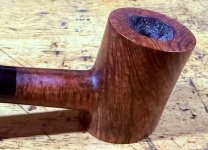
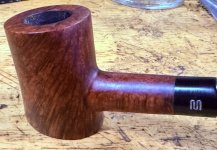
This pipe cost $43 tariffed, sales tax, and shipping paid from China.

IMG_2158.jpegIMG_2159.jpeg

In 1938 you could buy the cheapest pipes for a quarter and a decent one for a dollar and good ones started at about a dollar and a half.

IMG_2167.jpeg


When you buy a $3.50 pipe (Kaywoodie Drinkless) from the golden era, that’s an $80 pipe today.

IMG_2168.jpeg

$65 from China, in the mail.

IMG_2126.jpeg

New pipes have to be good.

There’s no market for cheapies.
 

anotherbob

Lifer
Mar 30, 2019
18,342
33,332
47
Central PA a.k.a. State College
Related to the thread about estate pipes. I had this question. Taking pipes made by small-scale artisans out of the equation, as for industrial pipes. Do you think the pipes made today are better, or are those made decades ago better?

mixed and every old is better is more likely the survivor paradox i.e. the pipes that stayed around were most likely the cream of the crop or the pipes that didn't end up in the trash.
 

sablebrush52

The Bard Of Barlings
Jun 15, 2013
22,960
58,323
Southern Oregon
jrs457.wixsite.com
Related to the thread about estate pipes. I had this question. Taking pipes made by small-scale artisans out of the equation, as for industrial pipes. Do you think the pipes made today are better, or are those made decades ago better?

I don't think, based on my experience, that such a generality will hold up. Sturgeon's Law applies (for those of you who are unfamiliar with Sturgeon's Law, the metric is "90% of everything is crap".). Most of the cheap crap was happily used until it died, leaving a higher percentage higher grade, more durable goods, which gives the illusion that the yesteryear overall average of quality was higher than what is being made today. Also, given the prominence of artisanal carvers in today's market, I can't really exclude them.

That said, it also depends on what floats your boat.

If you like bling with your pipes, like elaborate silver work, or if you like fine figural meerschaum carving, the level has dropped through the basement and is approaching the Earth's core in comparison to the best quality 19th century craftsmanship.

If you like imaginative shaping, wide open airways, shaped airways, thin bite zones, wide slots, or a variety of surface treatments, today's pipes are the better option by far.

If you like both, you have choices for picking out what most satisfies you.

And if you are asking about smoking qualities, that's subjective. I have century plus old first rate smokers and just carved first rate smokers.
 

OzPiper

Lifer
Nov 30, 2020
8,086
46,357
73
Sydney, Australia
There’s good and bad from both eras.
Sturgeon's Law applies (for those of you who are unfamiliar with Sturgeon's Law, the metric is "90% of everything is crap".). Most of the cheap crap was happily used until it died, leaving a higher percentage higher grade, more durable goods, which gives the illusion that the yesteryear overall average of quality was higher than what is being made today.
I like old(er) pipes - specifically old Britwoods and Danish-era Stanwells

The few corporate-era Barlings I have smoke every bit as well as their much, much older brethren.

I do not have any of the current production Barlings or the Italian-produced Stanwells, so I cannot comment on their quality.
 

anotherbob

Lifer
Mar 30, 2019
18,342
33,332
47
Central PA a.k.a. State College
The fact is we can't agree now on what's great or not so great in a pipe. Though it seems like we have more options in current production. It's really a matter of taste. People argue about what diameter is best and it really it is a matter of what's most comfortable to the smoker.
Though for every age of pipes I find pipes I love and pipes I don't.
 

georged

Lifer
Mar 7, 2013
6,830
19,894
Related to the thread about estate pipes. I had this question. Taking pipes made by small-scale artisans out of the equation, as for industrial pipes. Do you think the pipes made today are better, or are those made decades ago better?

The survivor thing definitely applies, but that is independent of what mass-producers were capable of at their quality peak.

Which is that "then" stuff is definitely superior to anything made today.

Not just slightly, but dramatically so. I've handled/worked on hundred-year-old specimens from English makers that I'd feel comfortable challenging any carver alive today---never mind a factory---to replicate without having to re-discover how it was done originally. (Meaning make repeated attempts and sacrifice significant material from several dozen hours of experimentation, re-inventing specialized tools and techniques, and so forth.)

To think that such pipes were once made by anonymous workers on a 9 to 5 production line as a standard catalog item is mind blowing.
 

LotusEater

Lifer
Apr 16, 2021
4,651
59,906
Kansas City Missouri
The survivor thing definitely applies, but that is independent of what mass-producers were capable of at their quality peak.

Which is that "then" stuff is definitely superior to anything made today.

Not just slightly, but dramatically so. I've handled/worked on hundred-year-old specimens from English makers that I'd feel comfortable challenging any carver alive today---never mind a factory---to replicate without having to re-discover how it was done originally. (Meaning make repeated attempts and sacrifice significant material from several dozen hours of experimentation, re-inventing specialized tools and techniques, and so forth.)

To think that such pipes were once made by anonymous workers on a 9 to 5 production line as a standard catalog item is mind blowing.
@georged
Why do you think this is? That is to say - can you speculate as to why anonymous workers were able to turn out such high quality pipes

 

telescopes

Pipe Dreamer and Star Gazer
@georged
Why do you think this is? That is to say - can you speculate as to why anonymous workers were able to turn out such high quality pipes
Although your question is directed for George, in reading old pipe magazine articles, pipe manufacturers prided themselves on retaining skilled workers and had a hierarchy of journeyman - that is, a person learned a skill and moved up only when they were proficient enough to do so. These machines also required care, maintenance, and skill to operate. Employee retention also seemed to be a priority. So, although the worker was anonymous to the buyer, they were not anonymous to the employer. Skilled labor has changed much today - people come and go and machines do much much more.
 

Sigmund

Lifer
Sep 17, 2023
4,376
45,627
France
I think people who were craftsmen at some level tended to care about the work they do. I think an awal lot still do. I dont think people working with their hands consider themselves anonymous at all.

That said, there were also a lot of real crap pipes out there. Maybe they were made on a Monday, maybe they were made by people in training and sold as seconds or as basket pipes with no name. Of course there were also plenty of good pipes as well.

Even if you dont sign your name to them if you go to work every day and make pipes you are likely to get pretty proficient in whatever portion of production you work. Anyone with any pride in themselves and half a brain would get damn good and able to do it with one eye shut. That is, in part, the concept behind any tooling/labor setup. You didnt have to be an expert at building an entire car to work at the Ford plant.
 

Alejo R.

Lifer
Oct 13, 2020
1,339
2,929
50
Buenos Aires, Argentina.
Although your question is directed for George, in reading old pipe magazine articles, pipe manufacturers prided themselves on retaining skilled workers and had a hierarchy of journeyman - that is, a person learned a skill and moved up only when they were proficient enough to do so. These machines also required care, maintenance, and skill to operate. Employee retention also seemed to be a priority. So, although the worker was anonymous to the buyer, they were not anonymous to the employer. Skilled labor has changed much today - people come and go and machines do much much more.
We have the example of Ashton and Les Wood who were once part of the Dunhill team.
 

Briar Lee

Lifer
Sep 4, 2021
6,958
23,516
Humansville Missouri
Another factor in new versus old pipes is quantum leap advancements in manufacturing.

All of the major high volume pipe makers used machines, for a hundred years.

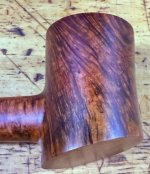
But not machines that can make pipes for a few hours pay that look like this.

IMG_2174.jpegIMG_2173.jpeg
IMG_2175.jpegIMG_2176.jpeg
When I bought my first really nice pipe, a Carey in 1974, I worked 80 hours a week at $1.25 an hour, or $100 a week. My Carey was $15 delivered. It was a nice London made pipe, but with a few fills, it wasn’t a straight grain, it was varnished, and the nylon stem wasn’t nearly the quality of the soft lucite stem on this $43 Chinese Muxaing.


Those Chicoms are some very accomplished capitalists these days.:)
 
  • Like
Reactions: dunnyboy and Joe H

telescopes

Pipe Dreamer and Star Gazer
It's clear from reading older pipe manufacturing articles that the companies saw their workers as craftsman. Certainly Dunhill and others like them took steps to ensure that their work force were valued and seen as such. But even when reading interviews and articles about Marx, Sven Lars, and other companies, it is clear that having talented craftsman was considered a priority. These workers were known by name to those in the industry or at the least, could be vouched for by those in the industry. It was a real job that real people committed themselves to. Any one of those workers would be able to today open up their own shop and put out a decent pipe based on the skills they utilized in the shop where they worked. Off centered draft holes - when it comes to my most ancient estates - are non existent. I am not referring to the cheap dime store pipe, but the ones that came from the established houses such as Comoy and Dunhill.