


Radio Talk Show
 Pipes Magazine Radio Show Episode 690
Welcome to The Pipes Magazine Radio Show Episode 690. Our featured guest on tonight’s show is artisan pipe maker JD Wolf. JD just started smoking pipes a little over a year ago, and he started making them at about the same time. His impetus for becoming a pipe maker came from the problem that his preferences in artistic handmade pipes were out the reach of his budget. He strives to make precise smoking instruments that are also a handcrafted piece of art that the “average workingman” can afford. At the top of the show in Pipe Parts, Brian will have a holiday gift giving guide for pipe smokers.
 Pipes Magazine Radio Show Episode 689
Welcome to The Pipes Magazine Radio Show Episode 689. Our featured guest on tonight’s show is artisan pipe maker Patrick Kehler from Marchand, Manitoba Canada. He grew up in a strict religious environment where his behavior was restricted and smoking (and drinking) were frowned upon. One day, when he was older and in the process of providing himself more freedoms, a co-worker showed him a pipe. He was captivated. Hear the whole story on tonight’s show. At the top of the show in Pipe Parts, Brian will have a review of four different brands of pipe cleaners.
 Pipes Magazine Radio Show Episode 688
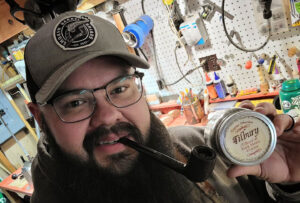
Welcome to The Pipes Magazine Radio Show Episode 688. Our featured guest on tonight’s show is Texas-based artisan pipe maker Ryan McCawley from Smokin’ Barrels Briars. Like many of us, Ryan was attracted to the scent of aromatic tobaccos. Also, like many new pipe smokers, he burned the heck out of his tongue. That was a long time ago. Now he is a regular pipe smoker and he has been making his own pipes for five years now. He started with classic shapes, but now he is more interested in Danish-style freehands. At the top of the show Brian will discuss cake. Not the cake that you eat, but the cake that builds up in your pipe bowl. This is based on a question sent in by a listener.
Tobacco Reviews
 McCranie’s Catawba River Tobacco Review
There has been a lot written about the Lakeland style of tobaccos over the past couple of centuries. Perhaps nothing else in the tobacco world is quite as polarizing, tending to segregate folks into camps of loving it or despising it with uncharacteristic vehemence. This month’s inspection of an American rendition of the Lakeland style will add just a few more words to the volumes that have come before, but in the interest of topicality I’ll avoid the larger debates, histories, and comparisons, limiting our purview to the experience of this blend alone. Though it’s the earliest hint of an impending spring now, I began sampling this tobacco in the fall. At first, it was mild and pleasant, lightly aromatic, and earthy in a very appealing way. However, when winter’s foul weather hit, I moved on to other tastes. Through no particular fault of the tobacco, it just didn’t fit for my tastes at the time—as is often the case, and, I’m sure, an experience shared with the vast majority of pipe smokers out there. But now the world is thawing, and the faintest scent of the re-emergence of all things growing is in the air. Unscrewing the jar of Catawba River once again, I am treated to a soft and slightly sweet aroma perfectly concomitant with the weather and my mood. “McCranie’s Catawba River is a lakeland style aromatic tobacco. Notes of honey and berries give the blend an outstanding aroma. Comprised of cavendish, burley, and a dash of perique. A singular mixture sure to entice every aromatic smoker.” The first thing to note is an appreciation for the McCranie’s Choice Reserve blends being offered in full 2-ounce glass jars, as it’s the surest way to keep them properly intact when shelved for longish periods—I naturally have a predilection to hopscotch around between a dozen or so open blends at any given time before finishing the tins, and this saves me the trouble (which I admittedly rarely do anymore) of transferring them to a truly airtight container for safe keeping. It also affords a gander at the leaf before opening; in Catawba River’s case a nicely balanced mottle of dark and mahogany brown interspersed with the occasional raw umber-toned leaf. The first thing to note when opening the tin is the rush of rich aromas: milk chocolate and cherry predominate, with a defined floral tilt; sweet fringes of honey and melon; even hints of a complex background note of root beer or sarsaparilla, likely the telltale sign of Perique in the mix. It’s not a cloying sweetness, and is rather transparently layered atop the earthy and acrid tobacco smell. It is a fine balance, and the leaf is as soft and supple as the aroma. If one is expecting or searching for it, yes, there is the intimation of a baby-powderish vanillin tone, but in all respects it functions as any other Cavendish-forward aromatic blend. In the bowl, Catawba River certainly has an amenably lazy flow to it, much like the river itself flowing through McCranie’s hometown in North Carolina. As noted from the bouquet, the added aromatics are layered rather transparently over the tobacco, accentuating rather than masking or overpowering the natural taste from coming through. Allowed a short drying time, it lights easily and releases the aromas and flavors in warm tones, rich and substantial. The tenor of the Cavendish predominates, with an excellent pillowy mouthfeel to the smoke and a smoothness on the palate. The floral sweetness translates directly from the aromas, and adds the woody, earthy notes of the tobaccos perfectly—the soil, oak, and leather of good tobacco is the star here. Perique, then, is the guest star: in turns offering its deep stewed-fruit aspect and then evincing a spiciness that tickles the nose, always fluttering in the background with wavering spice. Floral notes remain in the range of tuberose and rosehips and honeysuckle, with sweet clover honey lining the edges. Retronasal olfaction is equally as smooth, and the room note is reported as “sweet and homey”. Puffing through to the heel requires a relight or two, owing more to a faltering of attention span that the properties of the leaf. But how “Lakeland” is it? This is surely the question on the tip of every reader’s tongue. While it’s only been a couple months of tasting, no appreciable ghosting of pipes has been noted, aside from the vague remnant of aromatic-ness one would expect. As too often happens with my reviewing efforts, I think of the burning questions, as it were, far too late—but fear not, a conference call with the blender is scheduled, so there will be an addendum to this write-up forthcoming. My suspicion is that Catawba River is just a good Cavendished blend that relies on garden-variety tobacco casing and saucing, along with the intrinsic flavor of the Perique, to impart an American impression of the Lakeland style, rather than an importation of the ancient and secretive Kendal sauces. No ravening and long-deceased grannies arose unbidden from the bowl to clobber my senses with candy bowls and urinal cakes; no, it was altogether a pleasant and promising early-Spring smoke that made an afternoon of repotting some plants an absolute delight. EDITORIAL UPDATE: Matthew McCranie was kind enough to take some time from his day to answer my questions last evening, and I’m delighted to share the revelations. First, Catawba River does indeed contain Kendal-processed leaf in addition to its locally processed components—meaning, of course, that this is truly and definitively a “Lakeland” blend, albeit from our very own shores. He further explained that the McCranie’s Choice Reserve blends were precisely that—choice, small-batch blends, made by hand from purchases of the small quantities of the best leaf available to him at any given time. The downside of this, of course, being that when the ingredients run out, it’s up to the caprice of the marketplace to find some more to restock. He assured me that Catawba River and the other blends […]
 Pipe Force Episode III & Cringle Flake Holiday Edition 2024 Reviews
There is a transitory nature to this enjoyment of pipes and tobacco, making it an easy metaphor for the nature of time and our place within its flow, and, hopefully, enhancing our appreciation to lend focus to moments which we allow our perceptions to linger within. It is ephemeral, like all things we hold dear; so, too, the holiday season aims to serve as reminder to enjoy and cling to those moments—with family, loved ones, and spirit of good cheer. As another holiday season winds down and confronts us with the promise of renewal in the year ahead, let’s keep that in mind as we examine some of the sunset offerings from the Sutliff Tobacco Company. Pipe Force Episode III Stoved and Red Virginia give a naturally sweet, tangy, woody foundation. The hearty Rustica leaf has been hot-pressed and stoved for the first time. The process slightly tempers the bold tobacco and imparts a floral note, but still, the robust character is not lost, bringing body to the smoke. A portion of Dark-fired Kentucky then offers a mesquite spice to the mixture. The last of the Pipe Force Project releases, Episode III keeps with the Star Wars aspect in much the same way as Revenge of the Sith did. Lieutenant General Marshall is the portrait of the Cthulian officer gracing the tin and the lucky challenge coin within, intoning a portent of the unknown and, possibly, the unfathomable—in this case, the first time stoved Rustica leaf has been included in a commercial blend. Inside the tin are a few stout, thick flakes that release a bouquet of campfire coals, almost a Scottish blend experience even absent Latakia or Orientals. Crumbling for preparation is easy, with the nearly quarter-inch flakes parting easily and at a good moisture for packing straight from the tin, or with a minimum of air drying to preference. On the light there is not as much of a bass note as the aroma would suggest, nor are there an abundance of high and bright notes either; it plants itself firmly in the middle of the range. A decidedly woody dimension continues from the aroma through the light and all the way to the heel; it is definitely the defining character of the blend’s flavour palette. Between the dark-fired and the stoved Rustica leaf, little room for expression remains. Perhaps this is something that some time in the tin will alter, allowing the red Virginia to pronounce some sweetness and depth eventually. On the technical side it burns strikingly well, requiring only a single light to find the heel—outdoors in a light breeze, mind you—and leaves the aftertaste of a flat IPA with hints of barbecue on the tongue, mercifully absent of bite. Overall the blend feels a bit flattened out and perhaps a bit too fresh to exhibit depth, with too much compression in the mix to feel the highs and lows, though at moments one can taste the umami that floats as a potential in the background. Not to say that it was a disappointment by any means—the smoke is agreeably as stout as the flakes, on the hearty and dry side, and with a good amount of nicotine delivered in the process. Cringle Flake Holiday Edition 2024 Aged Red Virginias from 2010 are pressed and sliced to showcase the dark side of the flue cured leaf. The mature Virginias offer bread, dark fruit and spice in this special smoking mixture. This year’s holiday special edition, the last from the marque, is built around a legacy bundle of leaf from the storied McClelland holdings. Cringle Flake 2024 is nearly a companion smoke to Pipe Force III in the woody flavour spectrum, owing to the particular complexion of the flue-cured red Virginia leaf. The tin art is seasonably festive, either in the Cringle Flake version or the alternate Krampusnacht packaging exclusive to TobaccoPipes.com, though both are the exact same blend; my personal preference is for the wilder Krampusnacht image, as it calls to mind the art of Ed “Big Daddy” Roth, but it makes no difference to the flavor—or does it…? (No, it doesn’t.-ed.) As noted, the flakes are a blend of two vintages of red Virginia, a 2000 US crop and a 2010 Canadian from an earlier acquisition of McClelland stock. Nosing the tin there is detectably a hint of that old vinegary aroma, so fond memories of Christmases past are certainly contained therein. Overall it has its own read, though; to me, it’s a woody, oiled mahogany aroma, not unlike the smell of a new acoustic guitar (yes, I spent an inordinate amount of time smelling my Christmas gifts). There is a bit of tang, high and sour, though it lacks clear sweetness up front, both in the aroma and smoke—the notes of dark fruit and spice are slight at best. It seems apparent that the intention is that this is a Virginia blend destined for at least a little bit of tin-ageing. The woody tilt continues through the top to middle of the bowl, leaning into that aspect of the leaf and its curing. Though it took a few bowls to dial in, there was a richness to be found with some deepening of the bass notes—think brown bread and extra-sharp cheddar—and highlights of a clover honey character on the palate and retrohale. The blend benefits greatly from a sharp black coffee or strong tea, particularly for repeated servings, as well as some delayed gratification technique—I found that taking an initial light and burning until it needed tending, then allowing it some room to breathe, suitably amplified the flavour profile. Despite some astringency in the overtones, after finding the proper pace it proved a very repeatable and enjoyable smoke. The holidays are a celebration not of what we acquire, but of what we can share. Stashing away a tin or three of these stocking stuffers will make for savoury moments to enjoy, hopefully with good company. In closing, with a repeat of last […]
 Sutliffe Silver Quarter + Maple Shadows II Reviews
Well there’s nothing like a touch of the plague to usher in the changing season. Leaving the airport just when the first advertisements for all things pumpkin spice began to appear—lattes, muffins, shampoos, trash bags, and myriad other concoctions—so, too, my ability to breathe freely disappeared. The unfortunate side effect of losing one’s sense of taste and smell for weeks is the utter inability to enjoy tobacco. Not that I consider myself an expert on anything but my own tastes, but be forewarned that this review was made with mildly impugned sensory equipment. Just when a comforting pipe was most needed, its comfort was denied. Be that as it may, the road to recovery found me limping along on one lung this past month, trying to wrest the particulars of two blends on offer from Sutliff: the latest 175th Anniversary blend, Silver Quarter, as well as their spooky seasonal Maple Shadows II. Silver Quarter is a new style on offer from Sutliff, their first coin-cut blend. Naturally a Virginia-Perique, it is enhanced with a traditional core of black Cavendish. In the tin it holds much promise, with a lightly bready and very woody, if ever-so-slightly sour, aroma. After some time acclimating to air, the bouquet softens further and offers hints of the burley with some chocolaty notes wafting through the more dominant dry grassy aspect. The tin art is of a coin-style bas-relief bust, presumably of a founding Sutliff brother, à la The Old Boss On the reverse of the tin we find the blend’s description: Reflecting on Sutliffs 175 years of tobacco excellence, we came across a brand that embodies true value, SILVER QUARTER. This name pays homage to Sutliffs roots, the legacy of two brothers who popularized pipe smoking in the burgeoning mining society of San Francisco. We celebrate this heritage with a coin cut composed of the finest African Virginias, complemented by a core of Perique and Black Cavendish. The tin notes are, forgive the pun, on the nose for a good VaPer blend: mild tart sweetness peeking out from behind dried hay and slight chocolate undertones, with a lightly tannic finish of weathered oak. It is always a joy to prepare a coin cut, my preference being to put a few in my palm and vigorously warm my hands together to fully break them apart. These well-formed discs pack and light easily, and smoke with little prodding to the end of the bowl. For technical points it scores well—it smokes light, and it’s easy to tend the ember. While it gets sharp after a few quick bowls, pacing should be heeded to easily smoke down to the heel without inviting bite. Of the flavor, though, I am left a bit wanting. There are tart and high notes aplenty, but very little of the lemony citrus I would anticipate, as well as scant midtones; they tend more toward the red wine-vinegary and sour. The flavors are muted, also, lacking the sweetness and piquancy of other marques—the small measure of Perique tickles the nose now and again with peppery hints, and there is a smidge of a deeper sweetness to be found in the Cavendish from puff to puff, but overall it lacks some dynamism. The Virginias, to my palate, come off a bit on the dry side, and here they dominate the blend. The aftertaste and mouthfeel are neutral, again evincing more of the dry, woody, tartly tannic end of the spectrum. The blend has plenty of polish, but not enough depth or richness (*yet) to make it a standout. Here, comparisons are inevitable: Luxury Bullseye Flake has more sweetness, both from its Virginia as well as its Cavendish, and a better finish; Davidoff is similar but with a pronounced umami that is absent here; as for Escudo, I haven’t had any fresh tins lately so it would be unfair to compare. While it rates as a solid, fairly mild smoke, particularly to lovers of the genre, it does not surprise with any exceptional flavors. To be fair, all the boxes have been checked for the blend to benefit from some real aging, and it would be worth checking in on this after a couple of years sealed away. I’ve set half my tin aside to sample again in a month or two, in case I’m merely suffering from the lingering effects of parosmia, and will amend this review in that case. Maple Shadows II, on the other hand, made up for the weeks of sniffling and sneezing I’d endured. Offered in a full 8 ounce tin with delightfully spooky Halloween art, it’s (hopefully) enough to last through the season. Somehow I had missed this last year, so it’s a real pleasure to get some in my candy bucket this year. As the chilling winds of autumn draw eerie prattle from contorted, deciduous limbs, we find ourselves possessed by the spirit of the season. Bewitched by a dissonant charm, we’ve created Maple Shadows. In a season that is defined by the unlikely harmony of treats and frights, we’ve joined the enchanting sweetness of maple with the earthy spice of Dark Fired Kentucky for a smoking experience that captures the senses with an otherworldly fusion of flavor. This may be the best aromatic blend Sutliff’s ever made—and they make a ton of them. First off, it’s not overbearing in the least—quite the opposite, it is also one of the more restrained aromatics they’ve ever made, with a clear but very light topping that melds oh-so-well with their choice Kentucky added to the mix. Opening the tin, the sweet maple is up front and center, but so too is the must of fallen leaves, bready pie crusts, and a crackling fire in the hearth—a perfect invocation of Herbstdüfte in a can. Packing best in an open and capacious bowl, the flavoring is subtle, and recedes to the background while puffing. With a sweet coffee or tea to accompany, the aftertaste of the maple is reinvigorated on the palate […]
Fireside
 Sleeping Dogs?
A few years ago, I remember it well, I received in the post an unexpected gift of the sort that inspires the instantaneous rendition of an awkward happy dance. I’m apparently not a very good dancer, at least if the reactions of my kid and dog hold true. Everybody’s a critic. Sometimes, I just can’t help myself. (It’s a good thing disco died before I gained any sort of notoriety for my exhibitions. When it comes to tripping the light fantastic, I’m more like Elaine from Seinfeld than Saturday Night Fever’s Tony Manero. No videos are forthcoming. Don’t even ask.) The plainly wrapped parcel was in the postbox, my own address cryptically hand-written as the return, and no postmark indicating the source of the package. Since I had no recollection of having sent anything to myself, it was a genuine surprise. After a little head scratching, I pulled open the wrapping and opened the box without ceremony, only to find another similarly wrapped one within, also lacking any clues as to the package’s origin. Curious. A mail bomb? Surely anyone with seriously nefarious intentions would be more thoughtful about not arousing undue suspicions. I poured a dram of my finest whisky, just in case it might be my last, took the smaller parcel to the farthest reaches of the weed patch loosely referred to as the “yard,” and, listening carefully for ticking, carefully sliced the sealing tape with my pocket knife. I carefully opened the flaps, and averted my eyes while pondering that digital detonation devices probably don’t tick… Too late to call in the EOD. Fortunately, no explosive device was detonated, no deadly gas released. Instead, inside was a plain white envelope emblazoned in pink ink with my name and adorned by a small heart. Cute. The envelope concealed a little card, with the hand-written words, “Your tobaccos turn me on.” It was signed simply “Scarlett J,” with another little heart. Ever since seeing Lost in Translation, I’ve had a thing for Scarlett Johansson, but I had no idea she was a pipe smoker. Bonus! Under the envelope, wrapped in bubble packing, was a fabric pipe sock of anonymous origin, quite plain, with a thin cord tied round the top. I took the package back inside, poured another Scotch, and sat down to explore the contents further. After removing the pipe from the sock, I immediately recognized it. I’d seen it not long before on a seller’s site. I’d even shared the link with a friend who shares my adoration for interesting old pieces, and who knows of my predilection for a particular actress, at least in one role. While there may be another one like this out there, it’s unlikely. It’s a beautiful old Comoy’s Virgin Briar made for the 1933 Chicago World’s Fair, a uniquely fluted apple with a tapered stem. These were all the clues I needed. Using my finely honed skills of detection, I now knew both where it had come from, and who had been responsible for it finding its way to me. I gave my presumed benefactor a call, and employed all the subtle interrogation techniques I’d learned from watching too many episodes of Criminal Minds in an attempt to draw a confession out of him. Eventually, he broke by asking the question, “How does it smoke?” Aha! Got you. But, at that point, I couldn’t answer him. I’d been too busy gawking at the thing to fill it with tobacco. So, while we were talking, I gave it a go. I’d just finished a bowl of some excellent vintage leaf in another really nice pipe. It was a great smoke, but nothing prepared me for what was to come. There was so much more depth and complexity here, with nuances clearly articulated that were almost completely missing in the prior bowl. The virginias delivered a caramel-like sweetness, the orientals swirled over my tongue like a genie set free from Aladdin’s lamp, and the latakia rendered softer, more polished. In a word, it was superb. Even after all these years, it’s still unfathomable to me that one pipe can deliver a really good smoke, while another can transcend. Beyond purity of taste, there’s some sort of fascinating interplay, an inexplicable synergy between certain tobaccos and briars that transforms the smoking experience into something more, something sublime. For all we know and understand about pipes, about pipe making, about briar and brands, it remains the unknown that continues to fascinate and delight. With this pipe, was there something special about the wood that made it great? Was there something about the way it was made that perhaps enhanced its strengths, while deleting any potential weaknesses? In many cases with very old pipes, I’m inclined to attribute a superior smoke to the way it had been treated during all the years I did not possess it, but this one had been so lightly smoked that the cutting lathe’s chuck marks were still visible in the bowl, so it wasn’t that. It’s even possible that the last time this nearly pristine pipe was smoked, maybe the only time, was shortly after it was sold. Eighty years is a long time to rest. Here’s the problem, the sleeping dogs part. After such a magical smoke comes the fear that the next bowl might not live up to the expectations set by the first. It’s unlikely, sure, but it’s happened enough times in the past that the thought crosses my mind. Or could it be that the excitement of receiving this precious gift had simply influenced me sufficiently to make me focus more on the subtleties causing the experience to seem better than it was? Would it be best just to have the memory of that great smoke intact in my noggin, rather than risk disappointment? It took me a long time to give it another go. Fortunately, it again delivered, and has every time I’ve smoked it since. Maybe there’s still a bit of bias at […]
 Forgotten Treasures
I remember the first time I heard someone else say it. “How many pipes do I need? Just one more.” It’s glib, sure, a bit of a joke, but it also rings a bell of truth, at least to me. I certainly have “enough” pipes, but pipes are seductive little things. Just when we think we’re all set, we have enough, another will come along that tempts us beyond any sense of reason. I suppose it’s the same way with any sort of collecting. There’s always another white whale we’re in pursuit of. When we finally track that one down, though, another will almost inevitably breach the surface, taking its place as the new object of our desire, enticing us to change course and set sail once again. But, there’s a potential problem with having a lot of pipes. Maybe. The more pipes we may have, the harder it can be to keep them in rotation. It makes sense. We tend to gravitate towards our current faves, the ones that most appeal to us for whatever reason, and sometimes, maybe they stay in rotation longer than they really should. The side-effect of this, of course, is that another favored pipe might end up too-long forgotten. That’s exactly what happened recently. Exhibit A: The Castello pictured is one that has been long overlooked. It’s a Trademark shape #55. It’s a really nice example of the shape. The red pearlized stem is beautifully done. The wood isn’t really anything special to look at, but it’s evenly covered, without any bald spots. When I look at it, I wonder why it wasn’t done in the more typical dark ruby-red finish that adorns most Trademarks. I’ve seen a great deal of variation amongst the grade over the years, including one really nice bent-bulldog that left the factory with a brown sandblasted finish. (For those who don’t know, Trademark has long been the lowest Castello smooth grade, usually finished in a dark red.) Was this a stamping/grading error, or is there just more leeway in the grade than we’ve come to expect? I might never know. This example is from the early 1970s, maybe even the late 1960s, identified by the upper case Ks in the grade designation. (On Sea Rock and Old Antiquari pipes, the Ks reflect the size, while with the smooth finishes, Trademark, Castello and Collection, the Ks represent the relative grade.) It has been living in a different rack than the one housing the majority of my #55s. I don’t recall why I put it there, but as many of us can relate to, rack space is often at a premium. I stumbled upon it while looking for something completely different. “Oh, you? Why are you there? I remember you smoke pretty well.” Yeah, I sometimes talk to my pipes – one of many quirks, I suppose. I won’t begin to worry until they start talking back. I grabbed it from the rack, dusted it off, and decided to give it a fill with a bowl of a slightly aged VA/perique blend, Telegraph Hill, from 2018. What a delightful smoke! At five years, the tobacco is expressing a lot of the complexities of aged Virginias and the perique adds a delightful fruitiness. When young, the composition is a bit brighter, maybe a little spicier, but time has polished any edges, and amplified the sweeter notes. Like the pipe, I’d forgotten about this blend for quite a while, but one evening in March, after chatting with my good friend Nate, who is quite a fan of it, I decided it might be time to revisit it. I got a couple of fresh ones, and excavated a couple older tins from the library. I normally reach for Fillmore when I want a VA/perique thing because of its boldness and depth, but in revisiting this one, I’m finding something soothing and comfortable about it that I’ve really been enjoying, both young and aged. Sticking with the theme of the forgotten, and as a perhaps interesting tidbit to the photographically inclined, I shot the pictures for this month’s column with my old Nikkor-O 35mm/2.0 mounted on my trusty Nikon Df. The last time I used this lens, it was adapted to one of my Fujifilm bodies, and I didn’t care much for the results, so I put it away and pretty much forgot about it. But, I’ve recently been exploring some of my old kit, deciding what to keep, what to pass along, and this one once again came to my attention, kind of like that old Castello. On the Df, there’s something about its vintage rendering that I find truly appealing. Another forgotten treasure, and just like with that old pipe, it seems that, at least today, everything old is new again. If your collection is on the large side, are there pipes or tobaccos that you’ve all but forgotten, only to come back to them one day to find yourself wondering why? Maybe it’s just another fun dimension to this endlessly fascinating journey.
 Persistence of Memory
There’s a pipe in my collection that I cannot bring myself to smoke, though I’ve had it for more years than I care to recall. It’s old, or shall I say, well experienced; that experience, that oldness came to it long before it was in my possession. The pipe is an old Comoy’s Grand Slam from the 1940s. The shape (#93), a slightly canted, stack billiard (sometimes referred to as a Belgian) is right up my alley, and it’s a beautiful example of it. It came to me with some wear and tear; nothing unusual for an old pipe, but more the signs of one that has been well loved, smoked a lot, treated as a favorite tool, cherished, in a sense, by frequent use. It’s the pipe equivalent of a vintage car that’s been driven a lot, enjoyed fully and maintained adequately, rather than one kept in a spotless garage, dusted and detailed weekly, brought out only for leisurely Sunday drives, or to be ogled behind the ropes at the next Concours d’Elegance. When it arrived, those uncounted years ago, it wanted a little restoration. Nothing dramatic needed to be done to it, but the stem was oxidized, the finish a little dingy. The cake was even and fairly thin, and the airway was relatively clean, both signs that its previous owner cared for it, but the bowl’s surface was a little drab and dull. It took little effort to reveal its beauty, to show the lovely contrasted stain and interesting grain beneath the old wax. I often think I should do before and after photos of pipes that I work on, but those thoughts always come after the work’s been done. This one would have been a great illustration of how years of handling that can sometimes make a pipe more beautiful, can other times make it just look grungy. Once I’d cleaned up the externals, it was time to address the inside bits. I approach this a little bassackwards, I realize. It would be more sensible to take care of the inside before addressing the outside, but it’s how I roll. If an old pipe isn’t pretty to look at, it’s unlikely that I’ll care much about it, and cleaning is usually the hardest part, or at least the most boring part of any restoration for me. Alcohol and pipe cleaners. Lots of pipe cleaners. That’s why I leave it for last. Sometimes, I’ll even give a pipe a test smoke before a deep cleaning, just for a point of reference. I gave it a sniff to get an idea of what I was up against, and it stopped me cold. There in that bowl was an aroma that I had not smelled in decades. My head was instantly filled with memories of being in the back room of a fabled Berkeley tobacconist’s shop where I stumbled upon a few jars of long discontinued blends. One of them, a blend called Forty and Eight, had the most engaging and unusual scent of any tobacco I’d stuck my schnoz into. It was sweet, but not in a candy store way. There were none of the usual vanilla, cherry, berry or anise notes of typical aromatics, nothing that could be compared to aftershave or deodorant soap, but something almost musky, a little earthy, something exotic. The shop’s owner couldn’t tell me what was in it, how, or where it had been produced. The old blend had been retired before he’d bought the place. The printed catalogue gave no clues, either, other than being overprinted with the word “DISCONTINUED” in bold, rubber-stamp type. (And, I don’t recall it as being “highly aromatic” as the description indicates.) There was still quite a bit in the jar. Being, at that point, an intrepid explorer of all kinds of tobaccos, whether I thought I’d like them or not, I had to give it a try. It was burly based, but also comprised a good measure of virginia leaf, and maybe some other varieties; I didn’t have enough experience at the time to really pick it apart. But, that aroma was unlike anything I’d experienced before or since. It was something now completely lost to time. Until it wasn’t. Memories are powerful things, and there is no sense more tightly bound to memory than our sense of smell. One whiff was all it took to carry me back in time, conjuring a vivid recollection of something long submerged in the inky depths of a subconscious mind. Look, I know as well as anyone that pipes are meant to be smoked, and that many feel it almost sacrilegious to have a pipe and not set it to its intended task. In this case, I simply can’t. I won’t. Ever. Rationally, I am fairly certain this pipe would probably be a great smoke. It was too well loved by its previous caretaker to be anything less than that. My choice not to smoke it is an emotional one, not something rational. Of the thousands of pipes that have passed through my hands over the years, this is the only one to create such a singular and vivid, almost Proustian recollection of temps perdu, of lost time. It revivified a long dormant memory that is mine, and mine alone, and that’s enough. I keep it in a drawer with other old English pipes. In some ways, it’s nothing special, just a nice old pipe. I don’t lavish it with any particular care that arguably befits the hidden treasure that it holds. It’s not in a special box, or displayed preciously in a glass cabinet. Every once in a while, I take it out, point my nose bowlwards, and every time, those memories return just as powerfully as they did the first time. I have no idea how long it’s been since its last owner smoked it, but in the years I’ve had it, there seems to have been very little degradation of the aroma, and that’s […]
The Pipe Pundit
 Holidays are Made for Pipes and Tobacco
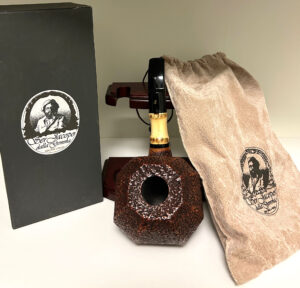
This may seem out of character for Pundit, but I am truly captivated by the Ser Jacopo Insanus. Years ago, I purchased an enormous, barn-sized pipe and tucked it away, only to forget about it. Recently, the urge to hold it resurfaced, prompting a frantic search through my collection until I found my prized Insanus. It’s an impressive, beautifully rusticated paneled bowl with bamboo shank extension—possibly weighing just over five ounces. I love it! To clarify, “insanus” in Latin can mean “incredible.” I must admit, I learned this not from my distant high school Latin but from consulting a dictionary. Okay, a few pipe makers go for heavy-duty pipes, of course. But the Ser Jacopo brand has not been shy about creating, well, great ol’ big ‘uns, and a few that defy the imagination. Some of the Ser Jacopo creations seemingly belong in a museum of art. Which makes sense when you look at the name’s origins. Giancarlo Guidi founded the brand and possibly named it for a 16th-century Italian painter. Now, Pundit does not go gaga for all the Insanus versions. Especially those that appear to have been in a bad accident and are broken and wired together. Or the larger-than-life bowl that twists back onto the stem to surveil your tobacco brand preferences before you load up. Do not get Pundit wrong, here. If your choice is the Insanus that is wired up or the pipe that looks back at you, then I will cheer you on. They are fun and spark a great deal of curiosity, especially in your pipe club gatherings. In research about Insanus pipes, I found that Guidi and Bruto Sordini founded Ser Jacopo in Pesaro, Italy, after leaving Mastro de Paja. They aimed to blend expertise and creativity, establishing Ser Jacopo as a distinct force in Italian pipe making. According to my research, Guidi was inspired by the imaginative art of Picasso and Van Gogh. This led Ser Jacopo artists to push creative limits, carving pipes by drawing inspiration directly from the briar and their artistic instincts. Pundit also owns a couple of Ser Jacopo’s more “sanus” (sic) pipes, including some of the beloved Picta Van Gogh rusticated styles, which have been put away for safekeeping. These pieces stand out for their unique craftsmanship and artistic flair. Van Gogh, you might recall, was a pipe smoker. He painted many self-portraits smoking a pipe. These paintings served as one of the blueprints for the Van Gogh Picta series. I first saw the Picta Van Gogh at a pipes and tobacco show in Nashville, TN. It was love at first glimpse. I bought it faster than you can say Van Gogh. I barely had time to get out my credit card, worried someone else would snatch it up. Some Insanus designs, such as those that appear broken and wired together or feature oversized bowls that twist back toward the stem, exemplify the brand’s boundary-pushing approach. The Picta Van Gogh is but one of a series of pipes in the Van Gogh pipe styles. A few include a cutty, a hawkbill, a Belge and even a poker. All appear in Van Gogh’s artworks. Giancarlo Guidi was inspired not only by Van Gogh but also by the art of other major artists for the different collections within the broader Picta series. Just a couple of these artists in the series include René Magritte and Pablo Picasso. Over time, my preferences have evolved—much like my ageing tobacco blends. As my pipe collection has grown, so has my appreciation for artisanship. I admire Ser Jacopo’s intricate Italian craftsmanship. But I also value traditional British makers and own Dunhills, Ashtons from the William Ashton-Taylor era, and Ian Walker’s beautifully crafted British style pipes. Ian’s pipe shop is on a transformed canal boat. Cool! If you are interested in an American pipe maker who also offers some larger-than-life pipes, check out J.M. Boswell Pipes in Chambersburg and Alexandria, PA. Boswell’s freehand designs and unique finishes are spectacular. Some of his creations feature names such as the Jumbo and Triple X Jumbo. He has also created a monster line known as King Size. These heavy-duty briars can weigh in at over two pounds! One could say they are even muscular. The Kings are worth a look just to see what can be accomplished with briar in an artist’s hands. And these pipes are not only beautifully designed but also offer an exceptional smoking experience. Now, it’s time for a Pipe Smoker of the Past: Rudyard Kipling was born Dec. 30, 1865, in India and died Jan. 18, 1936, in London. He was a journalist, novelist, short-story writer and poet. He won the Nobel Prize in Literature in 1907. Even though he was particular about his pipe preferences, his tobacco choice, according to research, was a common black shag pipe tobacco. The black shag tobacco was strong, but popular in the Victorian era. I always prefer to believe the best of everybody; it saves so much trouble. —Rudyard Kipling A Parting thought: We pipe smokers are part of a rather large family. And with the holidays in full bloom, it is time to be grateful for the artists who create magnificent pipes and craft exquisite tobacco blends. Just for us! Happy Holidays!
 A ‘Meer’ Molding of History
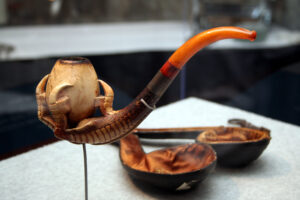
A number of years ago, I was fortunate to be able to visit historic Fort Monroe in Hampton, Va. The famous military stronghold in later years became a museum and a national monument. It was notable for its place in history at the end of the Civil War for the incarceration of Jefferson Davis, President of the Confederacy. Much later in a pipe shop in Atlanta, Ga., I came across a remarkably close replica of the Davis pipe. Mine is now quite nicely colored with age, which reminds me not of nostalgia for the man, but of the unexpected ways history is often embedded in objects we encounter. In my tour of the fort that day, I was drawn like a magnet to metal to a glass display featuring the meerschaum pipe Davis smoked during his incarceration. As a longtime admirer and collector of meerschaum pipes, I was enthralled by the fact that Davis smoked a meer, and the stunning beauty of that pipe. Meerschaum is mined from a rare mineral located in deep underground Turkey. Meerschaum is molded from mounds of seashells pressed for eons in deep mines once on a sea floor. It is porous, light and produces a gentle, cool, and dry smoke. Meers are also prized for their artistic aspects. When the meerschaum is first brought up from deep mines in Turkey, the material is soft and can be carved. Skilled artisans carve a wide variety of shapes, from mythological scenes and realistic figures to intricate patterns and abstract designs. Each pipe is a work of art. These unique shapes become highly prized in a collection, such as Pundit has worked toward for years, reflecting both my passion for pipe artistry and my interest in the way such objects serve as vessels of personal and historical stories. I fell in love with meerschaums the first time I saw them on display in that Atlanta pipe shop. I just had to have one and have been hooked since. My meer collection is a large part of my present pipe herd. Thus, the Davis replica. However, my love of history extends beyond artifacts. I have been fortunate to interview Shelby Foote, the renowned Civil War historian and author, several times. Foote, himself a dedicated pipe smoker who blended his own tobaccos, often spoke about how pipes were an integral part of his writing routine. His insights remind me that objects like pipes can serve as quiet witnesses to history—connecting us to the past, while also inviting us to reflect on its complexities. Research has turned up several notable meer pipe enthusiasts, including poet Rudyard Kipling, Alfred Dunhill, known for manufacturing the majestic Dunhill pipes—of which Pundit has snagged a few—and Albert Einstein, whose image also appears on meers. A couple of reasons why meerschaum pipes are quite popular now is craftsmanship and cool smoking properties are highly appealing. And the more a meer is smoked, it develops a patina that darkens the pipe. The creation of a beautifully smoked meer is a kind of personal history of the pipe smoker’s preferences. As a point of pride, Turkey’s government halted the export of freshly mined meerschaum in the 1970s, according to online reports, to safeguard its national carving commerce. This also ensured training new pipe makers with crafting skills for carving meers remained strong. Now for some notable quotes from Pipe Smokers of the Past: Walter Cronkite was born Nov. 4, 1916, in St. Joseph, Mo., and died July 17, 2009, in New York City. “Uncle Walter” was the top broadcast journalist for CBS for 19 years. He smoked a Wilke pipe and Wilke’s Mixture 72, according to research on his pipe and tobacco preferences. And that’s the way it is. I can’t imagine a person becoming a success who doesn’t give this game of life everything he’s got—Walter Cronkite Archibald Alec Leach (aka Cary Grant) was born Jan. 18, 1904, and died Nov. 29, 1986. Grant, the famous American film star, was born in Bristol, England, before his movie acting days in the U.S. He notably smoked pipes and pipe tobacco especially blended for him by Kramer’s Pipe Shop in Beverly Hills, Calif. The blend was the “Blend for Cary Grant.” It was a mild English aromatic mixture of Virginia, Latakia, Orientals, Black Cavendish, and a light Irish Mist for flavoring, according to his printed history. Destiny is not necessarily what we get out of life, but rather, what we give—Cary Grant And a Parting Thought: Many days we worry about small things in life, but our pipes and tobacco invite us to reflect, keeping us rooted in the occurrences that really matter.
 Women Enjoy Pipes, Too
It has been a few moons since the thought of women pipe smokers popped up in Pundit’s vision. But a recent piece in SmokingPipes.com caught my eye. My grandmother, who lived deep in the heart of South Georgia peanut land, not only smoked a corncob pipe, but she also dipped snuff. She was a small woman with the stamina of a mule and would work you into exhaustion. I recall the tiny, round tin of Tops Snuff Maudie carried with her, which was, by the way, the same apron pocket in which she once stuffed a coral snake. She said she thought it was a pretty colored worm—until she showed it to a visiting uncle. “Red on the head, you’re dead,” he said and immediately dispatched the pretty red-headed worm. I recall her uncle telling us some time later that Maudie reached for her corncob pipe to think over the red on the head part. Normally, she left the corncob primarily for the evenings on the front porch in her rocking chair. I do not know what tobacco she smoked in the cob. Probably something like Sir Walter Raleigh—or some other light burley. My grandmother was the first woman I ever encountered who smoked a pipe. Nobody among the family or friends ever questioned her about her pipe smoking, as that would not have gone over well. She was the kind of woman who refused electricity when the Rural Electrification Administration, a New Deal agency to bring electricity to rural sections of the nation, came through red dirt backroads to turn on the lights. In her words, “if they can cut it on, they can cut it off.” As for well-known women pipe smokers, let’s begin with Kayla Ivan’s excellent history in Pipe Line, featuring Rachel Jackson, wife of our seventh president, Andrew Jackson, and the military hero at the Battle of New Orleans. In this battle against the British, Tennessee earned the state’s nickname, the “Volunteer State.” Jackson called on Tennesseans to join him in New Orleans to take on the British once more in the battle known as the War of 1812. And they did in droves. Rachel, a frontier woman, smoked a pipe pretty much all her life. Andrew did not mind, because he often smoked a pipe with Rachel. She preferred her long-stem clay and corncob pipes. Rachel Jackson was born in Virginia, June 15, 1767, and died Dec. 22, 1828, a few months before Andrew Jackson was sworn in as the seventh president of the United States. They were married for 35 years. Now for more women pipe smokers of the past: Dorothea (Dolley) Payne Todd Madison. Born May 20, 1768, and died July 12, 1849. She was the wife of President James Madison. Dolley was born in a Quaker community in what is today known as Guilford County, N.C. During the War of 1812, as British troops invaded Washington, she remained in the White House until she could ensure the rescue of important artifacts, including a portrait of George Washington. History recounts that Dolley preferred snuff but often smoked a pipe. It’s not readily known what kind of pipe or her tobacco preference. Margaret Taylor, wife of President Zachry Taylor, 12thU.S. president, was born Sept. 21, 1788, in Calvert County, Md., and died Aug.14, 1852, in Pascagoula, Miss. She is buried in the Zachary Taylor National Cemetery. And for a more modern woman pipe smoker: Millicent Fenwick, Republican Congresswoman from New Jersey, was born Feb. 25, 1910, in New York, and died Sept. 16, 1992, at Bernardsville, N.J. She was a four-term congresswoman from 1975 to 1983. It is reported in her bio that when her doctor told her to stop smoking cigarettes, she began smoking a pipe. Now for some parting thoughts from the Pundit: As fall begins its colorful march, it triggers unique memories. In the past, fall weather meant I changed my blend preferences, generally switching from heavier Orientals, Virginias, Perique, and Latakia to a more relaxed and sweeter Aromatic blend. I know for diehard heavy hitters, adding fruity vanilla flavors to some Burley or Virginia is akin to sacrilege. Now, in my early dotage, I have changed again. I miss the old McClellan Virginia 5100. So, I have switched to a similar blend of Cornel & Diehl’s Virginias, especially some of the Old Belt red Virginia blends. To my tastes, the C&D red ribbons are not quite the same as 5100, but close enough for me now. Though, in my humble opinion, I do not believe there will ever be another 5100. One more thought: My pipes have become as precious to me as my love for Shakespeare. So, I leave you with this quote from the Bard: …This above all: to thine own self be true, And it must follow, as the night the day, Thou canst not then be false to any man… – William Shakespeare, Hamlet, Act 1, Scene 3.