






Vulcanite Stem "Bath"?

Log in

SmokingPipes.com Updates

Watch for Updates Twice a Week

PipesMagazine Approved Sponsor

PipesMagazine Approved Sponsor

PipesMagazine Approved Sponsor

PipesMagazine Approved Sponsor

PipesMagazine Approved Sponsor

tartanphantom

Starting to Get Obsessed
Oct 20, 2025
191
1,498
62
Murfreesboro, TN
Ooh, nice idea! I experimented with shaking the liquid and never allowing the granules of oxyclean to rest on them etc. but with no change. But next time I’ll be sure to try this!

So you basically take off the first layer, allowing the Oxy to work its magic again on "fresh" rubber? What’s the timetable roughly, and how many cycles of this do you go through? What end result does it produce? Similar to the stems that clean up on the first go?

It all depends on the initial level of oxidation. My soaks have varied from as little as one hour to as many as 4-5 hours. In my personal experience, the vulcanite used by Danish factory pipes (Danpipe, Stanwell & similars) in the '60s and '70s turns green a lot quicker than many of the British factory pipes from the '50s and '60s. Nevertheless, please take that with a grain of salt as purely anecdotal-- I have no empirical proof of this, just firsthand experience only.

Therefore, you just have to experiment with your own stems to figure out what works best. Sometimes, after the initial soak, the warm water rinse will yield significantly noticeable results, where you can see the stem actually darkening as you rub it under the water. In other cases, you may notice very little change.

In the end, I view it as somewhat akin to cleaning the corroded terminals on a car battery-- you can pour a little Coca-cola on them or a bit of baking soda solution, and it will soften things up, but in the end you'll still have to do a bit of scraping with a wire brush to bring the whole thing up to snuff.

I am by no means an expert on the subject, but I've developed a method that works for me for even the ugliest oxidation. Essentially it's oxy-bath (multi-stage if needed), a bit of magic eraser, #0000 steel wool with Compact Disc scratch remover/polish, followed by a light-pressure dry buff at low speed with a felt Dremel wheel, followed by a felt Dremel wheel loaded with green dremel polishing compound, next is a final buff with a soft dry cloth dremel buffer wheel, and finally food grade mineral oil or Decatur No-Ox oil. LOTS of good old-fashioned elbow grease and patience throughout.

I don't always strive for that flawless mirror finish; sometimes it is achieved, and sometimes I just want them back to a clean black with a smooth satin-esque finish. It depends on the pipe, and how much time I have on my hands.

I don't have an arbor or bench grinder/buffer, since I don't do this for a living or for resale-- it's just keeping my own pipe collection to my personal liking. My collection runs around 130 pipes in size, 60% of which are estate pieces. I just developed this method over the years by experimenting on cheap, ugly estate lots that I would find on Ebay back in the day.

Wish I had a before-after for this one, but I just did the pipe pictured below a few days ago, it was only moderately green, and a single oxy soak was all that was needed-- an Amphora X-tra that I recently purchased for around $15 on Ebay. I'm quite satisfied with the results.
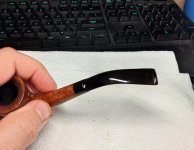
KIMG0724a.JPG
 
Last edited:
  • Like
Reactions: AreBee and Alanon

Dshift

Lifer
Mar 28, 2025
1,265
6,605
Germany
ebay.us
I've tried the Before and After oxidation product and while it seems to have removed some discoloration, it left the stem dead matte. The effort needed to return the luster was the same that would have been required without using the stuff.

Oxidation, which is a chemical change in the composition of the Vulcanite, not a deposit of mouth crud, needs to be physically removed by being sanded away followed by polishing the Vulcanite. Bleach pits Vulcanite, and the work involved in removing the pitting is more than not using bleach and just doing the sanding.
Does it remove the oxidation completely though, or does it just hide it? I have been doing some diy chemistry trying to make what before and after claims but it just hides oxidation for me… it hides it very well but still that’s not my goal… The matt finish doesn’t sound very hard to polish up
 

sablebrush52

The Bard Of Barlings
Jun 15, 2013
23,063
58,955
Southern Oregon
jrs457.wixsite.com
Does it remove the oxidation completely though, or does it just hide it? I have been doing some diy chemistry trying to make what before and after claims but it just hides oxidation for me… it hides it very well but still that’s not my goal… The matt finish doesn’t sound very hard to polish up
I can’t answer your question. A lot of brownish crud floated off the stem into the thick medium, like wispy clouds, overnight. I just looked at the matte result and went to polishing it up without much inspection.
 
  • Like
Reactions: Dshift

Alanon

Might Stick Around
Nov 1, 2025
91
219
Europe
I am by no means an expert on the subject, but I've developed a method that works for me for even the ugliest oxidation. Essentially it's oxy-bath (multi-stage if needed), a bit of magic eraser, #0000 steel wool with Compact Disc scratch remover/polish, followed by a light-pressure dry buff at low speed with a felt Dremel wheel, followed by a felt Dremel wheel loaded with green dremel polishing compound, next is a final buff with a soft dry cloth dremel buffer wheel, and finally food grade mineral oil or Decatur No-Ox oil. LOTS of good old-fashioned elbow grease and patience throughout.

I don't always strive for that flawless mirror finish; sometimes it is achieved, and sometimes I just want them back to a clean black with a smooth satin-esque finish. It depends on the pipe, and how much time I have on my hands.

I don't have an arbor or bench grinder/buffer, since I don't do this for a living or for resale-- it's just keeping my own pipe collection to my personal liking. My collection runs around 130 pipes in size, 60% of which are estate pieces. I just developed this method over the years by experimenting on cheap, ugly estate lots that I would find on Ebay back in the day.
This is very interesting! I have a similar outlook and generally I’ll try anything once to see if it works. My current method is quite a bit simpler, just oxy and then progressively finer and finer sandpaper grades. I never go coarser than around P1000 or P1200 grit (European SEPA scale), which is quite fine as far as wet sandpaper goes. It takes a bit longer but leaves fewer gouges to later have to remove. I’m guessing that’s also your logic with the disc scratch remover and things. From there I go through my grades of sandpaper and usually finish somewhere around P10k. Exactly as you’ve said, sometimes I chase an almost mirror finish, sometimes less so if I can’t help it or if I’m in a hurry.

This is about as good a sheen as I can get using this primitive method on an old workhorse Peterson’s Kapet:

PXL_20251209_233806817~2.jpg

I don’t really need to make them better than this, but quicker would be nice. :LOL:
 

Skyfall

Lifer
Dec 17, 2024
2,160
11,652
I tried it and it worked to a limited extent. Followed their instructions for an overnight bath. A lot of stuff came off the stem and it left the stem a flat matte. By the time I repolished the stem, the effort was the same as just sanding it down and then polishing.

It worked but didn’t really save me any work.
What did you polish the stem with?
 

sablebrush52

The Bard Of Barlings
Jun 15, 2013
23,063
58,955
Southern Oregon
jrs457.wixsite.com
This is very interesting! I have a similar outlook and generally I’ll try anything once to see if it works. My current method is quite a bit simpler, just oxy and then progressively finer and finer sandpaper grades. I never go coarser than around P1000 or P1200 grit (European SEPA scale), which is quite fine as far as wet sandpaper goes. It takes a bit longer but leaves fewer gouges to later have to remove. I’m guessing that’s also your logic with the disc scratch remover and things. From there I go through my grades of sandpaper and usually finish somewhere around P10k. Exactly as you’ve said, sometimes I chase an almost mirror finish, sometimes less so if I can’t help it or if I’m in a hurry.

This is about as good a sheen as I can get using this primitive method on an old workhorse Peterson’s Kapet:

View attachment 436873

I don’t really need to make them better than this, but quicker would be nice. :LOL:
Looks good to me. People can make this as complicated as they like. The basic logic is the same. Remove the diseased material and smooth the surface with increasingly fine grit until you're polishing the surface to a mirror like luster. The trick is knowing when to move into the initial polishing as you're removing the last of the oxidized material so that you're removing as little as possible between removing the oxidation and achieving a high polish.

I spent a decade manufacturing and restoring fine jewelry and people would be surprised at the simplicity of the methods we used. The difference was in the touch. It's all in the touch.