Vulcanite Stem "Bath"?

Log in

SmokingPipes.com Updates

Watch for Updates Twice a Week

PipesMagazine Approved Sponsor

PipesMagazine Approved Sponsor

PipesMagazine Approved Sponsor

Drucquers Banner

PipesMagazine Approved Sponsor

PipesMagazine Approved Sponsor

sittingbear

Part of the Furniture Now
Jul 20, 2015
767
3,871
Olympia, WA
There is a member who does a great job restoring pipes and uses some kind of "bath" to remove oxidation. A while back I asked them what they used and they told me, but I can't find that thread. (If this was you, please jog my memory!)

What's the best way to remove severe oxidation from a stem, aside from (or in addition to) sanding and buffing?
 

georged

Lifer
Mar 7, 2013
6,871
20,046
What's the best way to remove severe oxidation from a stem, aside from (or in addition to) sanding and buffing?

Chemical (liquid) oxidation removal leaves a finely pebbled, uneven surface that still must be sanded and polished, so using it is simply extra work that accomplishes nothing.

(Talking pipe stems, here, NOT vulcanite pen barrels which are often etched with designs. Those guys have no other choice than to use a liquid to get in the spaces and cracks. The design ends up matte, but it's either that or sand the design off completely.)
 

sablebrush52

The Bard Of Barlings
Jun 15, 2013
23,059
58,949
Southern Oregon
jrs457.wixsite.com
There is a member who does a great job restoring pipes and uses some kind of "bath" to remove oxidation. A while back I asked them what they used and they told me, but I can't find that thread. (If this was you, please jog my memory!)

What's the best way to remove severe oxidation from a stem, aside from (or in addition to) sanding and buffing?
I've tried the Before and After oxidation product and while it seems to have removed some discoloration, it left the stem dead matte. The effort needed to return the luster was the same that would have been required without using the stuff.

Oxidation, which is a chemical change in the composition of the Vulcanite, not a deposit of mouth crud, needs to be physically removed by being sanded away followed by polishing the Vulcanite. Bleach pits Vulcanite, and the work involved in removing the pitting is more than not using bleach and just doing the sanding.
 

ssjones

Moderator
Staff member
May 11, 2011
20,050
15,824
Covington, Louisiana
postimg.cc
I've tried the Before and After oxidation product and while it seems to have removed some discoloration, it left the stem dead matte. The effort needed to return the luster was the same that would have been required without using the stuff.

Oxidation, which is a chemical change in the composition of the Vulcanite, not a deposit of mouth crud, needs to be physically removed by being sanded away followed by polishing the Vulcanite. Bleach pits Vulcanite, and the work involved in removing the pitting is more than not using bleach and just doing the sanding.
I suspected there is no magic elixir.
 

sablebrush52

The Bard Of Barlings
Jun 15, 2013
23,059
58,949
Southern Oregon
jrs457.wixsite.com
I wonder if this was the "bath" that you might be referring to? 8oz Bottle of Extra Strength Deoxidizer | La Belle Epoque - https://www.lbepen.com/product-page/8oz-bottle-of-extra-strength-deoxidizer

I have no personal experience, but it is highly recommended by the Southland Piper on YouTube.
I tried it and it worked to a limited extent. Followed their instructions for an overnight bath. A lot of stuff came off the stem and it left the stem a flat matte. By the time I repolished the stem, the effort was the same as just sanding it down and then polishing.

It worked but didn’t really save me any work.
 

pipersalmanac

Starting to Get Obsessed
Aug 14, 2025
132
2,900
59
Carmel, IN
I tried it and it worked to a limited extent. Followed their instructions for an overnight bath. A lot of stuff came off the stem and it left the stem a flat matte. By the time I repolished the stem, the effort was the same as just sanding it down and then polishing.

It worked but didn’t really save me any work.

Oh well. No shortcuts. Thanks for taking one in the name of science and saving me the trouble.
 
  • Like
Reactions: sablebrush52

AreBee

Lifer
Mar 12, 2024
1,208
5,854
Farmington, Connecticut USA
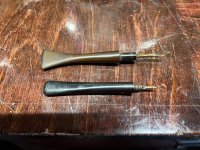
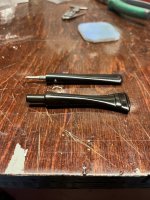
I use Oxiclean as a first step to restoring vulcanite stems. I stir every 30 seconds or so never letting the grains rest on the stem. This avoids the pitting. Learned from experience!
After that, I rinse with water then begin sanding with micro polishing pads. 400-600 for the heavy tooth chatter all the way up to 12,000. Then a Dremel with a cotton pad and buffing compound (rouge) to restore the shine.

IMG_5541.jpegIMG_5535.jpegIMG_5536.jpegIMG_5543.jpeg
 

georged

Lifer
Mar 7, 2013
6,871
20,046
I use Oxiclean as a first step to restoring vulcanite stems. I stir every 30 seconds or so never letting the grains rest on the stem. This avoids the pitting. Learned from experience!
After that, I rinse with water then begin sanding with micro polishing pads. 400-600 for the heavy tooth chatter all the way up to 12,000. Then a Dremel with a cotton pad and buffing compound (rouge) to restore the shine.


You are too easily satisfied, methinks.


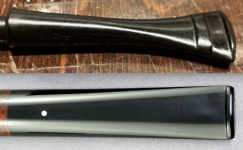
Screenshot 2025-11-17 at 2.50.02 PM.png


Screenshot 2025-11-17 at 3.06.29 PM.png
 

sittingbear

Part of the Furniture Now
Jul 20, 2015
767
3,871
Olympia, WA

Alanon

Might Stick Around
Nov 1, 2025
91
218
Europe
I’d like to chime in with my experience using OxyClean powder that you dissolve in water and create a stem bath. While the results for me are extremely inconsistent, the only thing I can pin it on are different vulcanite compositions?

When this sort of bath works, it works wonderfully. A green stem goes in, and a black or almost black one comes out - without any trace of pitting or roughness, basically in a condition many would be happy with! Personally I sand them further to get them shiny, but by no means is the texture of the vulcanite affected by the process. This is the outcome that looks like magic.

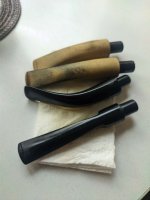
In other cases, what you get is a whitish-green matte surface you do have to sand down to get to the actual rubber. Here is an example - all four stems entered the bath together, all were fairly oxidised but moderately, meaning that you could still see that black rubber was underneath. Two came out perfectly, two came out looking worse than when they came in.

I personally still use it because the time saved on the good ones makes up for the sanding work I have to do on the bad ones.

photo_2025-10-12_10-39-24.jpg
 

tartanphantom

Starting to Get Obsessed
Oct 20, 2025
190
1,485
62
Murfreesboro, TN
I’d like to chime in with my experience using OxyClean powder that you dissolve in water and create a stem bath. While the results for me are extremely inconsistent, the only thing I can pin it on are different vulcanite compositions?

When this sort of bath works, it works wonderfully. A green stem goes in, and a black or almost black one comes out - without any trace of pitting or roughness, basically in a condition many would be happy with! Personally I sand them further to get them shiny, but by no means is the texture of the vulcanite affected by the process. This is the outcome that looks like magic.

In other cases, what you get is a whitish-green matte surface you do have to sand down to get to the actual rubber. Here is an example - all four stems entered the bath together, all were fairly oxidised but moderately, meaning that you could still see that black rubber was underneath. Two came out perfectly, two came out looking worse than when they came in.

I personally still use it because the time saved on the good ones makes up for the sanding work I have to do on the bad ones.

View attachment 436816

I've had similar results, and the only thing I can think of as major variables is the quality and age of the vulcanite in question. Therefore, I tend to agree with you on this.
However, regarding the stems that tend to turn greener, I have found that if midway through the soak, I remove the stem and rinse it under warm running water while rubbing it all over to remove the surface layer of oxidized offal, it tends to remove a top layer of scum and becomes a little darker again. Then, I return it to the oxy-bath for more soaking until the bubbling nearly stops.

I've also found that pre-treating the stems with very warm water before the soak tends to yield better sulfur removal results-- probably has something to do with opening up the pores of the vulcanite surface a bit more, but I ain't no scientist, for sure.
 

Alanon

Might Stick Around
Nov 1, 2025
91
218
Europe
However, regarding the stems that tend to turn greener, I have found that if midway through the soak, I remove the stem and rinse it under warm running water while rubbing it all over to remove the top layer of oxidized offal, it tends to remove a top layer of scum and becomes a little darker again. Then, I return it to the oxy-bath for more soaking until the bubbling nearly stops.
Ooh, nice idea! I experimented with shaking the liquid and never allowing the granules of oxyclean to rest on them etc. but with no change. But next time I’ll be sure to try this!

So you basically take off the first layer, allowing the Oxy to work its magic again on "fresh" rubber? What’s the timetable roughly, and how many cycles of this do you go through? What end result does it produce? Similar to the stems that clean up on the first go?