


Now that’s a Stack ! Look at that Birdseye! Great googly moogly
What’s the height on the bowl ?

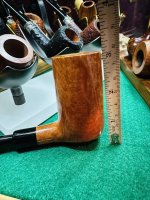





Now that’s a Stack ! Look at that Birdseye! Great googly moogly
What’s the height on the bowl ?



 Or better yet, how much smaller is a single K-sized bowl?


Mike Glukler told us that upper case K's began in 1969 and went to lower case k's in 1982. So, I suspect that is your date range.This rather handsome Castello practically fell into my lap recently. I’d always considered getting the Sea Rock finish some day as it always seemed like such an intriguing texture, so this was incredibly serendipitous for me, as who knows when that would’ve happened if certain events hadn’t unfolded the way they did.
From what I gather, this should be a smaller pipe (KK in an oval), but to me it’s pretty much medium, at about 4cm in depth and 18mm in bowl width. If this is on the small scale, what is large?
Also, I’ve read online that Sea Rock is mostly darker brown, while mine is more of a honey brown colour, or Dunhill’s Tanshell. I wonder what that’s about?
The shape ought to be a 65, and the pipe also has a Made in Cantu Italy stamp, and a barely legible Carlo Scotti imprinted as well. I’ve tried reading up on how to date this pipe, and I gathered that for the Sea Rock finish there’s only so much one can do. I’m quite confused about large and small K’s and also if/when the Scotti imprint stopped being placed on the pipes?
If anyone could tell me how old she is, I’d be most grateful.
View attachment 437607View attachment 437608View attachment 437606View attachment 437609
Oh, interesting! I sort of presumed it’s a newer vintage but that may be because it was practically unsmoked.Mike Glukler told us that upper case K's began in 1969 and went to lower case k's in 1982. So, I suspect that is your date range.
I have a 2k size Sea Rock 65, but the rustication is now where near that gnarly!
Here is my 2017 KK Sea Rock. I guess it is similar, but I think your tan color accentuates the rustification.Oh, interesting! I sort of presumed it’s a newer vintage but that may be because it was practically unsmoked.
Indeed I’d consider the texture quite gnarly, though I must admit I haven’t seen too many Sea Rocks to be able to compare.


Since the pipe has a Carlo Scotti stamp, within an oval it is pre 2007. Kino, within an oval, began in 2007. Lower case k means post 1982 ish. BUT ....... it has the shape number 65. The precise year that shape numbers were discontinued is something I do not have an exact timeline on.Mike Glukler told us that upper case K's began in 1969 and went to lower case k's in 1982. So, I suspect that is your date range.
I have a 2k size Sea Rock 65, but the rustication is now where near that gnarly!
I love that kind of detail Mike! If not detailed here, eventually lost to time.Since the pipe has a Carlo Scotti stamp, within an oval it is pre 2007. Kino, within an oval, began in 2007. Lower case k means post 1982 ish. BUT ....... it has the shape number 65. The precise year that shape numbers were discontinued is something I do not have an exact timeline on.
The rustication style is different than current models. It appears deeper, and more "rounded" if that makes sense.
Ignore the color of the briar, when comparing to current offerings. IF this pipe was completed in the 1980's, then it has been siting for around 40 years. Depending on how and where it was stored could have altered the color. If left in a sunlight filled room, it would have lightened. If stored in a poorly lit area in a pipe shop, then it would have absorbed smoke etc and possibly darkened. It could also be that it was stored in a box and that was the initial color. Briar blocks do not all "accept" stain exactly the same. Some blocks "absorb" better than others. Thus the same stain applied to two different blocks might end up with a slight or drastically different final color.
The final thing to understand is ....... the pipe is stamped at the time of sale, at the factory, or the grading, is maybe a better way of explaining.
So, this pipe may have been "completed" and stamped ( Sea Rock , Carlo Scotti etc ) except the grading ( k's ) at some point pre 1982. Since it has the shape number it is a possibility. Then it may have sat at Castello in their workshop inventory drawer, OR had been set aside for some reason, and left untouched for decades.
Then found, and selected by a dealer for the retailers inventory. At that time it would have been stamped with the grade ( k's ).
Thusly, to get an exact year of creation is not possible. From the style of rustication, the shape number stamp, and Carlo Scotti stamp, I would hazard a guess that the pipe was made in the 1960's to early 80's and sold to a retailer after 1982. Plus not made in 1969, for in that year the pipe were stamped "HAND MADE".
It does not have a stamp to indicate which retailer it was sold to, nor the US stamp, which began in 1997. This narrows it's year of leaving the workshop at pre 1997.
As a final note, let me say, sometimes we "need" to know far more about a pipe than we need to. We can dive deep into a rabbit hole to find the story behind a treasure. Forgetaboutit!!! It's a great looking older pipe that will probably smoke like a champ. In the end that IS ALL that matters!!!
Enjoy it. Love it. Cherish it.
Mike


This is fantastic insight, thank you Mike! I’ve always loved knowing these details about my pipes, when possible. It’s part of the charm of having an estate pipe, knowing there’s some kind of story behind it.Since the pipe has a Carlo Scotti stamp, within an oval it is pre 2007. Kino, within an oval, began in 2007. Lower case k means post 1982 ish. BUT ....... it has the shape number 65. The precise year that shape numbers were discontinued is something I do not have an exact timeline on.
The rustication style is different than current models. It appears deeper, and more "rounded" if that makes sense.
Ignore the color of the briar, when comparing to current offerings. IF this pipe was completed in the 1980's, then it has been siting for around 40 years. Depending on how and where it was stored could have altered the color. If left in a sunlight filled room, it would have lightened. If stored in a poorly lit area in a pipe shop, then it would have absorbed smoke etc and possibly darkened. It could also be that it was stored in a box and that was the initial color. Briar blocks do not all "accept" stain exactly the same. Some blocks "absorb" better than others. Thus the same stain applied to two different blocks might end up with a slight or drastically different final color.
The final thing to understand is ....... the pipe is stamped at the time of sale, at the factory, or the grading, is maybe a better way of explaining.
So, this pipe may have been "completed" and stamped ( Sea Rock , Carlo Scotti etc ) except the grading ( k's ) at some point pre 1982. Since it has the shape number it is a possibility. Then it may have sat at Castello in their workshop inventory drawer, OR had been set aside for some reason, and left untouched for decades.
Then found, and selected by a dealer for the retailers inventory. At that time it would have been stamped with the grade ( k's ).
Thusly, to get an exact year of creation is not possible. From the style of rustication, the shape number stamp, and Carlo Scotti stamp, I would hazard a guess that the pipe was made in the 1960's to early 80's and sold to a retailer after 1982. Plus not made in 1969, for in that year the pipe were stamped "HAND MADE".
It does not have a stamp to indicate which retailer it was sold to, nor the US stamp, which began in 1997. This narrows it's year of leaving the workshop at pre 1997.
As a final note, let me say, sometimes we "need" to know far more about a pipe than we need to. We can dive deep into a rabbit hole to find the story behind a treasure. Forgetaboutit!!! It's a great looking older pipe that will probably smoke like a champ. In the end that IS ALL that matters!!!
Enjoy it. Love it. Cherish it.
Mike
Well, when the Internet stops telling us, so probably never.I wonder when people will stop thinking the "k" is an indicator of size? The Ks are an indicator of the wholesale price for dealers. Size is only one factor. How do I know this? Because I heard it from the horse's mouth (so to speak), the Castello factory rep explained it to me over coffee at Novelli's in Rome years ago.

Very correct. The k grading "system" is a combination of factors. For non smooth pipes it's a combination of size and thus the price. On smooth pipes, the combination is, size, grain, and thus the price.I wonder when people will stop thinking the "k" is an indicator of size? The Ks are an indicator of the wholesale price for dealers. Size is only one factor. How do I know this? Because I heard it from the horse's mouth (so to speak), the Castello factory rep explained it to me over coffee at Novelli's in Rome years ago.