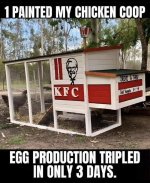


Locally here in northern Illinois, backyard chicken eggs are selling for $7.00 a dozen. Store bought eggs are around $5.00 a dozen.I used to raise backyard chickens and had so many eggs I couldn't give them away. I'm thinking of getting some again.




Locally here in northern Illinois, backyard chicken eggs are selling for $7.00 a dozen. Store bought eggs are around $5.00 a dozen.I used to raise backyard chickens and had so many eggs I couldn't give them away. I'm thinking of getting some again.
 www.thetruckersreport.com

There is almost zero talk about this. A few things I'd like to see on the news. First, this is global. Most countries, China included, have worse inflation than the USA. I don't know who or what they're doing in WashDC, but comparatively, they're doing a pretty good job. Second, while inflation has been 6-8%, prices have gone up 15-20%. That's not inflation. That gouging. Couple the gouging with shrinkflation, and you have a lot of business taking advantage of the situation. Third, since we're talking about eggs, according to Farm Report, they've killed 57 million chickens so far. Inflation is a small part of what is happening with eggs. Fourth, there hasn't been a new oil refinery built since 1974. This is for a couple reasons: 1) oil companies have no interest in creating a greater supply 2) no citizens/towns want a new refinery in their backyard. Fifth, like gouging in the grocery store, oil companies have reported consistent record-breaking profits every quarter for a while now (too lazy to look it up). Each quarter is a new profit record. Again, that isn't inflation. That's good ol' opportunistic gouging. There are a slew of recordings of oil heads talking about how it is good for them if we're in a slight recession. They aren't going to do anything to help out public matters because it isn't in their best interest. If anything, they're going to slyly contribute to a recession because it better serves their stockholders.Lots of reasons for the current inflation, including gouging by businesses who see this as the perfect opportunity.



The work place and manufacturing has been forever altered. There was an exodus of boomers from the job market. Simultaneously all retired at once over the course of about two years. They were a massive generation that were all clumped together age wise. There are not enough people of working age to fill the gap they left in the workforce. With wages rising people are leaving low paying jobs in favor of jobs willing to pay more. Low level manufacturing positions are not getting filled. This drives up the price of goods, it makes raw materials more expensive and harder to get. Transportation was one of the industry’s hardest hit by the Boomer & wage exodus. This drives up price of transporting the already more expensive goods and materials even further. At my company we cannot get micro chips for components to repair our automation equipment throughout the entire food processing industry, so equipment goes un-repaired further driving up the cost food. Avian flu, fuel prices, etc. The point is there is not any one single thing, political party, or any other source driving inflation. It’s a combination of many different factors, none of which have readily available solution.

Very wise. The diner owner, if wise, passes on the cost of taking a credit card to the consumer. Smart business that as he/she is facing the same inflation as the customer is. The owner could, without undue loss most likely, reduce the tab by three percent to encourage less credit card usage. That would/could be a "win,win" situationI always bring CASH now when we dine out.

This. I shop at 3 different stores. A big chain that has everything, a smaller bargain chain, and a local organic store. One interesting thing to note is that the price on the high quality local organic stuff has barely gone up and is often cheaper than non-organic non-local meat/eggs/produce. I deduce a few reasons: low shipping distances, no dependence on fertilizers that come from a region of the world that is experiencing war, no flu viruses seem to hit these free roaming chickens as they aren’t crowded into feedlots.Going to put this here.
If you want to add info to your wide views of prices I will invite you all to look into the logistics side of things. Most notably trucking .
Recent Posts | TruckersReport.com Trucking Forum | #1 CDL Truck Driver Message Board
Scour this site and you will be able to glean how the trucking industry is being effected and how that moves into the cost of goods. Notably the price of diesel, rates, and cost of operations for owner operators. Also gives you an unbiased (mostly) look in to supply . You can also from that information glean why maybe in some particular areas prices are effected differently. Such as maybe you didn't realize how much your area has to import. Or. Regulations effecting the ease of receiving the import.
It's ok though, we'll have millions of awesome tik tockers and virtual reality gamers! The world will crumble around them and they won't even notice!This ^^^^
Put into the fewest words:
We've created a world no one wants to maintain.
The "dirty jobs" are going unfilled.
The domino effect will be profound.

They have a legal obligation to follow the best policies with regard to shareholders. My retirement plan is heavily invested in oil stocks. My state is heavily dependent on the oil business (taxes, passed on to the consumer) and, not incidentally, income tax free. So, mixed emotions. Expensive oil means a rise in gasoline,heating oil prices, and so forth. So, do I root for lower price per barrel with less income to the state and lower return on investment for me, a shareholder or, do I pull for lower prices at the pump? A real poser that!They aren't going to do anything to help out public matters because it isn't in their best interest.
That's always been part of the overall cost. Now they reflect it on your bill singularly, most likely in an effort to keep prices reasonable. But, banks will raise that rate, sooner rather than later, and, the menu prices will rise accordingly.Since the pandemic, I've noticed more and more restaurants charging a 3% fee for paying with a card.

My daughter and her husband raised ducks on their farm for egg production. Their birds were pasture raised and given the type of care you give to your pets. Then they were hit with the bird flu.Avian Flu has hurt the egg industry. Processed foods seem to be still inching higher and higher, but meats and veggies seem to be staying level. We never buy processed, ready to cook stuff, so we haven't had the sticker shock, except with eggs. Sausage and other breakfast meats seem to be dropping for us.
Visa/Mastercard/American Express/etc charge the restaurant around 3% + a standard surcharge per transaction, like PayPal, to use the card. Plus, they pay the bank and/or credit card for the in-house technology to accept credit card payments. I'm not arguing on their behalf, but all they're doing is passing on those exact costs to the customer. At 3%, they might even be losing a little bit still. It's really no different than gas stations offering a cash price vs a credit price. And with today's tight margins, 3% is obviously significant to them. Food service is a brutal business on every level.Since the pandemic, I've noticed more and more restaurants charging a 3% fee for paying with a card. These are the same restaurants that we continued to order (carry out) while they were closed for indoor seating. We were supporting our local restaurants (not chain restaurants). I understand some restaurants are still struggling, but the local restaurants we visit are always crowded. I always bring CASH now when we dine out.
Yeah, I get it. We still go out at least twice a week, but I now bring cash. Plus if I pay in cash, at least the server is getting the whole tip...at least I hope so.Visa/Mastercard/American Express/etc charge the restaurant around 3% + a standard surcharge per transaction, like PayPal, to use the card. Plus, they pay the bank and/or credit card for the in-house technology to accept credit card payments. I'm not arguing on their behalf, but all they're doing is passing on those exact costs to the customer. At 3%, they might even be losing a little bit still. It's really no different than gas stations offering a cash price vs a credit price. And with today's tight margins, 3% is obviously significant to them. Food service is a brutal business on every level.