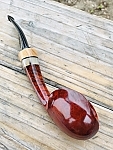
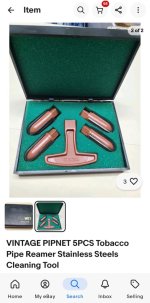
Certainly a pipenet in the hands of a careful and thoughtful “hobbyist” is a perfectly fine tool capable of reaming a pipe.
I think part of the problem is that the Pipenet is not longer made and the lookalikes on the market are poorly made butchers tools. The new ones are dreadfully dull and better suited to spoon carving.
I use “ “ around hobbyist because to me, you claiming to be a humble hobbyist is tantamount to Caravaggio claiming to have dabbled in oil paints.
I almost spewed my coffee when i read your reply! Thank you! The Pipnet copies are truly crap, flimsy dull blades and not always properly finished. One Castleford I tried had burr left on the blade edge.
One can definitely do some damage with a Pipnet, which is why I gradate sizes when going lower because one can score the wood at if not careful, and I always finish with careful sanding.
Here's a little story that you might appreciate. I got my first studio matte painting job because I restored a 19th century Pleyel piano action that the professional repair services had said was "impossible". The action in a piano transfers the energy from the pianist's touch on the keyboard to the striking of the strings.
The owner of the piano, which had belonged to her grandmother, was Toby Rafelson, the production designer on
Five Easy Pieces and other films. A mutual friend introduced us, telling me that if I could help Toby out she might be able to get me a gig.
The action has been shattered at several points and would require fabrication of the damaged and missing parts. with the exception of the hammers, almost everything else would need to be carved from scratch. At that time I lived in a small apartment and had no workshop. Everything would be done tabletop.
I took out the broken parts as well as intact action sections on either side of the damaged sections, to use as reference. Unlike modern actions, the parts were scaled differently from the bass to the treble, so I would have to calculate the scale of the damaged sections.
I bought bought a micrometer, a coping saw, files, felts, a tabletop drill press, a vise, etc. I bought seasoned spruce and had it milled to the precise widths needed, and set to work. A piano action is a complex set of levers, supports, and a "let off" mechanism. I hand carved the jacks, wippens, knuckles, set up the drop screw, backcheck, etc wherever necessary, keeping anything that was still intact
A week later I contacted Toby and brought back the action parts, installed the assemblies and lubed the pivot points, added felt cushions, adjusted the weights, etc, and shoved the repaired action back into place. Then came the acid test. Would it work? I played a Bach Prelude. Everything worked! I made a couple more minor adjustments and played some Chopin. Done deal. It would still need to be voiced and probably regulated, but those are jobs for experts.
Toby was thrilled! She made an appointment to look over my portfolio. Two weeks later I was working at Universal Studios.
Had I ever fixed a piano action before? No.