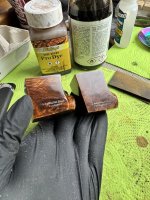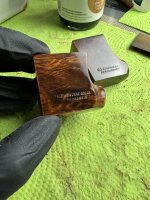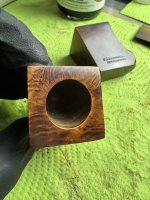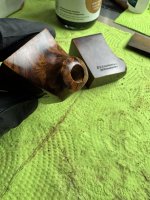




Restoring The Two US Spartans From 1943

Log in

SmokingPipes.com Updates

Watch for Updates Twice a Week

PipesMagazine Approved Sponsor

PipesMagazine Approved Sponsor

PipesMagazine Approved Sponsor

PipesMagazine Approved Sponsor

PipesMagazine Approved Sponsor

Dshift

Lifer
Mar 28, 2025
1,165
5,545
Germany
ebay.us
Here is a link to the thread with before photos and a bit of research on the pipes(patents, photos etc.):
I Just Got 2x 82 Years Old American Pipes From German eBay :: General Pipe Smoking Discussion - https://pipesmagazine.com/forums/threads/i-just-got-2x-82-years-old-american-pipes-from-german-ebay.109866/
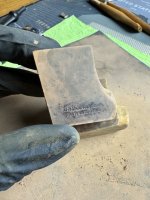
Before photo:IMG_3748.jpegI am just fascinated by these two pipes! They are both very old and very unique in my opinion. I love that I managed to find so much information on them and that they were pipes made to support the war efforts in Europe, which by itself I find interesting, especially because they were bought in Germany. This probably meant that they were not just surplus but were actually shipped to the fronts.
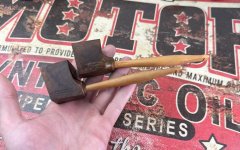
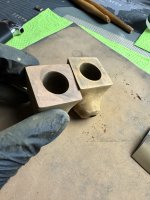
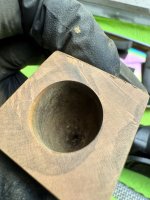
Let's add to all that , the fact that I am very certain they are unsmoked! At first when I saw multiple dings, scratches and all kinds of damage I didn't notice it, but when started cleaning them I only found dust and raw wood with splinters from machining and all and absolutely no smells or residues. The bowl is dark on the inside but that was maybe some type of coating and not a carbon layer, at this point if the pipe was smoked even once the rest would have looked differently.

I tend to have a very personal and individual approach for my restorations, depending on the pipe. For these two I decided not to try to make them look as brand new, because I could see the future owner have them in their collection and put value on their rich history, not their smoking performance and maybe not smoke them at all or like once per year.
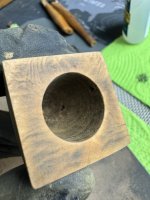
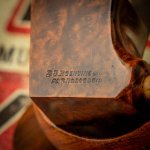
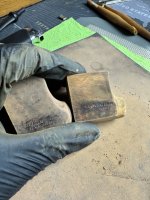
With this in mind, I took it upon myself not to do any major permanent repairs for now. I started by steaming all dents I could see , so I could minimize the sanding that needed to be done. It worked surprisingly well and allowed me to skip the 240 sandpaper that I would normally have to use to get rid of some of the deeper dents and went through grids 400 and 600(going around the stamped text), finishing with 1000, gently passing through the text, just to take off the top shine.
IMG_3784.jpegIMG_3783.jpegIMG_3785.jpegIMG_3787.jpegIMG_3788.jpegIMG_3789.jpegIMG_3791.jpeg
Up until this point everything went as expected, until decided to wipe the dust with some cotton pads and alcohol - the wood sucked up all of the alcohol immediately stayed matt.. normal briar would turn very shiny and wet for a couple of seconds and then dry out.
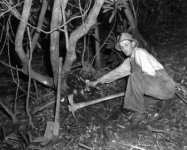
I was starting to get suspicious since we figured out that they didn't use real briar on all the pipes when they had supply problems and I started digging again on google. I found the patent they had and it turns out they did their boiling in boric acid solution not just to make briar more heat resistant, but also to reduce the toxicity of the poisonous rhododendron and mountain laurel burls they used in manufacturing. I even found a photo of them digging up the burls:
man-digging-rhododendron-burls-sized-500x403-1.jpg
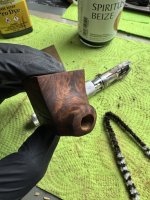
I also decided to retain the pipes because on of them had pretty patchy stain already. I went with my lightest leather dye, which normally gives me this kind of a result:
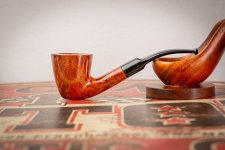
DSC04861.jpg
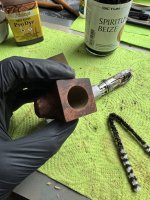
As soon as I started applying it, things got weird fast! First of all, I had to use 4 times the amount I normally use just to cover the somewhat small pipe once and it didn't feel like I was painting it on and maybe get a couple of leaks, no it felt like I was drawing with a sharpie, if that makes any sense... The fully soaked pipe cleaner would just leave multiple thin lines and I had go over the same spot 5 or 6 times to completely cover it. The biggest surprise though, came when I was finished with the stain - I was left with a very dark finish and basically a contrast stain effect, which should have never happened with this light of a dye. the Lorenzetti pipe above got its color from 3 or 4 layers, sealed in with fire in between...
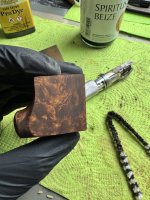
IMG_3793.jpegIMG_3792.jpegIMG_3794.jpeg
You can see in the background that I had the dark brown ready for the pipe with the patchy previous stain, but thank god I decided. to try the lighter dye first.

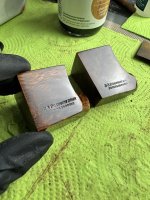
Next came buffing, polishing and waxing - here the wood being so porous and soft made the process very fast and easy and the results speak for themselves. You can also see some of the "battle scars" I decide to leave in.
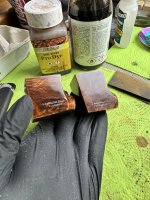
IMG_3795.jpegIMG_3796.jpeg
And I just hit the 15 photos limit, so lets move underneath for part 2...
 

Dshift

Lifer
Mar 28, 2025
1,165
5,545
Germany
ebay.us
PART 2
IMG_3795.jpegIMG_3797.jpegIMG_3798.jpegIMG_3799.jpegIMG_3801.jpeg

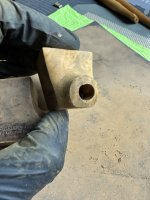
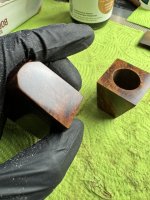
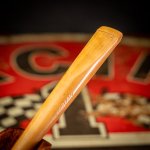
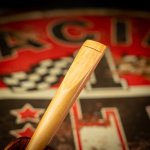
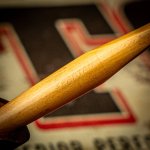
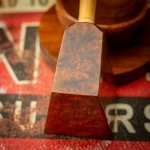
With the bowls out of the way I moved to the stems, which are made out of maple I think. Again decision had to be made here. Both stems were very roughly machined by the manufacturer, they also had multiple dents all over and in addition to that one of them was very loose and the other had big splinter missing(not a full crack thankfully).
IMG_3751.jpeg

I wasn't sure if I wanted to fix this, because the fix would be obvious and for this specific pipe I think the splinter would be more valuable than I a repair. At the end I went with a compromise - I filled it in with a water soluble wood repair mixture, that could be rubbed off with some alcohol even after full cure. This would give the future owner some options. I already knew that it wasn't gonna be pretty but it was ok since it is not a permanent repair.
DSC05122.jpg

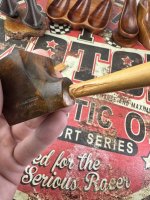
Now I had to address the other stem that was way too loose. Here I had two options - either put some bees wax and hope for the best, or do a proper repair and start reconstructing the inside of the shank by adding glue and briar dust and then filing it to fit. Again I went with the non permanent solution and tried the wax- it actually worked surprisingly well and it gave the stem a snug fit, but I would never call the pipe smoke ready like that. It will absolutely work if the pipe stays in a collection and is smoked a couple of times per year.
Now I tried steaming the dents which worked on some but not on some that were probably due to the rough machining. At the end I decided to start sanding with the 400 grid to smooth things a bit, but again I didn't get rid of everything because I would have to sacrifice too much material. For a second I felt as if I was the worker in the 1943 factory, who responsible for the finishing touches but obviously this position just didn't exist back then... After the 400 I did 600 and finally 1000 grid again brushing over the engraving just to get the old finish off.
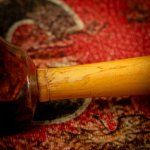
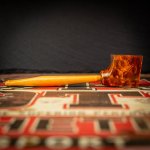
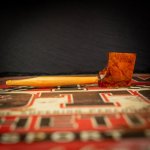
Finally I polished and waxed the stems with some carnauba and they were ready for some sexy shots!

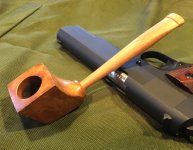
Here is the first pipe:

DSC05101.jpgDSC05102.jpgDSC05105.jpgDSC05103.jpgDSC05106.jpgDSC05107.jpg
DSC05104.jpg

And I guess the second has to go in PART 3...
 
Last edited:
Jun 9, 2015
4,198
26,480
43
Mission, Ks
thehawsepipe.wordpress.com
Nice work, Mt Laurel and Rhododendron are more porous than traditional briar, it’ll soak up alcohol based stain as fast as you can apply it. Mostly D&P didn’t stain them for that reason among others. The GI’s that smoked them claimed they burned out pretty quickly but were better than nothing. The maple stems tend to chew up pretty fast as well.


Here’s one of my Spartans.


IMG_2868.jpeg
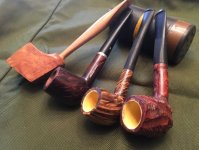
Here’s a few more war time production American Pipes, manzanita and Mt Laurel.IMG_2870.jpeg
 
Last edited:

Dshift

Lifer
Mar 28, 2025
1,165
5,545
Germany
ebay.us
Nice work, Mt Laurel and Rhododendron are more porous than traditional briar, it’ll soak up alcohol based stain as fast as you can apply it. Mostly D&P didn’t stain them for that reason among others. The GI’s that smoked them claimed they burned out pretty quickly but were better than nothing. The maple stems tend to chew up pretty fast as well.


Here’s one of my Spartans.


View attachment 396385
Here’s a few more war time production American Pipes, manzanita and Mt Laurel.View attachment 396386
@RustiePyles CPG could you please help with figuring out a fair value for the pipes?

I still fell weird discussing prices on the forum, so if I broke some rule, a moderator should just delete this reply.
 
  • Like
Reactions: John C.
Jun 9, 2015
4,198
26,480
43
Mission, Ks
thehawsepipe.wordpress.com
They’re not terribly valuable, most pipe collectors don’t have a lot of interest in them because they’re not traditional pipes and they smoke terribly. The only people who are really collecting them are people with crossover interest in militaria or the Second World War. They don’t generally sell for more then $30-40. Sometimes re-enactors want them for their kit. But all in all they are a pretty obscure pipe.
 
Dec 3, 2021
6,294
56,107
Pennsylvania & New York
@Dshift

You did a very nice job making the pipes look spiffy. Well done!

That said, as a collector, I would have preferred them in their original “before” state, especially since they were nearly unsmoked. But, I’m more of a purist in my approach when it comes to the things I collect. I lean towards wanting things “as issued,” as close to the way they would have come from the manufacturer. As @RustiePyles CPG said, these would not have been coloured with dye because of their porosity. With first edition books, I hate seeing restoration done on dust jackets—I don’t mind an archival mend to prevent a tear from worsening, but truly dislike seeing worn ink filled in. I can’t tell you how many copies of On the Road I have seen at antiquarian book fairs with retouched jet black dust jackets; finding an unsophisticated jacket (no restoration) is incredibly difficult and virtually impossible. Luckily, I’m not a Kerouac collector. But, with authors I do collect, the same issue has been a problem. There’s a very popular pipe seller that makes every pipe look like it is glossy and dripping like a candied apple; very often they look nothing like they would have from the factory, but he commands the highest prices—I have been guilty of buying from him because there have been rare pipes that he had that I wanted—but I hate that he ruins history; his pipes are an abomination in that regard.

I’m more anal retentive than a lot of collectors. I suspect you’ll have no problem finding a good home for these pipes. There are all types of collectors out there. Some care about the things I touched on; many do not, but it might be worth considering finding out the history before embarking on restoration in case the restoration can devalue the pipe or interest in it.
 
  • Like
Reactions: John C.

Dshift

Lifer
Mar 28, 2025
1,165
5,545
Germany
ebay.us
@Dshift

You did a very nice job making the pipes look spiffy. Well done!

That said, as a collector, I would have preferred them in their original “before” state, especially since they were nearly unsmoked. But, I’m more of a purist in my approach when it comes to the things I collect. I lean towards wanting things “as issued,” as close to the way they would have come from the manufacturer. As @RustiePyles CPG said, these would not have been coloured with dye because of their porosity. With first edition books, I hate seeing restoration done on dust jackets—I don’t mind an archival mend to prevent a tear from worsening, but truly dislike seeing worn ink filled in. I can’t tell you how many copies of On the Road I have seen at antiquarian book fairs with retouched jet black dust jackets; finding an unsophisticated jacket (no restoration) is incredibly difficult and virtually impossible. Luckily, I’m not a Kerouac collector. But, with authors I do collect, the same issue has been a problem. There’s a very popular pipe seller that makes every pipe look like it is glossy and dripping like a candied apple; very often they look nothing like they would have from the factory, but he commands the highest prices—I have been guilty of buying from him because there have been rare pipes that he had that I wanted—but I hate that he ruins history; his pipes are an abomination in that regard.

I’m more anal retentive than a lot of collectors. I suspect you’ll have no problem finding a good home for these pipes. There are all types of collectors out there. Some care about the things I touched on; many do not, but it might be worth considering finding out the history before embarking on restoration in case the restoration can devalue the pipe or interest in it.
@TheIronMonkey
Thank you so much for this feedback! My intentions were exactly that - to bring the pipes to out of the factory condition. I think I just did one mistake in the process. Let me explain what I did and why:

1. The surface - if you saw the before photos of the pipes, they were already stained(with big rectangular blocks of darker stain) and they had some kind of a thin shiny finish that has already peeled off half way. Now if it was factory or someone gave it a try through the years, I have no way of knowing. I tried to find some reference photos, in order to determine if they were stained originally at all and with what color, but I found all types of different stain colors in addition to unstained pipes too, so I didn't learn much. Also through my research I learned that these specific pipes were not manufactured under strict quality control rules, because of multiple factors like availability of materials, time pressure, low price requirements etc..
This in my opinion gave me a bit of creative freedom, just a little bit. Anyways I had to take decisions because neither of the pipes looked either usable or in out of the factory condition. So I got to work and got rid of some of the dents and scratches that were 100% not manufacturing defects, but caused by the pipe being carried in someone's pocket with their key most likely. All the while trying to take out as little material as possible. This whole process lightened up the dark blocks of extra dye too.
For the stain I tried to replicate the original stain they had when I got them and although things went a bit crazy, I am glad I took the extra step of dying them with my lightest stain first, instead of going directly to the one I though would match the best. At the end I think I managed the color matching to the best of my ability.
Now about the shine and this is true for almost all of my pipes - if you take a cotton pad with alcohol you will get rid of the very thin carnauba wax in seconds and if the result is still too shiny, you will just have to rub the pipe with something like a cloth kitchen towel for a couple of seconds and almost all shine will be gone.

2. The inside of the pipes and the damage on the shank rim - absolutely no repairs or retouching done, I just cleaned it with alcohol and on one of them put some bees wax so it could at least hold the stem.

3. The Stems - This is also where I had to take my biggest decision and possibly made a mistake. The decision was about the splinter- I was almost certain that if it was a manufacturing defect, they would have replaced it and not send it like this, because it could drastically reduce the stability and longevity of the pipe. Assuming it was just dropped by someone at some point, I decided in favor of the repair but under one condition - it had to be completely and 100% reversible! My choice of material also made it easily achievable by the future owner himself, without the need to send the pipe to a professional.
In my opinion smoothing out the surface of the stems could be a potential mistake, but I decided to do it because it just looked bad and cheap... and yes I know the pipes were bad and cheap but thats not what I mean. It looked like a modern, Chinese, cheap material almost like a 3d printed surface, with very evenly spaced out ridges along the stem. I find old craftsmanship very superior to modern one and in my opinion these stems didn't represent that, so I allowed my self not give them a mirror polish but to smooth them down a bit. Again there is wax on the stems right now, which there more for protection than for shine but it can be taken off in seconds.
Please don't take this as me defending or excusing myself, I just wanted to share a bit more of my thought process. Also on pipes where some questionable decisions had to be made I often go with the safer route and offer a potential buyer different options that I will finish before shipping. Perfect example is rare Lorenzo pipe I am working on right now with a very orange but too faded in my opinion stain - It is a very specific orange that I can't replicate as of right now so instead of just restaining it, I leave the decision to the buyer.
Thanks again for the feedback its genuinely appreciated.
 

John C.

Starting to Get Obsessed
Nov 7, 2020
178
1,140
Just wanted to say that I really enjoyed this thread! The before and after photos are great and the history is fantastic. Thanks for sharing this!
 
  • Love
Reactions: Dshift

condorlover1

Lifer
Dec 22, 2013
8,804
32,094
New York
Fascinating article and a lot of information about something I was completely unaware of! I have seen some British 'ersatz' WW2 pipes over the years when elderly relatives have fallen off their perches and these things surface as part of a house clearance but this is something completely different.
 
  • Like
Reactions: Dshift