First off, welcome Hal to the forum. You have excellent taste in pipes and your interest in the history of the men who made them touches a subject near to my heart.
The OP’s question is simple and the answer is possibly yes, but (I suspect) probably no. As mentioned above the definition of a Reuben era pipe is one made before he died. Beyond that point one can argue as to how to classify a pipe made in the window between Reuben's death and the time his heirs sold the business to Herman Lane. "Family Era" for sure since the widow (Esther) and one of her sons (Geoffrey) were at least nominally involved and longtime Charatan employees remained in place, but we can't minimize the impact on the business of losing the longtime owner, manager, and son of Frederick. Luckily this question is moot since in practice the interval between the date of Reuben's death and the acquisition by Herman Lane is much briefer than has been suggested. To be specific Reuben died on March 9, 1962 and less than six months later (on November 1, 1962) the two companies involved in the business restructured their shares in such a way as to leave Lane in control. I say "two" because while we often think of Charatan as one company it was not. F. Charatan was the original entity (later restyled F. Charatan & Son) of which the limited liability version was formed on March 20, 1912. On November 1,1934 a second firm, Charatan Pipes Limited, was established as a sales and distribution arm, with the specific mandate to "Market the products and manufactures of F. Charatan & Son Limited". A controlling interest in both was acquired by Lane at the same time.
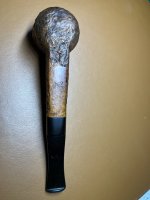
With that out of the way let's address what the OP has stated about the pipe:
-As mentioned by Jesse the presence or absence of the florid L is irrelevant since a) this stamp originated during Reuben's tenure, and b) its absence can easily mean merely that the pipe was not intended for sale by Herman Lane (i.e. to be sold in the Commonwealth or Europe).
-The DC stem is theoretically more helpful since the date of its origin is well known, as is the history of the man who created it; so its presence would have clearly denoted a post-Reuben pipe, but its absence as with the L tells us nothing.
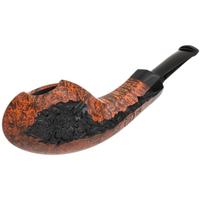
-That brings us to the "Free Hand Relief" stamping. Here we enter murky waters. For all its following among the cognoscenti we tend to forget that Charatan was a minor player in the UK pipe industry and tended to leave a smaller footprint in trade journals, fancy goods brand directories, marketing collateral, newspaper advertisements, etc. So the ever necessary observation that "absence of evidence is not evidence" is particularly apt in the case of Charatan. Having said that it's pretty clear that Charatan historically had a limited line of models, and that this was gradually expanded under Herman Lane's influence, first in additional offerings for the American market when he began his relationship with the company, and then much more aggressively when he was in control. This is what I can tell you based on a pricing history table I prepared from limited documentation (in this case an incomplete run of RTDA almanacs) a decade ago: a Charatan Relief Grain first appears in in the 1957 edition and continues to appear intermittently as least as late as the 1970s. More specifically the Charatan Free Hand Relief first appears in the 1969 edition. It's important to note that I had access to the 1964 edition but not 1965-1968. Almanac editions came out in the Summer so anything introduced after the Spring of each year would be excluded; which is to say even if the Free Hand Relief was available in 1964 it would have had to been introduced early in the year to make it into the 1964 directory. As another data point I can tell you that in a review of newspaper archives the first advertisements mentioning the "Charatan free-hand relief" I found weren't until October of 1965. So in sum while the relief as a finish clearly originated in the Reuben era, the model you have appears to have originated after Lane got control. This is obviously determinative without being definitive so you still have room to believe what you like. My personal take is that this particular model post-dates Reuben's death and the sale of the two Charatan companies to Herman Lane.
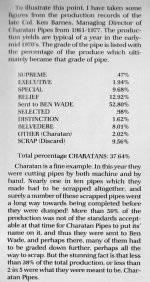
-Finally all references (including the remarks Ken Barnes made which can be found in the fantastic compendium Jesse made) to "Made by Hand in the City of London" are largely unanimous that this nomenclature dates to after Reuben's death in 1962.
Cheers,
Jon
p.s. The more general "free hand" discussion I'll save for another day. It's intricate without being terribly enlightening or in this case particularly necessary.