Charatan Question

Log in

SmokingPipes.com Updates

12 Fresh Ashton Pipes
11 Fresh Vauen Pipes
3 Fresh Tom Eltang Pipes
36 Fresh Nørding Pipes
9 Fresh Brebbia Pipes

PipesMagazine Approved Sponsor

PipesMagazine Approved Sponsor

PipesMagazine Approved Sponsor

PipesMagazine Approved Sponsor

PipesMagazine Approved Sponsor

Stonemonk

Lurker
Sep 11, 2022
21
31
Rhode Island USA
Hello People,

My name is Hal and I collect Charatan's, Barlings, and Sasieni's. I smoked for a decade or so into the mid 80's and then gave it up until Covid Lockdowns when I started back again but this time was able to begin collecting. I LOVE these pipes and learning more about the history of all of them. I have been a lurker on the Forum until about a month or so ago when I posted a long message about Sasieni Sub-brands.

So, My Charatan question is this: Can there be a Reuben-era Charatan called "Free Hand Relief?" I have two such pipes that have no Lane "L" and no Double Comfort Stem. No X, either. One even says, "Made by Hand in the City of London" in script.
The second one can't be a Reuben-era pipe, can it? How about the first one?

Thanks for any replies.

Hal
 

Lemuel Pitkin

Starting to Get Obsessed
Mar 28, 2025
246
928
Someone, I'm thinking Agnosticpipe, posted a photo of one here several years ago, a tall bowled, tapered stem freehand relief with a FABULOUS straight grained deep blast. I especially remember that pipe as it was offered by Smoking Pipes and I was considering it myself. You can search the "Show us your Charatans" thread for the photo (I hope I'm not sending you on a wild goose chase with a faulty memory!)
 

sablebrush52

The Bard Of Barlings
Jun 15, 2013
22,956
58,307
Southern Oregon
jrs457.wixsite.com
Hello People,

My name is Hal and I collect Charatan's, Barlings, and Sasieni's. I smoked for a decade or so into the mid 80's and then gave it up until Covid Lockdowns when I started back again but this time was able to begin collecting. I LOVE these pipes and learning more about the history of all of them. I have been a lurker on the Forum until about a month or so ago when I posted a long message about Sasieni Sub-brands.

So, My Charatan question is this: Can there be a Reuben-era Charatan called "Free Hand Relief?" I have two such pipes that have no Lane "L" and no Double Comfort Stem. No X, either. One even says, "Made by Hand in the City of London" in script.
The second one can't be a Reuben-era pipe, can it? How about the first one?

Thanks for any replies.

Hal
Hello Hal,

I don’t have access to my materials at the moment, but I recall that the double comfort stem was patented around 1965.

Only pipes intended for the US market received the Lane stamp, so the lack of a Lane stamp doesn’t mean that the pipe is pre-Lane.

Above the Forum there is a section called Ken Barnes on Charatan and Upshall. Ken apprenticed at Charatan and his father was the General Manager.

I remember that Ken writes about the Made By Hand in the City of London stamp, in that section, so maybe there will be something there for you.
 

Lemuel Pitkin

Starting to Get Obsessed
Mar 28, 2025
246
928
Ken showed the patent paperwork for the DC stem dated to 1965, designed by one of the Barling family (Williamson-Barling? I'm writing all this from memory) I've also seen references to the stem being used earlier than this, but those claims could be suspect. This does raise the question to me if the design could have been used before the patent was granted, which would place the starting date of use up to 1962/3 when Williamson-Barling had left the Barling firm...otherwise I suppose the DC stem would have found its way onto Barling pipes if he has stayed with the family firm. Sorry if my memory is playing tricks again.
 
  • Like
Reactions: telescopes

bayareabriar

Lifer
May 8, 2019
1,175
1,956
It all depends on semantics at this point.

Pipedia says the L is definitely Lane Era (BUT they are saying lane era is from 1955 on)

I say Lane Era is from 1962ish on because
There were 8 years where Lane was the IMPORTER of Reuben Era pipes, not the Maker.

Good rule of thumb:

Reuben Charatan passed away in 1962, and his widow sold the firm to Herman Lane 1 or 2 years after his death

The X denotes absence a DC stem. DC stems were not used til mid 60s. (May be exceptions but again a rule of thumb)

If it has an L and an X it’s not Reuben Era

If it has an L, it COULD be a Reuben Era. They used it in 1955 on. Again, it was sold to Lane in 63ish.

Free Hand Relief may have been introduced around 1958.

So to answer your question…it more than likely is a Rueben Era… if you consider who made the pipe and not imported it.
 

Lemuel Pitkin

Starting to Get Obsessed
Mar 28, 2025
246
928
Freehand Reliefs are not listed in the 1951 Charatan catalogue, but are in the 1964 one, so late '50s-early '60s are the good bet for the origin of that model. Since Barry Jones made the first "freehand" in 1959 according to Ken, it would appear that the Relief came subsequent. One more observation about Freehand Reliefs: it appears to me that they went through three different iterations, the early ones a VERY deep blast and a very dark, chocolate-y brown finish; by the time I bought my first one in 1973 it still had a good blast (all Charatan blasts were good) but a lighter, honey colored stain. By the time just before Dunhill bought the company, or just after, I had a couple that appeared to have no stain, just natural or nearly so, like a Savinelli Corollo.
 

bayareabriar

Lifer
May 8, 2019
1,175
1,956
Freehand Reliefs are not listed in the 1951 Charatan catalogue, but are in the 1964 one, so late '50s-early '60s are the good bet for the origin of that model. Since Barry Jones made the first "freehand" in 1959 according to Ken, it would appear that the Relief came subsequent. One more observation about Freehand Reliefs: it appears to me that they went through three different iterations, the early ones a VERY deep blast and a very dark, chocolate-y brown finish; by the time I bought my first one in 1973 it still had a good blast (all Charatan blasts were good) but a lighter, honey colored stain. By the time just before Dunhill bought the company, or just after, I had a couple that appeared to have no stain, just natural or nearly so, like a Savinelli Corollo.
You seem to know quite a bit. I like your references. Agreed about the observation of freehand reliefs; you can always tell “later model ones” apart. Do you consider Lane Era from when they bought the company, or from 1955 on? Just curious what the consensus is.
 

Lemuel Pitkin

Starting to Get Obsessed
Mar 28, 2025
246
928
I'm no authority; I wish oldgeezersmoker was still here...he would have the answers. RIP. As far as the "Lane Era", I have no problem with either definition. 1955 was when he got involved and presumably held some influence with the company, probably akin to what Smoker's Haven (Ohio) did with GBD; after '62 he held the reins. Pete Siegel read all the "Lane Letters" between Herman and Col. (Maj.) Barnes, which were held by Ken Barnes, and would be a great source of info about the brand with his steel-trap memory, but is alas no longer active here. (I do have an article from the old PCI mags of the 1980s by Pete which give production percentages from Charatan archives which I'll photocopy and send to administration with some other articles of possible interest to members...I have no way to so directly.
 

sablebrush52

The Bard Of Barlings
Jun 15, 2013
22,956
58,307
Southern Oregon
jrs457.wixsite.com
This does raise the question to me if the design could have been used before the patent was granted, which would place the starting date of use up to 1962/3 when Williamson-Barling had left the Barling firm...otherwise I suppose the DC stem would have found its way onto Barling pipes if he has stayed with the family firm.
Could the DC stem have been used prior to the patent being granted? Possibly, though not two or more years prior.
As an example, when Barling applied for a US patent on their stem design, they used the stem in the year prior, but they stamped “Reg Design” on those pipes in 1935, prior to the patent being granted in 1936. Of course, they had the GB patent which had been granted in 1930.
Williamson-Barling became the General Manager at Charatan after being let go from Barling in 1962.
 

jguss

Lifer
Jul 7, 2013
2,909
8,076
First off, welcome Hal to the forum. You have excellent taste in pipes and your interest in the history of the men who made them touches a subject near to my heart.

The OP’s question is simple and the answer is possibly yes, but (I suspect) probably no. As mentioned above the definition of a Reuben era pipe is one made before he died. Beyond that point one can argue as to how to classify a pipe made in the window between Reuben's death and the time his heirs sold the business to Herman Lane. "Family Era" for sure since the widow (Esther) and one of her sons (Geoffrey) were at least nominally involved and longtime Charatan employees remained in place, but we can't minimize the impact on the business of losing the longtime owner, manager, and son of Frederick. Luckily this question is moot since in practice the interval between the date of Reuben's death and the acquisition by Herman Lane is much briefer than has been suggested. To be specific Reuben died on March 9, 1962 and less than six months later (on November 1, 1962) the two companies involved in the business restructured their shares in such a way as to leave Lane in control. I say "two" because while we often think of Charatan as one company it was not. F. Charatan was the original entity (later restyled F. Charatan & Son) of which the limited liability version was formed on March 20, 1912. On November 1,1934 a second firm, Charatan Pipes Limited, was established as a sales and distribution arm, with the specific mandate to "Market the products and manufactures of F. Charatan & Son Limited". A controlling interest in both was acquired by Lane at the same time.

With that out of the way let's address what the OP has stated about the pipe:

-As mentioned by Jesse the presence or absence of the florid L is irrelevant since a) this stamp originated during Reuben's tenure, and b) its absence can easily mean merely that the pipe was not intended for sale by Herman Lane (i.e. to be sold in the Commonwealth or Europe).

-The DC stem is theoretically more helpful since the date of its origin is well known, as is the history of the man who created it; so its presence would have clearly denoted a post-Reuben pipe, but its absence as with the L tells us nothing.

-That brings us to the "Free Hand Relief" stamping. Here we enter murky waters. For all its following among the cognoscenti we tend to forget that Charatan was a minor player in the UK pipe industry and tended to leave a smaller footprint in trade journals, fancy goods brand directories, marketing collateral, newspaper advertisements, etc. So the ever necessary observation that "absence of evidence is not evidence" is particularly apt in the case of Charatan. Having said that it's pretty clear that Charatan historically had a limited line of models, and that this was gradually expanded under Herman Lane's influence, first in additional offerings for the American market when he began his relationship with the company, and then much more aggressively when he was in control. This is what I can tell you based on a pricing history table I prepared from limited documentation (in this case an incomplete run of RTDA almanacs) a decade ago: a Charatan Relief Grain first appears in in the 1957 edition and continues to appear intermittently as least as late as the 1970s. More specifically the Charatan Free Hand Relief first appears in the 1969 edition. It's important to note that I had access to the 1964 edition but not 1965-1968. Almanac editions came out in the Summer so anything introduced after the Spring of each year would be excluded; which is to say even if the Free Hand Relief was available in 1964 it would have had to been introduced early in the year to make it into the 1964 directory. As another data point I can tell you that in a review of newspaper archives the first advertisements mentioning the "Charatan free-hand relief" I found weren't until October of 1965. So in sum while the relief as a finish clearly originated in the Reuben era, the model you have appears to have originated after Lane got control. This is obviously determinative without being definitive so you still have room to believe what you like. My personal take is that this particular model post-dates Reuben's death and the sale of the two Charatan companies to Herman Lane.

-Finally all references (including the remarks Ken Barnes made which can be found in the fantastic compendium Jesse made) to "Made by Hand in the City of London" are largely unanimous that this nomenclature dates to after Reuben's death in 1962.

Cheers,
Jon

p.s. The more general "free hand" discussion I'll save for another day. It's intricate without being terribly enlightening or in this case particularly necessary.

 

Lemuel Pitkin

Starting to Get Obsessed
Mar 28, 2025
246
928
Very interesting. Do you think the 1957 Relief grain is a re-naming of the DeLuxe Sandblast model listed in the '51 catalogue, or is predecessor of the Freehand Relief? I assume there were blasted models, or "roughs" around for years earlier than that, what with Dunhill, Comoy, Sasieni, etc all showing models decades earlier. Or maybe Charatan was resistant to anything but smooths for a long time, just as Upshall ("The Tradition Continues...") never made a rough until Ken Barnes left the company.
 

sablebrush52

The Bard Of Barlings
Jun 15, 2013
22,956
58,307
Southern Oregon
jrs457.wixsite.com
Very interesting. Do you think the 1957 Relief grain is a re-naming of the DeLuxe Sandblast model listed in the '51 catalogue, or is predecessor of the Freehand Relief? I assume there were blasted models, or "roughs" around for years earlier than that, what with Dunhill, Comoy, Sasieni, etc all showing models decades earlier. Or maybe Charatan was resistant to anything but smooths for a long time, just as Upshall ("The Tradition Continues...") never made a rough until Ken Barnes left the company.
Charatan made the occasional sandblast as early as the 1930’s and possibly 20’s. I’ve seen a cased set of sandblasted Charatan Underboars, and own a ridiculously craggy possibly 20’s era prince.
 

jguss

Lifer
Jul 7, 2013
2,909
8,076
Charatan made the occasional sandblast as early as the 1930’s and possibly 20’s. I’ve seen a cased set of sandblasted Charatan Underboars, and own a ridiculously craggy possibly 20’s era prince.

Looked at pragmatically sandblasting was an economic gift to the briar pipe industry. How else to so easily salvage stummels with hidden flaws? Once Dunhill ignited demand few of his competitors didn't begin offering them as part of their portfolio.
 

bayareabriar

Lifer
May 8, 2019
1,175
1,956
First off, welcome Hal to the forum. You have excellent taste in pipes and your interest in the history of the men who made them touches a subject near to my heart.

The OP’s question is simple and the answer is possibly yes, but (I suspect) probably no. As mentioned above the definition of a Reuben era pipe is one made before he died. Beyond that point one can argue as to how to classify a pipe made in the window between Reuben's death and the time his heirs sold the business to Herman Lane. "Family Era" for sure since the widow (Esther) and one of her sons (Geoffrey) were at least nominally involved and longtime Charatan employees remained in place, but we can't minimize the impact on the business of losing the longtime owner, manager, and son of Frederick. Luckily this question is moot since in practice the interval between the date of Reuben's death and the acquisition by Herman Lane is much briefer than has been suggested. To be specific Reuben died on March 9, 1962 and less than six months later (on November 1, 1962) the two companies involved in the business restructured their shares in such a way as to leave Lane in control. I say "two" because while we often think of Charatan as one company it was not. F. Charatan was the original entity (later restyled F. Charatan & Son) of which the limited liability version was formed on March 20, 1912. On November 1,1934 a second firm, Charatan Pipes Limited, was established as a sales and distribution arm, with the specific mandate to "Market the products and manufactures of F. Charatan & Son Limited". A controlling interest in both was acquired by Lane at the same time.

With that out of the way let's address what the OP has stated about the pipe:

-As mentioned by Jesse the presence or absence of the florid L is irrelevant since a) this stamp originated during Reuben's tenure, and b) its absence can easily mean merely that the pipe was not intended for sale by Herman Lane (i.e. to be sold in the Commonwealth or Europe).

-The DC stem is theoretically more helpful since the date of its origin is well known, as is the history of the man who created it; so its presence would have clearly denoted a post-Reuben pipe, but its absence as with the L tells us nothing.

-That brings us to the "Free Hand Relief" stamping. Here we enter murky waters. For all its following among the cognoscenti we tend to forget that Charatan was a minor player in the UK pipe industry and tended to leave a smaller footprint in trade journals, fancy goods brand directories, marketing collateral, newspaper advertisements, etc. So the ever necessary observation that "absence of evidence is not evidence" is particularly apt in the case of Charatan. Having said that it's pretty clear that Charatan historically had a limited line of models, and that this was gradually expanded under Herman Lane's influence, first in additional offerings for the American market when he began his relationship with the company, and then much more aggressively when he was in control. This is what I can tell you based on a pricing history table I prepared from limited documentation (in this case an incomplete run of RTDA almanacs) a decade ago: a Charatan Relief Grain first appears in in the 1957 edition and continues to appear intermittently as least as late as the 1970s. More specifically the Charatan Free Hand Relief first appears in the 1969 edition. It's important to note that I had access to the 1964 edition but not 1965-1968. Almanac editions came out in the Summer so anything introduced after the Spring of each year would be excluded; which is to say even if the Free Hand Relief was available in 1964 it would have had to been introduced early in the year to make it into the 1964 directory. As another data point I can tell you that in a review of newspaper archives the first advertisements mentioning the "Charatan free-hand relief" I found weren't until October of 1965. So in sum while the relief as a finish clearly originated in the Reuben era, the model you have appears to have originated after Lane got control. This is obviously determinative without being definitive so you still have room to believe what you like. My personal take is that this particular model post-dates Reuben's death and the sale of the two Charatan companies to Herman Lane.

-Finally all references (including the remarks Ken Barnes made which can be found in the fantastic compendium Jesse made) to "Made by Hand in the City of London" are largely unanimous that this nomenclature dates to after Reuben's death in 1962.

Cheers,
Jon

p.s. The more general "free hand" discussion I'll save for another day. It's intricate without being terribly enlightening or in this case particularly necessary.

Excellent history and synopsis! I learn something everyday.
 

Stonemonk

Lurker
Sep 11, 2022
21
31
Rhode Island USA
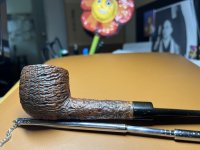
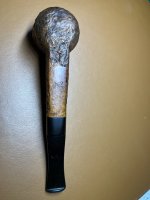
Wow! Thanks to all of you for these fascinating and very informative replies. I have spent many hours yesterday and today reading through the Ken Barnes interview collection and the wonderful posts on this forum. You have helped me date the pipes in question and, I think, many more in my collection. Thank you. Further, any additional posts from JGuss on Relief Grains or anything else and from Sable on his Charatan collection would be very gratefully received. I have a pretty decent collection including a bent stem Underboar that I snagged on eBay for under $100 because the seller didn't realize what he had and what I thought was a pretty decent set of Reuben Era pipes that I now have the information to re-evaluate because I now understand the significance or lack thereof of the presence or absence of the Lane "L." Thank you all so much. I will post some photos ("pipe porn"?) once I figure out how to do it. What a great group! I feel I am joining a brotherhood! I just tried to post two photos of my "Freehand Relief" Pipe. I see their files here but they haven't opened. So perhaps someone knows how to open them up. Anyhow thank you, brothers! Hal
 

Attachments

  • Charatan Free Hand Relief side blast.jpg.pdf
    2.8 MB · Views: 10
  • Charatan Free Hand ReliefBottom.jpg.pdf
    3.3 MB · Views: 4

jguss

Lifer
Jul 7, 2013
2,909
8,076
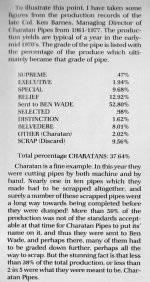
Pete Siegel read all the "Lane Letters" between Herman and Col. (Maj.) Barnes, which were held by Ken Barnes, and would be a great source of info about the brand with his steel-trap memory, but is alas no longer active here. (I do have an article from the old PCI mags of the 1980s by Pete which give production percentages from Charatan archives which I'll photocopy and send to administration with some other articles of possible interest to members...I have no way to so directly.

I can save you some trouble. I had a faint recollection of the piece and eventually found it in an issue of the old Pipe Smoker pci. Pete Siegel’s article was called You Must Be Kidding, and was about the briar pipe manufacturing process (a sort of prequel article discussed sourcing of briar). At one point Pete illustrates the typical yield (anyone with manufacturing experience will understand the economic impact of yield) showing percentages going off to sister Lane company Ben Wade (hint: this was over half and constituted the worst blocks of the bunch), or retained by Charatan for its own use. The largest percentage yield at Charatan was used making Reliefs (as mentioned earlier sandblasting can hide a multitude of sins), followed by unsalvageable blocks, followed by decreasing percentages as you move up the food chain to a Supreme. Unsurprising of course but still a stark look at the economic reality of manufacturing pipes.

IMG_1531.jpeg
 

Stonemonk

Lurker
Sep 11, 2022
21
31
Rhode Island USA
This is brilliant! And stunning, as the quotation says. So may I ask Jon and any others, then, if we can use these percentages to approximate the relative rankings of these various Charatans levels? So, in descending order:

Supreme
Selected
Distinction
Executive (usually above Distinction in many online sources)
Belvedere
Special
Relief
Was "Perfection" gone by the second half of the Lane Era? How about the multi-level After Hours?

BTW did my two photos come through? From my previous post? I think not, so I will try again.
 

Attachments

  • Charatan Freehand Relief Left side blast.jpg
    Charatan Freehand Relief Left side blast.jpg
    121.4 KB · Views: 3
  • Charatan Freehand Relief Nomenclature.jpg
    Charatan Freehand Relief Nomenclature.jpg
    129.8 KB · Views: 3