I don't think in those terms when I pick a block for grain. I've never ever picked up a block and seen nice grain and thought "Wow, that's a really young block."
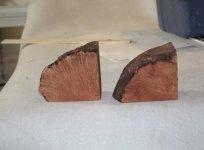
Grain as we talk about it is the xylem of the plant, and in the heart of the burl, it's twisty random stuff. Out at the edge it's usually much more linear.
I've seen briar with growth rings almost 1/4" apart, and I've seen briar with growth rings stacked like plates, so dense it couldn't be sandblasted with any detail. The corresponding "grain" running the other way is usually but not always finer in the tight ringed burls, and my assumption is that they grew slower, in less fertile conditions.
Really old briar is uniformally brown, it's really hard to get the grain to "pop" like newer wood, and certain regions produce somewhat less stripey briar than others. The Italian stuff tends to be really striated, some of the Spanish. Greek in general less so, and again I put this down to growing conditions.
I've had blocks in my shop with 100 growth rings, and they were packed tight, and the grain was also super fine. But that's not an age thing - at 50 years, that briar was just as good, only, smaller.
Mostly, when you pick up a real old pipe, and the grain is just sucky or non-existent, it's because the pipe was cut from an ebauchon with no regard at all to grain quality or orientation. I don't think the briar was older or younger per se than what is cut now.