Why is a Shell Briar So Called?

Log in

SmokingPipes.com Updates

Watch for Updates Twice a Week

PipesMagazine Approved Sponsor

Drucquers Banner

PipesMagazine Approved Sponsor

PipesMagazine Approved Sponsor

PipesMagazine Approved Sponsor

PipesMagazine Approved Sponsor

Status
Not open for further replies.

huntertrw

Lifer
Jul 23, 2014
6,989
12,165
The Lower Forty of Hill Country
menuhin:
So, one year after the merger Dunhill ceased oil-curing their pipes... As I said above, this comes as scant surprise, not only for the quality reasons which you cite, but also because of the labor-intensiveness of the process, its attendant costs, and the faster throughput which could be achieved by its elimination. My guess is that the partner company drove this decision
In my opinion the moral of this story is that faster and less costly SELDOM equates to BETTER.


sparrowhawk

Lifer
Jul 24, 2013
2,941
220
I would like to point this out: an oil cured pipe, at least the Cayugas I've owned and smoked well over thirty times, are significantly lighter than non-cured pipes. I've posted about this before. When I first noticed that my first Cayugu pipe seemed noticably lighter and easier to clench, I grabbed another pipe slightly larger. While the weight difference is difficult to discern with your hand, when I compared the way both pipes clenched. The Cayuga was easily the lighter of the two. I'm certainly no expert, but I suspect oil-curing opens up the grain or in some other way physically lightens the pipe. Could that in turn be why the Cayuga smokes so much better. I say these things as an amateur to the hobby, knowing the gentlemen above know much better than I, so what say you about weight, oil-curing, and smoking quality given my experience?


sablebrush52

The Bard Of Barlings
Jun 15, 2013
23,068
58,990
Southern Oregon
jrs457.wixsite.com
The purpose of oil curing was to speed up the curing process by using oil to remove sap from the wood, as opposed to air curing which could take a couple of years. Heat would sweat out the oil. But I think that the lightness is more a result of the structure of the briar used, than any process.


judcole

Lifer
Sep 14, 2011
7,958
48,939
Detroit
Interesting discussion on oil-curing - and 'shell' briar; thanks, fellas.

Besides Cayuga, there was another Detroit area pipe shop that used to oil-cure the briar they used for their line of pipes; darned if I can remember the name, though; I was only in there once, and don't own one of their pipes.

Lee Von Erck is also from Michigan; wonder if he got interested in oil-curing through Paul Spaniola.


allan

Lifer
Dec 5, 2012
2,429
8
Bronx, NY
Excellent discussion
I've often wondered why pipes of nearly same dimensions would weigh or feel so much different from each other. My guess was that the briars were of different qualities and the lighter ones were of better grade, to me, meaning that they were dried out for a longer period of time

 
Aug 14, 2012
2,872
130
I got so interested in this discussion that I let my pipe go out. I got my first Dunhill in around 1958-9. I hated the way it smoked. I tried to get a good smoke out of it for a few years, then finally threw it away. (I recently saw one of a similar date on Ebay, same shape and finish, bid up to $2500). The Dunhills I have now smoke much better. If that is because they are not oil cured, it was an improvement.


menuhin

Part of the Furniture Now
Oct 21, 2014
642
4
To continue this discussion, my observation is that whether oil-curing of briar is an effective and desirable treatment has not really reached a clear consensus. There is the understanding of the theoretical function of oil-curing - removing of oil-soluble impurities such as resin and other substances in briar when oil soaked inside the briar is also driven out through heat treatment; however, there has not been any systematic and scientific comparison in the real impact of this process on briar, for example, weight change and short-term ( 30-50 bowls) smokability.
In general, most collectors seem to believe that oil-curing has done some long lasting change to the briar and the fact that this good-old-bygone-days process was once used by a few prestige brands and is now a rare practice adds more desirability to these old-days oil cured pipes.
Expert collectors have the most divided opinion. Some believe in the oil-curing process, but some other join force with the amateur and semi-professional pipe makers to suggest that it may well do not as much to the briar as the majority may think. For example, they claim that the oil-cured briar smoked differently in the first 10-20 bowls but when a smoker uses it beyond 30-50 bowls, then the difference between oil-cured vs non-oil-cured becomes indistinguishable. They also claim that the lighter weight of some of the oil-cured briar is actually due to the more intense multi-phase heat-curing / treatment that has to follow the oil-soaking procedures during oil-curing. I also noticed some old factory briar pipes are very light, less than 25g or even less than 20g but of respectably normal size, and they made use of heat-curing procedures. The majority of briar makes use of air-curing, which is the least risky method.
My current only oil-curing era Dunhill shell pipe does not seem so light for my hand to hold or for me to clench, though a decent smoker, seems like a piece of solid stone to me, at least seems heavier compared to a few other non-oil-cured era Dunhill sandblast finishing pipes. But it is totally not legitimate to compare this way because some may be Algerian briar, some maybe Italian, and some perhaps Corsican. Also, I am not sure how long was the briar of each pipe exposed to heat and under what condition they were exposed to heat.
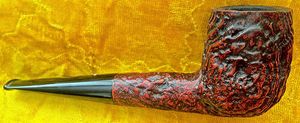
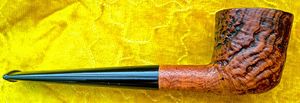
What I know for sure is that I like some of these super craggy pipes - 'Shell' finish pipes, the craggier the more pleasing to my eyes and my hands. Every super craggy pipe, be it a Dunhill or from some other brands, seems to have a good story to tell you when you are smoking it and holding it in your hand.

:puffpipe:
And some cragginess eye-candies:

300px-CraggyDunhill.jpg


300px-CraggyTanshell.jpg


menuhin

Part of the Furniture Now
Oct 21, 2014
642
4
I missed mentioning the third group in this oil-curing debate that may come up from time to time. The third group are full-time pipe makers and manufacturers (like Dunhill in previous earlier era) and their distributors selling pipes made from briar treated by secret and unique oil-curing processes. They claim that oil-cured pipes are definitely different and better in many aspects than non-oil-cured pipes.

:worship:


raevans

Starting to Get Obsessed
Apr 20, 2013
273
17
I find the actual process interesting. For example, Dunhill only used one type of oil when they oil cured their briar. Later, Bill Taylor, (although he never used the oil cure method while at Dunhill), developed his own process that involved three different types of oil. The same result in the deep craggy finish, but Ashton pipes took on an almost nutty flavor the first few smokes because of the oils he used. (They may smoke the same as one that has not been oil cured after a number of smokes, but I for one, liked the nutty flavor when breaking in a new Ashton pipe).

I'm not sure of the process that Radice used in oil curing their pipes, but I did notice that they produced a number of smooth finished pipes that were oil cured which would almost go against the "brings out more imperfections" thought. I have smoked a Radice oil cured pipe, but cannot make an honest comparison to Dunhill or Ashton as the Radice was also a twin bore.

I guess "Oil Cured" could be considered a very broad generic term...

 
Status
Not open for further replies.