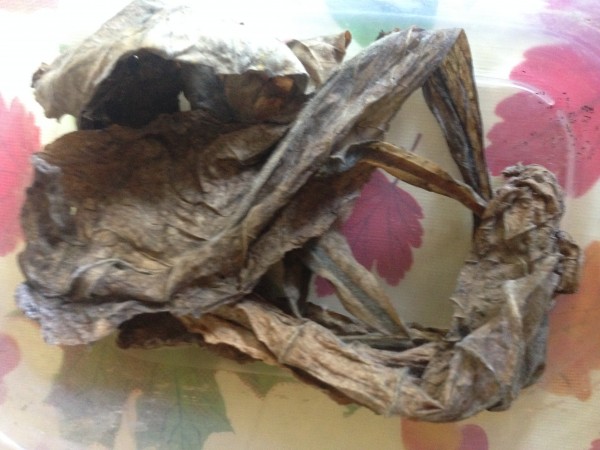


I am not sure how you cured it, but the mold isn't necessarily indicative to a failure in the curing process. That would be a failure in the mold inhibitor.
Give us some details.. How many leaves?, what type of environment were they in( hanging in an out building, your basement etc). How long did your cure take?
Jitterbugdude: there were two leaves, already dried out and put into a small prototype box I built that could regulate both heat and humidity. I'm thinking the problem I had was the box could very easily raise and maintain the humidity needed but couldn't deal with fluctuating temperatures outside of the box that caused the humidity inside to rise. And for the past week the temperatures have been anywhere from 36 degrees to 2 degrees over night. Like I said the box was a prototype and will need to be bigger for the amount of tobacco I have anyway so I'll have to rethink my design, maybe some sort of fan to extract excess humidity.
I don't think that you should be trying to cure dry tobacco leaves.
Please tell us more about your curing box. Got pix?
And in terms of temperature, are you talking °f or °c?
Cosmic: What I had meant was to ferment the tobacco.
Woodsroad: I don't have any pics of the box and have already torn it apart to build it bigger, but essentially it was an insulated box with a rack in the middle for the tobacco, a heating pad at the bottom, and a small home made humidifier in it. All hooked up to a temp control on the outside.
PaddyP, Sounds like your thermostat was defective. I can't see how you would get such a large temperature fluctuation.Another thought is that your heat pad takes way too long to heat up once the thermostat calls for heat. The other thing I noticed is that even at 36C you are way too low for fermenting. Raise your temp to 50C. At that temp you will not grow mold, no matter how humid your environment is. It is also the temp that most home-growers use.
Yeah, the 36 degrees was the highest outdoor temperature. And from everything I've read most home growers use beyween 90 to 140 degrees Fahrenheit for fermenting so I was already running mine at 120 degrees Fahrenheit.
Wow, you show real committment to the hobby! :clap:
Given the excellence of commercially produced tobaccos, I don't think I could ever summon the energy and resources to produce my own leaf. What were your goals and motivation?
My motivation was partially the fact that tins cost upwards of $50 for cheap tobacco here and I wanted to see if I could actually do it. The plants were a little on the small side but I've learned from my mistakes and hopefully next year they will be better. And I'm learning from my mistakes processing the tobacco.
There is always this for homegrown cobs
http://aristocob.com/Homegrown-Cobfoolery-Seed-Corn-Kit-Genuine-Missouri-Meerschaum-Corn-Cob-Pipe-Seeds-P5681929.aspx
I bought that kit this past spring. Right now I have 16 gigantic (diameter wise) corn cobs drying in my basement.
PaddyP: For next year you might want to try some Turkish tobacco and or Burley. The Virginia needs to be flue cured. Air curing will cause it to loose its sugars. I've had very good luck though sun curing Virginia. It is a little more labor intensive than just air curing but I get a Virginia that tastes nice and sweet and is bright yellow.
Jitterbug, I look forward to seeing your cob pipes once you have made them.
Some years ago I lived on a farm and had two large polytunnels for growing home veg in. One year I planted some seeds for growing the eating variety and was quite shocked at how fast they grew. Some even punctured the polythene cover sheet because I was too slow in topping them.
The resulting cobs (and there were many) were the best I ever tasted...just so sweet...yum ::
Regards,
Jay.