


THE RED BARON
- Thread starter UltraBlue
- Start date
You are using an out of date browser. It may not display this or other websites correctly.
You should upgrade or use an alternative browser.
You should upgrade or use an alternative browser.

SmokingPipes.com Updates
Watch for Updates Twice a Week
PipesMagazine Approved Sponsor
PipesMagazine Approved Sponsor

PipesMagazine Approved Sponsor

PipesMagazine Approved Sponsor

PipesMagazine Approved Sponsor








little known fact but that's shane ireland's great great gramps
Who, Snoopy?



It's a small worldlittle known fact but that's shane ireland's great great gramps

Edit: Great looking pipe too!

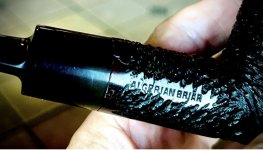
Very interesting pipe! French model name, English briar stamp. Orific bit. Very detailed sandblast. I wonder who made it and when. If it was made in 1917 it would very very interesting, considering Dunhill claims to have been the first to produce sandblasted pipes. Also, pipes in that period didn’t have date stamps, except for Dunhill.

There's also the red dot on top of the stem, just like Dunhill but for its color.Very interesting pipe! French model name, English briar stamp. Orific bit. Very detailed sandblast. I wonder who made it and when. If it was made in 1917 it would very very interesting, considering Dunhill claims to have been the first to produce sandblasted pipes. Also, pipes in that period didn’t have date stamps, except for Dunhill.
The pipe is French. And if I’m not mistaken, Red Baron either published his autobiography or was killed in 1917. This indicates the possibility of a ceremonial pipe. The orific bit is consistent with a pre 1920 production. I also understand that all Dunhills were produced in St Claude prior to 1920s and stamped in England.Very interesting pipe! French model name, English briar stamp. Orific bit. Very detailed sandblast. I wonder who made it and when. If it was made in 1917 it would very very interesting, considering Dunhill claims to have been the first to produce sandblasted pipes. Also, pipes in that period didn’t have date stamps, except for Dunhill.
Either way, the pipe is like a group 5, it’s like new, and smokes fabulous.
So much talking about it, I’m going to smoke it today with Ratray’s Red Rapparee. Thanks for your insights and interest. BTW, I got this pipe 4 years ago in an antique store for $15.
A ceremonial, or commemorative pipe seems likely. I’ve got a Lindbergh pipe.The pipe is French. And if I’m not mistaken, Red Baron either published his autobiography or was killed in 1917. This indicates the possibility of a ceremonial pipe. The orific bit is consistent with a pre 1920 production. I also understand that all Dunhills were produced in St Claude prior to 1920s and stamped in England.
Either way, the pipe is like a group 5, it’s like new, and smokes fabulous.
So much talking about it, I’m going to smoke it today with Ratray’s Red Rapparee. Thanks for your insights and interest. BTW, I got this pipe 4 years ago in an antique store for $15.
Orific bits were in use during the 1920’s as well. Given the use of the word “briar” rather than “bruyere”, the pipe may have been intended for export.
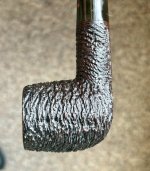
It’s the sandblast that’s interesting. Aside from Dunhill, who was suing everyone who tried to introduce a sandblast, I haven’t seen much in the way of sandblasted pipes from this period, certainly nothing with that level of detail.
Congrats on the snag!
EDIT: Dunhill seems to have carved almost none of their bowls, according to their description of their workforce in a 1928 deposition during the trial over amending the Merchandise Marks Act. They did the finishing, including sandblasting, and mounting.
Last edited:
Yeah the sandblasting is very good.A ceremonial, or commemorative pipe seems likely. I’ve got a Lindbergh pipe.
Orific bits were in use during the 1920’s as well. Given the use of the word “briar” rather than “bruyere”, the pipe may have been intended for export.
It’s the sandblast that’s interesting. Aside from Dunhill, who was suing everyone who tried to introduce a sandblast, I haven’t seen much in the way of sandblasted pipes from this period, certainly nothing with that level of detail.
Congrats on the snag!
EDIT: Dunhill seems to have carved almost none of their bowls, according to their description of their workforce in a 1928 deposition during the trial over amending the Merchandise Marks Act. They did the finishing, including sandblasting, and mounting.
Attachments
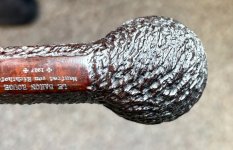
It almost looks like carving.Yeah the sandblasting is very good.

It almost looks like carving.
Agreed. It looks too uniform to be sandblasted and as Sable mentions, there is a date conflict.
Looks like a Sasieni Rustic to my eye.
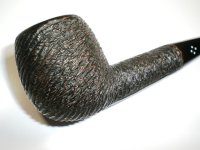
Agreed; looks more like the Sasieni Rustic to me too. And I'm wondering why either the French or English would produce a commemorative pipe for Richthofen (d. 1918), their deadly foe?
I don’t think so.Agreed. It looks too uniform to be sandblasted and as Sable mentions, there is a date conflict.
Looks like a Sasieni Rustic to my eye.
View attachment 441361
Sasieni never made pipes with an orific lip, and the mouthpiece has stamped Made in France.
That bring said, upon closer inspection it is sandblasted.I don’t think so.
Sasieni never made pipes with an orific lip, and the mouthpiece has stamped Made in France.