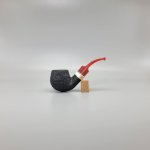







I am posting this to help people who are interested in making pipe bands. I preface all of this with… there is never just one way to do things. The way I am showing you is just one way, not the only way. But, I will explain to you why I am doing and what I am doing as I go, and if this helps someone, great. If not… then just do what you do.
I have made hundreds of square shank bands at this point, and a pipemaker has sent me a whole box of pipes to band. I have developed a process that works for me, and allows me to make a band in about 30 minutes per pipe. I work with a few pipemakers, and I have noticed that square shanks, even on a whole line of the exact shape pipes, even the best of pipemakers, the dimensions of a square shank are never the same. I chock this up to the nature of how square shanks are hand made. The dimensions of the square are never square, and the sides from the stem to the chamber all will have different angles. Meaning… they are never square in any direction.
I have no idea what pipe restorers do when needing to put a square band on a pipe. I have read about them forcing a round band onto a square shanked pipe. If that works, and you are happy with the results, then just continue. But, if you want to make a professional looking band, then I hope this helps.
First, I never buy sheets or wire. Everything I do requires so many different gauges and shapes, that I just make my own production stock by pouring ingots and running them through my rolling mills, or pulling it through a drawplate. As a side not; buying sheet and wire will cost 10-20% more than just buying grain of the metals you need.
To make a band, I start with 21 gauge sterling sheet. I will end up with someone around 22 to 23 gauge when I have finished. Plus, I find trying to
solder 24 or smaller gauge in a butt joint just an unnecessary pain in the ass.

So, to get each section of a square shank laid out. I will wrap the shank in four layers of masking tape. I use four layers, because of the thickness of the metal. Jewelers just instinctively know that thickness of the metal will affect how long a sheet needs to be cut. You want the bend at the edges to be perfectly sized, and the thickness has to be taken into account, or you will end up with a band that is just too tight to get onto the shank.


Pull the tape tight, and cut off the excess. I always start the tape on the top edge, which will be where I put the soldered join. I know, I know… I am placing the edge where I have brazed up front and center. If you don’t have that kind of confidence in your skills, then adjust, but… you can’t hide a bad join. They will see it no matter where you try to hide it.
Since the angles will give you a wonky square cone of tape, I measure how wide I want the band, using calipers, and then mark the tape.

Then I mark the LF and RF (Left Front and Right Front) section of the band on the tape. Then I remove the top layer of tape carefully. This will be my pattern.


Then I carefully trim up the tape along the scribed lines and stick it onto the metal sheet, and then using a scribe, I scratch the lines into the sheet, using a small straight edge for accuracy. Also, don;t forget to add the lines where it will bend.

If you scribe the lines on the top side, the side that the tape was on, transfer those lines to the inside.
I am missing some pictures, ha ha. But, just use your imagination. I also couldn’t take pictures of me using a jeweler’s saw to cut along the scribed lines, where the bends will be, because I don’t have 3 hands, ha ha. But, you will want to use the saw to cut exactly halfway through the sheet.


Use a large medium file to cut a 45 degree angle on the two ends, where the solder/brazed join will be. I use parallel chain nose pliers to bend each section along the scores, making your box.

Solder/braze… if you need directions for brazing, then this will be beyond the scope of your skills. I can assist you with beginning soldering, and there are Youtube videos. It is not rocket science, but it does require a little bit of skill controlling the heat with a torch in your non-dominant hand, while your dominant hand manipulates the pallion of solder into place.

Clean up the piece, but do not start polishing. Polishing should come dead last in the proicess, because it hardens the metal, and you don’t want to deal with hardened metal while fitting the band.
However, on the inside of the band, rough up the surface with a coarse diamond bit. I do this to help the band stay put on the pipe without having to use glue or epoxy. The “tooth” that you make will lay against the wood, and hold it secure. The band can still be removed, but will take a few pops with a mallet to budge it. This will just make life easier for whomever does any repairs in the future.

This is what I use to rough up the inside of the band.

Notice how the shank does not have flat sides. The band will need to be shaped like this to get it to slip on. To shape it, use a ring mandrell, or some round thing to force the band round, and then semi- square it back up with a small leather mallet.

Crap, I meant to take a picture of the band rounded out on the mandrell. Anyways, her it is before I started hammering it down onto the mandrell. Just don’t push it so far that you stretch any of the metal in length, or you will just have to scrap the band and start over.

Sand the band down to 1200 grit. I use Swiss files that will leave an almost polished surface, but any sandpaper will work. Snug the band on, with a few light pops of a small leather mallet. When doing this, hold the stummel in hand, do not brace it against anything. You aren’t trying to split wood, just tap it into place.
Put some tape on the shank to protect the briar’s finish, and then briefly polish with white diamond, and then black diamond polishing compound. Now, clean it up.
When done, clean the inside of the shank out really well. My first band, I learned the hard way that inserting the stem back in after banding a pipe without cleaning out the mortise will bugger up the tenon and may cause the stem to no longer fit as well. I just use a compressor to blow out the metal shavings, and then a Q-tip to swap it, then blow it out again.
Insert the stem, and then check your lines down the stem, shank, and band edges. I usually prefer to cut a dado into the shank to make the band flush. The pipemaker usually does this for me, (sometimes not) but for this design, he didn’t.
I have probably left out something, so feel free to ask questions.
But, I still have 12 bands to get done today, so please be patient with replies.
Let me know what you think...
I have made hundreds of square shank bands at this point, and a pipemaker has sent me a whole box of pipes to band. I have developed a process that works for me, and allows me to make a band in about 30 minutes per pipe. I work with a few pipemakers, and I have noticed that square shanks, even on a whole line of the exact shape pipes, even the best of pipemakers, the dimensions of a square shank are never the same. I chock this up to the nature of how square shanks are hand made. The dimensions of the square are never square, and the sides from the stem to the chamber all will have different angles. Meaning… they are never square in any direction.
I have no idea what pipe restorers do when needing to put a square band on a pipe. I have read about them forcing a round band onto a square shanked pipe. If that works, and you are happy with the results, then just continue. But, if you want to make a professional looking band, then I hope this helps.
First, I never buy sheets or wire. Everything I do requires so many different gauges and shapes, that I just make my own production stock by pouring ingots and running them through my rolling mills, or pulling it through a drawplate. As a side not; buying sheet and wire will cost 10-20% more than just buying grain of the metals you need.
To make a band, I start with 21 gauge sterling sheet. I will end up with someone around 22 to 23 gauge when I have finished. Plus, I find trying to
solder 24 or smaller gauge in a butt joint just an unnecessary pain in the ass.
So, to get each section of a square shank laid out. I will wrap the shank in four layers of masking tape. I use four layers, because of the thickness of the metal. Jewelers just instinctively know that thickness of the metal will affect how long a sheet needs to be cut. You want the bend at the edges to be perfectly sized, and the thickness has to be taken into account, or you will end up with a band that is just too tight to get onto the shank.
Pull the tape tight, and cut off the excess. I always start the tape on the top edge, which will be where I put the soldered join. I know, I know… I am placing the edge where I have brazed up front and center. If you don’t have that kind of confidence in your skills, then adjust, but… you can’t hide a bad join. They will see it no matter where you try to hide it.
Since the angles will give you a wonky square cone of tape, I measure how wide I want the band, using calipers, and then mark the tape.
Then I mark the LF and RF (Left Front and Right Front) section of the band on the tape. Then I remove the top layer of tape carefully. This will be my pattern.
Then I carefully trim up the tape along the scribed lines and stick it onto the metal sheet, and then using a scribe, I scratch the lines into the sheet, using a small straight edge for accuracy. Also, don;t forget to add the lines where it will bend.
If you scribe the lines on the top side, the side that the tape was on, transfer those lines to the inside.
I am missing some pictures, ha ha. But, just use your imagination. I also couldn’t take pictures of me using a jeweler’s saw to cut along the scribed lines, where the bends will be, because I don’t have 3 hands, ha ha. But, you will want to use the saw to cut exactly halfway through the sheet.
Use a large medium file to cut a 45 degree angle on the two ends, where the solder/brazed join will be. I use parallel chain nose pliers to bend each section along the scores, making your box.
Solder/braze… if you need directions for brazing, then this will be beyond the scope of your skills. I can assist you with beginning soldering, and there are Youtube videos. It is not rocket science, but it does require a little bit of skill controlling the heat with a torch in your non-dominant hand, while your dominant hand manipulates the pallion of solder into place.
Clean up the piece, but do not start polishing. Polishing should come dead last in the proicess, because it hardens the metal, and you don’t want to deal with hardened metal while fitting the band.
However, on the inside of the band, rough up the surface with a coarse diamond bit. I do this to help the band stay put on the pipe without having to use glue or epoxy. The “tooth” that you make will lay against the wood, and hold it secure. The band can still be removed, but will take a few pops with a mallet to budge it. This will just make life easier for whomever does any repairs in the future.
This is what I use to rough up the inside of the band.
Notice how the shank does not have flat sides. The band will need to be shaped like this to get it to slip on. To shape it, use a ring mandrell, or some round thing to force the band round, and then semi- square it back up with a small leather mallet.
Crap, I meant to take a picture of the band rounded out on the mandrell. Anyways, her it is before I started hammering it down onto the mandrell. Just don’t push it so far that you stretch any of the metal in length, or you will just have to scrap the band and start over.
Sand the band down to 1200 grit. I use Swiss files that will leave an almost polished surface, but any sandpaper will work. Snug the band on, with a few light pops of a small leather mallet. When doing this, hold the stummel in hand, do not brace it against anything. You aren’t trying to split wood, just tap it into place.
Put some tape on the shank to protect the briar’s finish, and then briefly polish with white diamond, and then black diamond polishing compound. Now, clean it up.
When done, clean the inside of the shank out really well. My first band, I learned the hard way that inserting the stem back in after banding a pipe without cleaning out the mortise will bugger up the tenon and may cause the stem to no longer fit as well. I just use a compressor to blow out the metal shavings, and then a Q-tip to swap it, then blow it out again.
Insert the stem, and then check your lines down the stem, shank, and band edges. I usually prefer to cut a dado into the shank to make the band flush. The pipemaker usually does this for me, (sometimes not) but for this design, he didn’t.
I have probably left out something, so feel free to ask questions.
But, I still have 12 bands to get done today, so please be patient with replies.
Let me know what you think...

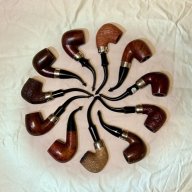





 Took way longer than i expected.