


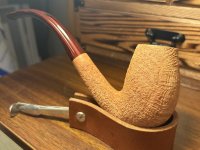
By Pipe Tristan. What does this remind you of? Maybe because of the almost-nude finish, it reminds me of a Becker. The elegance of it is French though.









I like the Merchant Service craggy attempt at the Dunhill style in their Blue Room Briars 1935 production pipes. Have you seen those? I bet someone is going to tell us that the French did it before Dunhill?Beautiful pipe.
This shape is inspired by Dunhill's LC. They were the first to make this shape.


You mean, this kind of shape? Dunhill borrowed it from Genod. It's not exactly a secret.bet someone is going to tell us that the French did it before Dunhill?
I'm looking around but don't see anyone who has one. I'll keep looking but I'd love to find a picture. Have you seen the Merchant Service 1935s? I wonder what iteration is closest to Genod's. Lots of people these days try to do LCs these days.You mean, this kind of shape? Dunhill borrowed it from Genod. It's not exactly a secret.
I love the blast.
As for what it reminds me of, it kinda reminds me of a fried chicken tender.

I haven't looked for hours but I can't see any reference to Genod being its creator?You mean, this kind of shape? Dunhill borrowed it from Genod. It's not exactly a secret.
I love the blast.
As for what it reminds me of, it kinda reminds me of a fried chicken tender.
I have seen photos, they are interesting.I like the Merchant Service craggy attempt at the Dunhill style in their Blue Room Briars 1935 production pipes. Have you seen those? I bet someone is going to tell us that the French did it before Dunhill?
It's old knowledge from decades ago. I have it written down somewhere, but I'll be damned if I know where to lay hands on it at this late date. The shape wasn't uncommon with St Claude made pipes at the turn of the last century. Supposedly, Alfred like the Genod take on itI haven't looked for hours but I can't see any reference to Genod being its creator?
Beautiful pipe.
This shape is inspired by Dunhill's LC. They were the first to make this shape.
Here's a Genod that's in the ballpark.I'm looking around but don't see anyone who has one. I'll keep looking but I'd love to find a picture. Have you seen the Merchant Service 1935s? I wonder what iteration is closest to Genod's. Lots of people these days try to do LCs these days.
That’s a beauty. It almost looks like some of the ones Briarworks make, almost.

Some of his work is on MSDB PIpes. At the moment, they aren't exorbitantly expensive.Beautiful, I had not heard of this carver. I love a fine sandblast finish like that one.
I saw that, quite reasonable.Some of his work is on MSDB PIpes. At the moment, they aren't exorbitantly expensive.
It's old knowledge from decades ago. I have it written down somewhere, but I'll be damned if I know where to lay hands on it at this late date. The shape wasn't uncommon with St Claude made pipes at the turn of the last century. Supposedly, Alfred like the Genod take on it
Indeed. Really, it makes sense. A lot of what we know as 'English classic shapes' are derived from French shapes.The Genod attribution could well be true, what's definitely known is that throughout the 1920s and beyond Dunhill turned virtually none of the millions of bowls they made into pipes and sold. If you take the mid to late twenties as the first and greatest authentic golden age of Dunhill pipes, at that time only 2 out of their approximately 350 UK employees were turners. Not only the LC shape originated in France, but the actual stummels almost always did too.
A lot of what we know as 'English classic shapes' are derived from French shapes
...French machinery acquired by Dunhill, French operators coming to the UK to train Dunhill employees on them...
Even Montague Barling, who in 1906 stated that they were pulling all of their production in house as a response to the St Claude carvers strike, was forced to grudgingly admit in that 1928 deposition that they were obliged to buy a percentage of turned stummels from St Claude to meet demand.Absolutely true. The briar industry as we know it originated in France, and several of the important players in England started there as well.
This effort was tried repeatedly at Dunhill and all the other English pipe factories and without exception failed. This was the dirty little secret of the industry. All the expertise in turning stummels came from France, and it was so difficult to get French workers to a) come to England, and b) convince them to stay if they did relocate, and c) train English workers in their craft, that in the end the overwhelming majority of "London Made" pipe stummels in the 1920s were turned in France and then shipped to England. And by "overwhelming majority" I think 98% plus is a very conservative estimate. As I've mentioned elsewhere Dunhill admitted in public hearings in 1927/28 that about 0.5% of its workforce were turners, and even those were only retained for customer service purposes. If Dunhill tried to turn all its own bowls at that time it would have had to employ 100-150 turners in-house instead of 2. Which is an oblique way of saying that very few if any Dunhill bowls were turned by Dunhill itself in the 1920s, something which was largely true both before and after that time. And of course what was true for Dunhill was true for its competitors.

