

7-4-2011
- Thread starter fhb2532
- Start date
You are using an out of date browser. It may not display this or other websites correctly.
You should upgrade or use an alternative browser.
You should upgrade or use an alternative browser.


PipesMagazine Approved Sponsor

PipesMagazine Approved Sponsor

PipesMagazine Approved Sponsor

PipesMagazine Approved Sponsor

PipesMagazine Approved Sponsor
- Status
- Not open for further replies.
 :
:
Thank you Frank,
Johnny, I wouldn't attempt to say it any better.
Happy Independence Day everyone!
Johnny, I wouldn't attempt to say it any better.
Happy Independence Day everyone!
All of the above. Here's a quote from Winston Churchill regarding our "Great Experiment":
How is that word “democracy” to be interpreted? My idea of it is that the plain, humble, common man, just the ordinary man who keeps a wife and family, who goes off to fight for his country when it is in trouble, goes to the poll at the appropriate time, and puts his cross on the ballot paper showing the candidate he wishes to be elected to Parliament—that he is the foundation of democracy. And it is also essential to this foundation that this man or woman should do this without fear, and without any form of intimidation or victimization. He marks his ballot paper in strict secrecy, and then elected representatives and together decide what government, or even in times of stress, what form of government they wish to have in their country. If that is democracy, I salute it. I espouse it. I would work for it.” —House of Commons, 8 December 1944
Here is an excerpt from one of my earlier blogs: Who Was Caesar Rodney? I encourage you to read about this remarkable American without whom the Declaration of Independence may never have been signed.
Not withstanding the accomplishments that have earned Caesar Rodney his place in the history books, his most important, and perhaps his greatest achievement had yet to be attempted. It was to be one of the most important independent acts of selfless determination in American History….
On July 1, 1776, Rodney was not in attendance at the Second Continental Congress due to the fact he was in Delaware investigating and subduing a Tory uprising. On July 1, 1776, Thomas McKean, also a delegate to the Second Continental Congress, sent an urgent message to Rodney requesting his immediate return to Philadelphia. The Congress had taken a vote on independence. Nine colonies voted for independence, with South Carolina and Pennsylvania dissenting, and New York abstaining. Delaware was deadlocked with McKean voting for independence and George Reed against. A unanimous vote was desperately needed for political and psychological reasons if independence were to succeed.
Upon returning home from the Tory uprising, Rodney received the message from McKean stating that the vote was scheduled for July 2, 1776. Physically weak from his cancer and asthma, and exhausted from the riots, Brigadier General Caesar Augustus Rodney embarked on an epic ride, as great as, or greater than the “famous” ride of Paul Revere. During a tremendous thunderstorm, complete with heavy rain and spectacular lightning, Rodney immediately left his home and headed for Philadelphia to cast the most important vote of his life. He rode the entire night and into the next day, which was oppressively hot. He had ridden eighty miles, stopping only to change horses. Rodney arrived at the meeting covered in baked-on mud and dust, just in time to cast his vote. He has been credited with saying, “As I believe the voice of my constituents and of all sensible and honest men is in favor of independence, my own judgement concurs with them. I vote for independence”. (Drummey, Their 3)
Once the voting was completed and unanimity achieved, Caesar Rodney’s sense of humor, during the ensuing debate, asserted itself when he deflated the self-important Virginian delegation. The Virginians had expressed reservations concerning Britain’s possible response to the vote for American independence. He was quoted as saying “Let Virginia be of good cheer, she has a friend in need; Delaware will take her under its protection and insure her safety”. (Independence, Caesar 1) Rodney’s sarcasm was not lost on the Virginian delegation because Virginia had the largest population, Delaware one of the smallest.
John Hancock signed the Declaration of Independence on July 4, 1776. All the other delegates signed this important document on August 2, 1776, after several lengthy debates. When Caesar Rodney was signing his name on the Declaration of Independence, he knew he was signing his own death warrant. If he were not hung for treason against the British Crown, he would die from facial cancer. Rodney knew he would no longer be able to get the much-needed treatment for his cancer. Treatment was available — only in Britain.

Read the Declaration of Independence in this morning's newspaper. A beautifully written document that everyone should read and digest.
Ah the 4th of July, the date our nation was conceived. I don't really consider America born until the Treaty of Paris and the Treaties of Versailles were signed on September 3, 1783 and England officially recognized us as our own independent nation. But it is great to celebrate the bold stance that our founding fathers took that 4th of July in 1776 by sitting down and writing the Declaration of Independence to stand up for themselves and lay the ground work for our great nation. The pen truly is mightier than the sword. I think today calls for a good bowl of some American tobacco. I'll definitely light up a couple bowls of some McClellands blends I have.


I keep the Declaration of Independence and the Constitution on my phone in searchable apps. I recommend everyone to keep them both at hand and to refer to them from time to time, particularly if one is a politician. :DRead the Declaration of Independence in this morning's newspaper. A beautifully written document that everyone should read and digest.

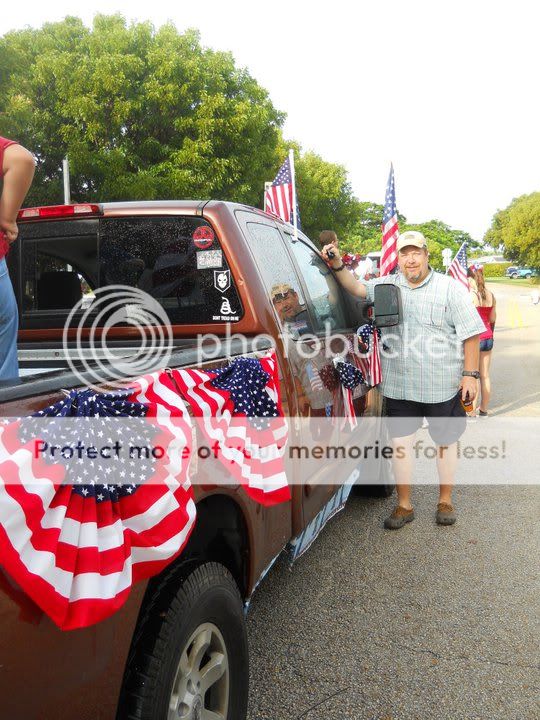
Getting ready for the community parade this morning. (You can't see the huge Old Glory and Gadsden Flags on poles in the back.)
My wife, son, niece, nephew, and some friends rode in the back and tossed candy to and shot water at spectators.
Then home for a while. Then down to Homestead Motor Speedway for music, munchies and fireworks.
My wife, son, niece, nephew, and some friends rode in the back and tossed candy to and shot water at spectators.
Then home for a while. Then down to Homestead Motor Speedway for music, munchies and fireworks.


- Status
- Not open for further replies.