




I tend to like to go opposite. If my tobacco is smoky, I lean toward unpeated Scots whisky (I will not call it "Scotch" her out of respect for my Caledonian friends). For Kentucky blends, I tend to keep it Continental and go with Kentucky Bourbon. I tend to smoke Virginias and Va/Per during the day, and they go well with coffee or tea. I find that doubling up on peat and latakia tends to mask the flavors of both.
Drinks that pair with English blends?
- Thread starter MontyTX
- Start date
You are using an out of date browser. It may not display this or other websites correctly.
You should upgrade or use an alternative browser.
You should upgrade or use an alternative browser.

PipesMagazine Approved Sponsor
PipesMagazine Approved Sponsor

PipesMagazine Approved Sponsor
PipesMagazine Approved Sponsor

PipesMagazine Approved Sponsor



I tend to like to go opposite. If my tobacco is smoky, I lean toward unpeated Scots whisky (I will not call it "Scotch" her out of respect for my Caledonian friends). For Kentucky blends, I tend to keep it Continental and go with Kentucky Bourbon. I tend to smoke Virginias and Va/Per during the day, and they go well with coffee or tea. I find that doubling up on peat and latakia tends to mask the flavors of both.
Not a bad approach at all. Being an expatriate Lousiana native myself, I find that a well-poured sazerac (the actual traditional cocktail, not the company) also goes well with a Va/Per. The combination of the bitters and the absinthe do a nifty dance with the Va sweetness and the Perique kick.


“Yes if you want to run cool you need heavy heavy fuel” Mark KnopflerLaphroaig is a primary component of my blood, like plasma.
I enjoy Ardbeg too, but the under-10-yo expressions tend to be fairly woolly. I think Ardbeg created Wee Beastie a few years ago in order to fill a market niche for a lower-priced alternative. Unfortunately, a 5-yo heavy-peat scotch tends to be a little rough around the edges, even if it is theoretically drinkable.
I'm far from proclaiming myself as an "expert" on anything other than my day job, which does not involve scotch or pipes, or tobacco.
However, I've actively researched, collected, pursued and enjoyed scotch for almost 35 years, so I've been around the block a bit, as well as the Scottish countryside itself. I've never limited myself to one region/style of scotch, but much like tobacco blends, each regional style has its own distinct character and charm, and I love the variety. I love talking scotch and sharing drams with anyone else who shares the passion for uisge beatha, no matter how much or how little they know. At the end of it, enjoyment is the end goal, not one-upmanship or snobbery.
I am partial to Islay and Campbeltown malts in particular, but I have much love for Highland, Speyside and Lowland malts as well. My philosophy when it comes to choosing scotch can be summed up as: "Why dance with only one lady, when you can dance with them all?"
Here's a pic of me on one trip to Laphroaig about 10 years ago-- this is the day they literally put me to work cutting peat in one of their peat bogs... well, at least they provided occasional refreshment between the labor!


nice pic, I wouldn’t have guessed but makes sense looks like a peat bog! I filled a form to own 1 square foot of that, a gimmick of course…. Dream trip one day. just drinking some Oak select, formally select which was a watered down Laphroaig when first on the market, but this new batch is pretty good. I like all regions too, but Islay and Highlands tops for me.
“Yes if you want to run cool you need heavy heavy fuel” Mark Knopfler
nice pic, I wouldn’t have guessed but makes sense looks like a peat bog! I filled a form to own 1 square foot of that, a gimmick of course…. Dream trip one day. just drinking some Oak select, formally select which was a watered down Laphroaig when first on the market, but this new batch is pretty good. I like all regions too, but Islay and Highlands tops for me.
The square-foot ownership is real. Yes, it's a gimmick of sorts, but the ownership is logged with the distillery and they keep records. I've been there, planted my own flag on my square, and collected my annual "rent", which is a complimentary dram at the distillery directly across the road. Laphroaig has multiple peat bogs around Islay, and that photo of me was taken about 5 miles away from the distillery itself in one of their active bogs.
Fortunately, they haven't harvested peat on the "Friends of Laphroaig ownership" stretch of land for quite some time. It is a nice, open pastoral field with various flags and little markers scattered about, although parts are quite soggy at times!
Hope you can make the trip someday. If you get to know the right people, they may take you into warehouse #1, which is basically a cave at/below sea level, filled to the brim with barrels of aging whisky.
Oh, by the way, I also have friends at Ardbeg... here's one of them--

Islay is truly a magical place.

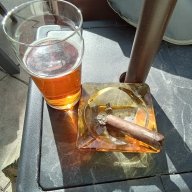
A good dark roast coffee or a Stout beer. I will say I tend towards the coffee most of the time.

We took a trip to Scotland 2 summers ago and spent 4 days on Islay. We stayed in Portnahaven. Laphroaig is my favorite of the Islay whiskies and the distilleries themselves (although going down to the waterside at Caol Ila is nice). Rusty Nails with the 10 year Laphroaig is my go-to cocktail. I need to go back and plant my flag on my square foot. Also want to take a bottle and some spring water out on a hike to the top of Beinn Bheigeir.The square-foot ownership is real. Yes, it's a gimmick of sorts, but the ownership is logged with the distillery and they keep records. I've been there, planted my own flag on my square, and collected my annual "rent", which is a complimentary dram at the distillery directly across the road. Laphroaig has multiple peat bogs around Islay, and that photo of me was taken about 5 miles away from the distillery itself in one of their active bogs.
Fortunately, they haven't harvested peat on the "Friends of Laphroaig ownership" stretch of land for quite some time. It is a nice, open pastoral field with various flags and little markers scattered about, although parts are quite soggy at times!
Hope you can make the trip someday. If you get to know the right people, they may take you into warehouse #1, which is basically a cave at/below sea level, filled to the brim with barrels of aging whisky.
Oh, by the way, I also have friends at Ardbeg... here's one of them--
Islay is truly a magical place.
All that said, I do not like scotch with pipe tobacco. Water, Diet Coke, or lager beer works best for me on English blends.

Y’all were right about coffee with English blends. 1/2 dark + 1/2 French roast with Westminster in a cob is phenomenal. I just haven’t tried it before since I smoke burley in the morning, and English blends in the afternoon/evening. Gonna need to buy some decaf coffee now to go with my evening smokes.
@tartanphantom , I’m totally ignorant of whiskey from across the pond. I’ve sampled a few, but they tasted like I was drinking smoked swamp sludge. I’ve got some 20 bourbons in my stash right now, and lean towards Eagle Rare, OF 1910, Colonel Taylor, Makers 46, New riff 100 proof, Russel’s reserve 10 year, and Knob Creek 9 or 12 year. Any suggestions for whiskey in your neck of the woods that’s sweet, and not peaty?

I’ve noticed a stout or porter works well with English blends. The sweetness cuts some of the smoke & the roasted malts of the beer play well with the Lat. You can also scale up depending on the ratio of Latakia. For example, Squadron Leader or Westminster=Porter, MM965=Stout, Pirate Cake=Imperial Stout.
Have fun finding what works for you!
Have fun finding what works for you!

I'm not really an alcohol and pipe person (I find the bowl becomes a bit wasted on me, and I'm not able to taste much of it), but the first time I tried Lagavulin in a Highland bar I remember turning to my mate and saying "Holy ****, it's like I'm drinking Nightcap!". Since then I've always meant to buy a bottle for pairing with it
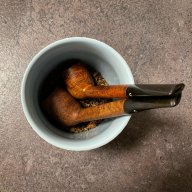
You’re right because they smoke the barley just like they smoke Lat tobacco. But Lagavulin is mid range Smokey, Ardbeg and Laphroaig even more powerful…I'm not really an alcohol and pipe person (I find the bowl becomes a bit wasted on me, and I'm not able to taste much of it), but the first time I tried Lagavulin in a Highland bar I remember turning to my mate and saying "Holy ****, it's like I'm drinking Nightcap!". Since then I've always meant to buy a bottle for pairing with it

@tartanphantom , I’m totally ignorant of whiskey from across the pond. I’ve sampled a few, but they tasted like I was drinking smoked swamp sludge. I’ve got some 20 bourbons in my stash right now, and lean towards Eagle Rare, OF 1910, Colonel Taylor, Makers 46, New riff 100 proof, Russel’s reserve 10 year, and Knob Creek 9 or 12 year. Any suggestions for whiskey in your neck of the woods that’s sweet, and not peaty?
Absolutely. Too often, folks who are unfamiliar with world of scotch often make a couple of fatal mistakes that puts them off completely.
Mistake #1 is the tendency to buying cheaper blended whisky-- bottom shelf stuff, without knowing what they're getting. Often this is a result of pure name recognition, where the underlying product may be OK for making cheaper cocktails, but definitely not OK for sipping or drinking neat.
For example, J&B, Cutty Sark, Clan MacGregor, Passport, etc... all quite economical, but for a reason-- they are primarily neutral grain spirits infused and blended with various amounts of different single malt whiskies-- In equivalent pipe tobacco terms, it is akin to starting with a tub of Granger codger blend, but then adding a mishmash of latakia, cavendish and orientals to it, and then suddenly calling it an English blend, or using a multitude of flavors and casings to mask the cheaper quality of the underlying tobacco.
Mistake #2 is starting at the wrong end of the flavor spectrum. The smokiest, peat-heavy, iodine-sea salt flavors are usually found in Islay malts, and certain malts from the the Hebrides, Campbeltown and the western Highlands. Many of them are plenty expensive and justifiably so, but here is a case where the money spent may disappoint you if you don't know what you are buying. The distillation and maturation style is quite different from the whiskies of the Speyside and Lowland region. which in general are much lighter in body and generally a bit sweeter in the finish.
It's important to remember that not all scotch is smoked or heavily peated; and even some Speyside malts may utilize peat barley in extremely small amounts, to give body to the whisky without adding a heavy smoke taste. It's also important to recognize that a scotch does not have to be super "old" to be smooth or enjoyable. The age statement game is a major marketing ploy, and only a very rough guideline, but not a bona fide guaranty that the scotch will actually be palatable to your taste. In the case of age statements over 16-20 years, the principle of diminishing returns kicks in hard, and the inexperienced will not recognize any appreciable improvement in flavor for the increased cost.
There are lots more things to consider that will siginificantly affect the flavor profile, but I won't get into them here. Things like the still design, cask size, type of wood used (American or European oak), and whether the barrel held a certain type of beverage previously (bourbon, port, sherry, rum, etc). These factors will definitely impart certain flavors during scotch maturation, but it's too much to go into here.
For the complete novice I have a few recommendations as easy entry points- these should not be hard to find at any liquor store with a halfway decent scotch selection.
1) Aberfeldy 12-yr old. This one is a real sleeper. Very affordable central highland single malt that is rich, smooth, with some brandy notes, and not peated. Will set you back somewhere in the $35-45 range in most of the US.
2) Aberlour 12-yr old. A little bit more expensive, This is a popular Speyside single malt that is reknown for using Port casks and Sherry butts in the maturation process. Again, not heavily smoky or peaty. There is the barest whisper of peat in the long finish, but the Sherry notes are much more to the fore on the palate. This one falls into the $55-65 range.
3) Glenkinchie 12-yr old.-- a Lowland style single malt with a very polite flavor profile. Not weak or watery, but not an "in your face" whisky by any stretch. costs about the same as the Aberlour 12-yr old, but with less Sherry character on the palate.
3) Monkey Shoulder. This is a blended malt that has gained a recent following in the US, and is easily found. It has lots of dry tannic American Oak notes in the finish, much like a well-aged Bourbon. Again though, not super sweet, but not overly peated either. A pretty darn good all-around blended malt, priced about the same as Aberfeldy, maybe a little less.
I hope this helps- I have a great fondness for Bourbon and Tennessee whisky as well, and I find that my palate enjoys most types of whisky, including Irish and a few select Canadian ryes.
The thing to remember with scotch vs. bourbon flavor profile is that the base grain is completely different. Scotch uses malted barley, whereas bourbon primarily uses corn (maize), which in itself is much sweeter than barley will ever be. Sweetness in scotch generally comes from the choice of maturation process and the type of cask used for aging, and not from the grain itself.
Last edited: