

Which Other Italian Brand Uses 10 Year Old Briar?
- Thread starter autumnfog
- Start date
You are using an out of date browser. It may not display this or other websites correctly.
You should upgrade or use an alternative browser.
You should upgrade or use an alternative browser.

PipesMagazine Approved Sponsor

PipesMagazine Approved Sponsor
PipesMagazine Approved Sponsor
PipesMagazine Approved Sponsor
PipesMagazine Approved Sponsor

Many companies and artisans use Briar well seasoned. Rather, they buy it aged from the sawmill.I've read somewhere that there is another Italian brand besides Castello that ages their briar for 10 years.
Don't recall which one, Ardor, Ser Jacopo, another?
Butz Choquim did, they had large deposits in the attic of their factory. Almost certainly Savinelli does.
A company that surely does, because in addition to being a pipe factory it is a briar sawmill that sells to other companies and even supplies turned stummels to other very famous brands is Bruken, from Valencia, Spain.
For all I know, I could be wrong, Castello is set up in a small house-sized workshop, it's hard to believe they keep large amounts of briar

The Barontini family in Lovorno, Italy were originally briar harvesters several generations ago until Cesare Barontini went into the pipe making business. Then in the 70's his cousin Ilio also made some pipes. But Bruno and Illico and their parents were harvesters first. Cesare, Barbara and Sylvio now hand make the pipes.
Unrelated to above, I thought good briar was aged 35 to 50 years before making pipes like those of St. Cloud and Older Savinelli, and older Peterson's and French made Algerian briar. I believe I have read that somewhere. 10 Years seems rushing it. (???).
Unrelated to above, I thought good briar was aged 35 to 50 years before making pipes like those of St. Cloud and Older Savinelli, and older Peterson's and French made Algerian briar. I believe I have read that somewhere. 10 Years seems rushing it. (???).


Over the years, the pipemaking gurus have given us such mixed messages. Recently, actual pipemakers tell us that the age of the briar when cut makes the most difference. And, that how long it sets after being cured is not relevant at all. And, then rumors... read somewhere... heard by someone.... someone told me... that letting it set for 10... 20... 50 years makes it better.
I remember a pipeshop owner telling me that the reason Castellos were so good was because they let it soak in sea water, hanging outside a castle window, thus the name. I've also been told that they let it age for 20+ years.
I'm pretty sure that this is all bullshit. They may let their briar set for a while, sure... but what difference does that make? Did they start with bad briar, and then let it age to make it better? We can babble back and forth, but I can't take this question seriously without some validation that Castello does anything special with their briar.
They make a damn fine pipe, but I've got racks of damn fine pipes.
I remember a pipeshop owner telling me that the reason Castellos were so good was because they let it soak in sea water, hanging outside a castle window, thus the name. I've also been told that they let it age for 20+ years.
I'm pretty sure that this is all bullshit. They may let their briar set for a while, sure... but what difference does that make? Did they start with bad briar, and then let it age to make it better? We can babble back and forth, but I can't take this question seriously without some validation that Castello does anything special with their briar.
They make a damn fine pipe, but I've got racks of damn fine pipes.

I would guess that letting cut briar sit in the open air allows it gradually to achieve the same moisture content as the average ambient relative humidity. Does this take one year? Ten? Not sure whether there would be any further benefit from letting it age beyond the point of equilibrium.
Yeh, I think most briar once cured... is just cured. But, I am not a briar expert. @sasquatch has had some inciteful posts about this.I would guess that letting cut briar sit in the open air allows it gradually to achieve the same moisture content as the average ambient relative humidity. Does this take one year? Ten? Not sure whether there would be any further benefit from letting it age beyond the point of equilibrium.
This comes up with other pipe brands also. Curing, aging, oil treating, etc... I enjoy reading and absorbing, but it seems like rumors, pipe company marketing, and other stuff, keeps stirring the mix over and over.

I believe the name you are looking for is Ardor.I've read somewhere that there is another Italian brand besides Castello that ages their briar for 10 years.
Don't recall which one, Ardor, Ser Jacopo, another?

So ... its all just well made tasty bullshit... pretty much like everything else ...I can live with that.I'm pretty sure that this is all bullshit.

Taking into account that the heather is boiled to extract the oils, tannins, sage and impurities in general I guess it is more about drying ...I would guess that letting cut briar sit in the open air allows it gradually to achieve the same moisture content as the average ambient relative humidity. Does this take one year? Ten? Not sure whether there would be any further benefit from letting it age beyond the point of equilibrium.

Don't confuse the time a root burl spends in the ground, developing its patterns of capillary structure, with the amount of time it is seasoned after it has been removed from the ground and subjected to a series of treatments to render it fit for carving into pipes.Unrelated to above, I thought good briar was aged 35 to 50 years before making pipes like those of St. Cloud and Older Savinelli, and older Peterson's and French made Algerian briar. I believe I have read that somewhere. 10 Years seems rushing it. (???).
Desirable periods of growth and development range from 35 to 60 years before harvesting. The Algerian variety tends to be older before it's developed, according to the briar merchants with whom I corresponded.
Once the burl is harvested and is out of the ground, that's the "age" of the briar used.
Seasoning is the next series of steps, designed to remove as much sap and other impurities as possible while rendering the wood as dimensionally stable as possible.
Estimates for how to achieve a well seasoned block of wood differ, that's for sure, as do practices for achieving that state of stability, anywhere from 4 months to 10 years. But, this part is not calculated as "age" of the briar.
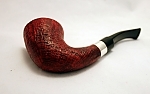
Amorelli uses old briar too.
Savinelli "brags" about using 3 year aged briar in their punto pipes, so the rest ain't ten years old, that's for sure.
Briar blocks change over time, they oxydize and the lignin crystallizes or something.... fresh briar tastes a little... fresh. It doesn't usually taste bad. But it's slightly less stable dimensionally than older wood, and I don't think it smokes as good as it would with more age on it. Mimmo suggests sitting on his product for 2 years, that's the steep part of the aging curve. And I tend to agree, most of the positive changes we see do occur pretty early on. I have 10 year old and old briar in my shop and it's generally harder to work with, stains with less contrast. It usually blasts well, and it tastes good, slightly corky and sweet, very small break in time.
I shoot to make pipes out of briar that is between 3 and 10 years old most of the time. And I have heard no real huge difference from customers buying a pipe from a 10 year aged block and a 3 year aged block. And it often happens I have a guy buy two pipes at the same time, and the source wood may not be the same..... I track this pretty steadily.
Savinelli "brags" about using 3 year aged briar in their punto pipes, so the rest ain't ten years old, that's for sure.
Briar blocks change over time, they oxydize and the lignin crystallizes or something.... fresh briar tastes a little... fresh. It doesn't usually taste bad. But it's slightly less stable dimensionally than older wood, and I don't think it smokes as good as it would with more age on it. Mimmo suggests sitting on his product for 2 years, that's the steep part of the aging curve. And I tend to agree, most of the positive changes we see do occur pretty early on. I have 10 year old and old briar in my shop and it's generally harder to work with, stains with less contrast. It usually blasts well, and it tastes good, slightly corky and sweet, very small break in time.
I shoot to make pipes out of briar that is between 3 and 10 years old most of the time. And I have heard no real huge difference from customers buying a pipe from a 10 year aged block and a 3 year aged block. And it often happens I have a guy buy two pipes at the same time, and the source wood may not be the same..... I track this pretty steadily.
And yes, Sable's point about the actual age of the burl versus the "age" or curing time of the block is right on. All briar is "30 years old" in that the plant is not big enough to harvest before then.
Punto is not savinelli's top line. I am referring to Autograph and Giubileo d´oroAmorelli uses old briar too.
Savinelli "brags" about using 3 year aged briar in their punto pipes, so the rest ain't ten years old, that's for sure.
Briar blocks change over time, they oxydize and the lignin crystallizes or something.... fresh briar tastes a little... fresh. It doesn't usually taste bad. But it's slightly less stable dimensionally than older wood, and I don't think it smokes as good as it would with more age on it. Mimmo suggests sitting on his product for 2 years, that's the steep part of the aging curve. And I tend to agree, most of the positive changes we see do occur pretty early on. I have 10 year old and old briar in my shop and it's generally harder to work with, stains with less contrast. It usually blasts well, and it tastes good, slightly corky and sweet, very small break in time.
I shoot to make pipes out of briar that is between 3 and 10 years old most of the time. And I have heard no real huge difference from customers buying a pipe from a 10 year aged block and a 3 year aged block. And it often happens I have a guy buy two pipes at the same time, and the source wood may not be the same..... I track this pretty steadily.
Thanks for clearing that up. You are right I was adding the two stages together and therefore misunderstood the discussion or was using wrong concept. Either way most of my pipes are older than me... (if they are 50 yrs old as pipes and the briar was 35-50 yrs old when harvested) ... and today that's pretty ancient ! ???Don't confuse the time a root burl spends in the ground, developing its patterns of capillary structure, with the amount of time it is seasoned after it has been removed from the ground and subjected to a series of treatments to render it fit for carving into pipes.
Desirable periods of growth and development range from 35 to 60 years before harvesting. The Algerian variety tends to be older before it's developed, according to the briar merchants with whom I corresponded.
Once the burl is harvested and is out of the ground, that's the "age" of the briar used.
Seasoning is the next series of steps, designed to remove as much sap and other impurities as possible while rendering the wood as dimensionally stable as possible.
Estimates for how to achieve a well seasoned block of wood differ, that's for sure, as do practices for achieving that state of stability, anywhere from 4 months to 10 years. But, this part is not calculated as "age" of the briar.
I do think there is a difference between briar of older pipes and briar of new pipes but its purely subjective observation on my part and have no ability to prove or test that belief. Thanks again !
As an aside, I wonder if the decline of the pipe-making industry in volume has allowed the growth of briar to significantly expand now that harvesting has decreased. Does this make it easier and more accessible to harvest and decrease the price relatively? Harvesting briar is heavy labor in the best of times, but I wonder if the lower sales of pipes compared to the 1950's, for example, has allowed the crop to flourish.

It amazes me what obfuscators marketers are. They'd rather deceive you than breathe.
Earlier today, I was wondering how much briar in plant form exists today.As an aside, I wonder if the decline of the pipe-making industry in volume has allowed the growth of briar to significantly expand now that harvesting has decreased. Does this make it easier and more accessible to harvest and decrease the price relatively? Harvesting briar is heavy labor in the best of times, but I wonder if the lower sales of pipes compared to the 1950's, for example, has allowed the crop to flourish.
Briar was being harvested like crazy for many years - big pipe companies produced a half million pipes a year and there were many of them. Today's demand for briar is probably not 1/10th of what it was in the 50s, say. Talking to cutters in Greece, Spain, and Italy, it sounds like they all understand that this is a resource needing to be curated and controlled, not just an infinitely available gift from God. In Greece, they have permits for sections of forest, and quotas and controls on how much they can take.
It's really hard to separate the briar part from the pipe as a whole - a pipe with a terrible stem will smoke badly even with the best piece of briar in the world attached to it. There are some really wonderful smoking machines from back in the day, but there's lots of absolutely crappy ones too.
The briar being sold as X or XX grade these days is lovely stuff, well cut, well cured. Having bought all kinds of pipes from all sorts of eras, I really can't say I find an old Dunhill or Barling or whatever brand you like to be better than a modern Castello, for example, or many modern single-artisan products.
And of the briar I've bought over the years, certainly cut 500 pieces... I think I've cut about 3 that I thought smelled bad or looked really poor.
It's really hard to separate the briar part from the pipe as a whole - a pipe with a terrible stem will smoke badly even with the best piece of briar in the world attached to it. There are some really wonderful smoking machines from back in the day, but there's lots of absolutely crappy ones too.
The briar being sold as X or XX grade these days is lovely stuff, well cut, well cured. Having bought all kinds of pipes from all sorts of eras, I really can't say I find an old Dunhill or Barling or whatever brand you like to be better than a modern Castello, for example, or many modern single-artisan products.
And of the briar I've bought over the years, certainly cut 500 pieces... I think I've cut about 3 that I thought smelled bad or looked really poor.
Since the early 80s the production of pipes is rather anecdotal. I suppose this has given the briar population time to recover from the exaggerated extraction of the mid-20th century. I would say that the briar that is being harvested today is quite, decent, if not totally suitable, to make excellent pipes.Thanks for clearing that up. You are right I was adding the two stages together and therefore misunderstood the discussion or was using wrong concept. Either way most of my pipes are older than me... (if they are 50 yrs old as pipes and the briar was 35-50 yrs old when harvested) ... and today that's pretty ancient ! ???