



About a month or so ago, during a discussion on tea (or coffee, or both), a couple of folks asked me to put together a post on “tasting” or on discerning nuance in flavours. As some of you know, I am a professional coffee and tea taster and spend my days buying and selling both as well as developing recipes for seasonal and promotional beverages. I do a LOT of tasting in my day-to-day, and also spend a fair bit of time teaching folks how to taste.
I’m going to break these posts up into a couple of different topics, so as not to create a monster wall of text. I'm hoping that these posts will generate a chat about the what, how and why of tasting... Well then I hope you’ll read on and share your thoughts.
Big Ass Caveat – I am in no way a tobacco tasting professional, I don’t profess to be, and I have significantly less smoking experience than most of you. So I’m simply trying to apply tasting fundamentals to our favourite hobby, past-time, way-of-life.
Let’s define ‘taste’:
Tāst - noun
1.the sensation of flavor perceived in the mouth and throat on contact with a substance.
"the wine had a fruity taste"
synonyms: flavor, savor, relish, tang, smack More
Right out of the gate the definition is somewhat confusing, as it uses ‘flavour’ as a synonym for ‘taste’. For our purposes, as budding tobacco (or wine, or whiskey, or coffee, or tea) tasters it is important to separate flavour from taste. These two words are NOT synonymous.
‘Taste’ refers to one of the five primary tastes; sweet, sour, salt, bitter and umami. Umami is a Japanese word meaning (mostly) a delicious, savoury taste. In fact your taste buds are able to pick up these primary tastes in varying degrees; including the possibility of being able to detect one primary taste to the point of being blind to others. It is possible for a person to be ‘blind’ to some tastes due to an absence or extremely low presence of taste buds specific to one of the primary tastes. But most of us have a healthy assortment of taste buds that are dominant, in varying degrees, to all five primary tastes thus allowing us to taste all five primary tastes effectively.
Your body's ability to detect these different tastes is an aid in identifying foods and beverages which can be helpful or harmful. Sweet foods tend to have calories, salty foods tend to bring in minerals, sour foods can be healthy (high in vitamin c) or harmful (like sour milk), bitter foods are often harmful, foods with umami tend to offer a more complete nutritional package.
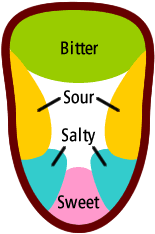
This is the image of the ‘tongue map’ a diagram which was used for most of the 20th century to describe where most people had the highest concentrations of taste buds specific to these four primary tastes. In recent years the tongue map has been attacked, as a number of studies have shown that humans can and do taste the different primary tastes all over the tongue. In my experience, while this map isn’t universal, I think you’ll find that in many of your own cases, the tongue map is relevant and does a good job in helping you localize and identify tastes. You'll note that there is not spot on the tongue for umami, it's generally held that umami is a unifying taste that identifies complex concentrations of salt and sweet and sour.
So that’s taste: five primary tastes which your body has evolved/been-engineered to identify from what you put into your mouth. Some tastes come with benefits (aint that the truth!?!) and others come with baggage.
If you’re interested in mapping out your own tongue, or trying to find where you taste the primary tastes, then consider doing the following:
1. Prepare four measured cups of water
In the first cup add a teaspoon of granulated sugar and stir until dissolved
In the second cup add a teaspoon of table salt and stir until dissolved
In the third cup add a teaspoon of lemon juice and stir until dispersed
In the fourth cup ad a teaspoon of unsweetened cocoa powder and stir until dissolved
2. Taste from the first cup, spit out or swallow, and notice where on your tongue you taste the most sweetness, consider where on your tongue you are NOT noticing sweetness
Rinse your mouth with fresh water
3. Taste from the second cup, spit out or swallow, and notice where on your tongue you taste the most salt, consider where on your tongue you are NOT noticing salt
Rinse your mouth with fresh water
4. Taste from the third cup and notice where on your tongue you taste the most sourness, consider where on your tongue you are NOT noticing sour
Rinse your mouth with fresh water
5. Taste from the third cup and notice where on your tongue you taste bitterness, consider where on your tongue you are NOT noticing bitter
I hope that this was interesting, over the course of the next few posts I’ll be raising the following topics for discussion:
- The Difference Between Taste and Flavour
- The Mechanics of Tasting
- Building a Tasting Protocol/Methodology
Cheers,
-- Pat
I’m going to break these posts up into a couple of different topics, so as not to create a monster wall of text. I'm hoping that these posts will generate a chat about the what, how and why of tasting... Well then I hope you’ll read on and share your thoughts.
Big Ass Caveat – I am in no way a tobacco tasting professional, I don’t profess to be, and I have significantly less smoking experience than most of you. So I’m simply trying to apply tasting fundamentals to our favourite hobby, past-time, way-of-life.
Let’s define ‘taste’:
Tāst - noun
1.the sensation of flavor perceived in the mouth and throat on contact with a substance.
"the wine had a fruity taste"
synonyms: flavor, savor, relish, tang, smack More
Right out of the gate the definition is somewhat confusing, as it uses ‘flavour’ as a synonym for ‘taste’. For our purposes, as budding tobacco (or wine, or whiskey, or coffee, or tea) tasters it is important to separate flavour from taste. These two words are NOT synonymous.
‘Taste’ refers to one of the five primary tastes; sweet, sour, salt, bitter and umami. Umami is a Japanese word meaning (mostly) a delicious, savoury taste. In fact your taste buds are able to pick up these primary tastes in varying degrees; including the possibility of being able to detect one primary taste to the point of being blind to others. It is possible for a person to be ‘blind’ to some tastes due to an absence or extremely low presence of taste buds specific to one of the primary tastes. But most of us have a healthy assortment of taste buds that are dominant, in varying degrees, to all five primary tastes thus allowing us to taste all five primary tastes effectively.
Your body's ability to detect these different tastes is an aid in identifying foods and beverages which can be helpful or harmful. Sweet foods tend to have calories, salty foods tend to bring in minerals, sour foods can be healthy (high in vitamin c) or harmful (like sour milk), bitter foods are often harmful, foods with umami tend to offer a more complete nutritional package.

This is the image of the ‘tongue map’ a diagram which was used for most of the 20th century to describe where most people had the highest concentrations of taste buds specific to these four primary tastes. In recent years the tongue map has been attacked, as a number of studies have shown that humans can and do taste the different primary tastes all over the tongue. In my experience, while this map isn’t universal, I think you’ll find that in many of your own cases, the tongue map is relevant and does a good job in helping you localize and identify tastes. You'll note that there is not spot on the tongue for umami, it's generally held that umami is a unifying taste that identifies complex concentrations of salt and sweet and sour.
So that’s taste: five primary tastes which your body has evolved/been-engineered to identify from what you put into your mouth. Some tastes come with benefits (aint that the truth!?!) and others come with baggage.
If you’re interested in mapping out your own tongue, or trying to find where you taste the primary tastes, then consider doing the following:
1. Prepare four measured cups of water
In the first cup add a teaspoon of granulated sugar and stir until dissolved
In the second cup add a teaspoon of table salt and stir until dissolved
In the third cup add a teaspoon of lemon juice and stir until dispersed
In the fourth cup ad a teaspoon of unsweetened cocoa powder and stir until dissolved
2. Taste from the first cup, spit out or swallow, and notice where on your tongue you taste the most sweetness, consider where on your tongue you are NOT noticing sweetness
Rinse your mouth with fresh water
3. Taste from the second cup, spit out or swallow, and notice where on your tongue you taste the most salt, consider where on your tongue you are NOT noticing salt
Rinse your mouth with fresh water
4. Taste from the third cup and notice where on your tongue you taste the most sourness, consider where on your tongue you are NOT noticing sour
Rinse your mouth with fresh water
5. Taste from the third cup and notice where on your tongue you taste bitterness, consider where on your tongue you are NOT noticing bitter
I hope that this was interesting, over the course of the next few posts I’ll be raising the following topics for discussion:
- The Difference Between Taste and Flavour
- The Mechanics of Tasting
- Building a Tasting Protocol/Methodology
Cheers,
-- Pat