

Sutherland Pipes Appreciation Post
- Thread starter mackthe419
- Start date
You are using an out of date browser. It may not display this or other websites correctly.
You should upgrade or use an alternative browser.
You should upgrade or use an alternative browser.

SmokingPipes.com Updates
Watch for Updates Twice a Week
PipesMagazine Approved Sponsor

PipesMagazine Approved Sponsor

PipesMagazine Approved Sponsor

PipesMagazine Approved Sponsor



A
AroEnglish
Guest
Watching this thread. I need to see more of this man's amazing craftsmanship and eye for aesthetics.
Watching this thread. I need to see more of this man's amazing craftsmanship and eye for aesthetics.
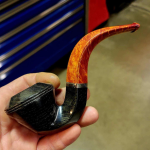

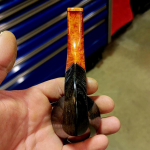


He's working on this one for me. Double curved drilling. Morta and Briar with brass ferrule.

A
AroEnglish
Guest
Geez, this guy is amazing!View attachment 208067View attachment 208069View attachment 208070View attachment 208071View attachment 208072
He's working on this one for me. Double curved drilling. Morta and Briar with brass ferrule.
Telfer is the only pipe maker I know of in the States who has mastered curved drilling.
His bents are very well executed. His straight pipes are also very well done. This guy has a great eye.
His bents are very well executed. His straight pipes are also very well done. This guy has a great eye.

Some beautiful pipes, Max Capps had been doing some really nice pecker drilled pipes but I'm not sure if he's still carving.Telfer is the only pipe maker I know of in the States who has mastered curved drilling.
His bents are very well executed. His straight pipes are also very well done. This guy has a great eye.
I'm not sure Capps is actually utilizing pecker drilling to make his pipes. Telfer I'm pretty sure does. He has made smooths and they don't look they are spliced. Perhaps I'm mistaken. When pipes are blasted and your good at concealing splicing the use of a pecker drill might be unnecessary. I've seen many Capps pipes and they are beautiful for sure. I can't say I've seen a smooth of his that couldn't be drilled without a pecker drill. But of course I haven't seen all of his work. Does it matter if he's using a different technique? Not to me.
Robert built a machine that drills curved holes.I'm not sure Capps is actually utilizing pecker drilling to make his pipes. Telfer I'm pretty sure does. He has made smooths and they don't look they are spliced. Perhaps I'm mistaken. When pipes are blasted and your good at concealing splicing the use of a pecker drill might be unnecessary. I've seen many Capps pipes and they are beautiful for sure. I can't say I've seen a smooth of his that couldn't be drilled without a pecker drill. But of course I haven't seen all of his work. Does it matter if he's using a different technique? Not to me.
Once you have a burr well attached to the guide wire that sits in the bent steel tube you fashion it has to get mounted to a jig that will move the stummel in a circular motion,. I think it would work that way. Maybe Telfer has worked that out. Todd Bannard has looked into this technique. I'm sure he could describe it far better than I.
I suspect that for a number of reasons a pipe maker could screw up many a stummel. I think the French fraized bowls from a model using ebauchons and factored the fail raite into their pricing. Labor and briar was cheap in the days they were using this technique. It took much longer to drill these pipes compared to straight drilling. Today even if a factory could make these shapes as they did many years ago, it might be impractical financially,
I suspect that for a number of reasons a pipe maker could screw up many a stummel. I think the French fraized bowls from a model using ebauchons and factored the fail raite into their pricing. Labor and briar was cheap in the days they were using this technique. It took much longer to drill these pipes compared to straight drilling. Today even if a factory could make these shapes as they did many years ago, it might be impractical financially,
He invested a decent amount of time and money into building a device that he says takes forever to set up, but when it is done, he can put the bit wherever he wants it to go.Once you have a burr well attached to the guide wire that sits in the bent steel tube you fashion it has to get mounted to a jig that will move the stummel in a circular motion,. I think it would work that way. Maybe Telfer has worked that out. Todd Bannard has looked into this technique. I'm sure he could describe it far better than I.
I suspect that for a number of reasons a pipe maker could screw up many a stummel. I think the French fraized bowls from a model using ebauchons and factored the fail raite into their pricing. Labor and briar was cheap in the days they were using this technique. It took much longer to drill these pipes compared to straight drilling. Today even if a factory could make these shapes as they did many years ago, it might be impractical financially,
I doubt it. I think he feeds briar worms tequila daily until they're dependant on alcohol, then when it's time, he places one in the mortice, adds a few drops of tequila to the bowl and let's the little lush work its way down to that sweet sweet nectar.
Labor and briar was cheap in the days they were using this technique.
Especially in France as compared to England. Labor costs, along with certain skill sets, is why for decades Made in London pipes almost universally had their bowls turned in France.
I've read that the LC bowls ( those which have the deeply bent shanks that required curved drilling) were made in St Claude and finished in England. It's unclear to me whether, at some point, Dunhill actually acquired the curved drilling technology so that they didn't need the French. And of course it's been alleged that Dunhill ( and other English houses) bought bowls for other shapes from St. Claude factories, Barontini and Stanwell ( when Stanwell was still making pipes on its own). I wonder if that outsourcing is going on even today?

I've read that the LC bowls ( those which have the deeply bent shanks that required curved drilling) were made in St Claude and finished in England.
Zero doubt. There were a number of lower-grade brands that put out dimensionally identical pipes to Dunhill's LC. (There's a collector in New York who specializes in them, in fact.)
There's no remotely practical way for different companies to produce identical stummels of a shape as distinctive and unique as the LC independently.
Zero doubt. There were a number of lower-grade brands that put out dimensionally identical pipes to Dunhill's LC. (There's a collector in New York who specializes in them, in fact.)
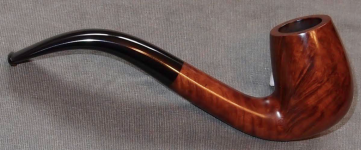
Here's one stamped "Barclay-Rex" that was found as a stemless, loose stummel (and had originally had a band).


And of course it's been alleged that Dunhill ( and other English houses) bought bowls for other shapes from St. Claude factories
More than alleged, it was an admitted fact and formed the heart of the debate in the 1928 hearings held by the Standing Committee (General Merchandise) of the Board of Trade into what pipes should or should not be entitled to be marked as of domestic manufacture (i.e. bear stamps stating that they were made in "London" or "England").
It was an almost universal industry practice (although not one known to the British public) for many years to import bowls turned in France, finish them in England, and label them with domestic nomenclature. Barling, which claimed to turn all its own bowls in London (the operative word here is "claimed"), brought the issue before the Standing Committee, requesting that all pipes whose bowls were turned in France be marked as of foreign manufacture. Almost all of the rest of the industry joined in opposition to Barling's clearly self-interested request. The story is long and involved, but the relevant part here is that Dunhill definitely turned almost all its bowls in France for years, both for economic reasons and because there was an absence of the relevant skill among English pipeworkers.
Here is an extract of Vernon Dunhill's testimony on this point:
We employ at present about 350 hands in our Pipe Factory - of these only 2 are turners and 2 are bowl filers - the two turners being French subjects who came over to England under the Ministry of Labour permits.
Our cost for turning and pumicing bowls in London is just over 3/- per dozen - this cost we admit is high, and we know that our bowl turning in London is done at a loss but we keep our Bowl shop running to give service to our customers.
The St. Claude (France) cost of turning and pumicing is approximately 9d. per dozen.
[to translate for Americans this means the cost of turning a bowl in England was a bit over 4 times the cost of a bowl turned in France]
Our standard quality pipes are made from roughly the best three pieces out of a gross of selected briar root blocks. In order to carefully select this cream of the Bruyere, the blocks of root must be turned into bowls. If we had to turn all the root in London we should have to turn a quantity practically 48 times greater than the number of required bowls in order to obtain the extra quality grade used in the complete pipe.
...
Regarding labour for turning and filing - these are very highly skilled and specialised trades - so much so that we believe the majority of the few bowl turners actually working in this country are French. Should we attempt to turn all bowls in England, we are convinced it would be impossible to find the required skilled labour in this Country.
----------------------------------------------------------
Dunhill goes on to dilate on the obstacles to importing the requisite labor into England.
His arguments were echoed (and others brought to bear) in voluminous testimony by representatives of Comoy, GBD, Civic and Sasieni.
Last edited:
You might think this jguss guy ^^^^ is a hella book researcher, but it's not the case at all.
He put together a REAL Bill & Ted's phone booth time machine and just goes and sees for himself.
Truth.

He put together a REAL Bill & Ted's phone booth time machine and just goes and sees for himself.
Truth.
In my opinion, Guss is a truly great pipe and tobacco historian and in his field, Dibos is without peer. We are fortunate to have these fellows in our hobby.
Thank you, I appreciate it. I can’t be objective about myself, but can whole heartedly agree with what you say about George. He’s a gift to the hobby and every pipe I have that he restored is very precious to me. But please don’t tell him that; his head is swollen enough as it is.