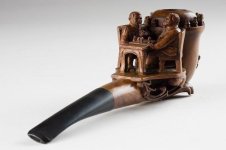
A justly famous pipe, it was carved by Hetzer Barton Hartsock (1918-2003) in 1946. The backstory is a bit convoluted but in brief the first post-war chess match between the USA and Russia was conducted via radio in the Fall of 1945. Contrary to all expectations (at least in our country) the Russians, and I think this is the technical word, clobbered the Americans. A rematch, this time in person, was set for the Fall of 1946. Tracy Mincer, founder of Custombilt, commissioned the pipe you see from Hartsock to commemorate this historic event, and arranged for it to be presented to Stalin as "an additional gesture of friendship".
As a first step Mincer contacted Jack N. Landau, a prominent briar importer and chess fan, who promptly shipped some of the best Algerian briar blocks he could find to Indianapolis, home of Custombilt. Hartsock went to work right away, ultimately spending over 200 hours creating the pipe. The pipe was valued, at least for publicity purposes, at a thousand bucks, perhaps $16,000 in today's money. Eugene Rich, sole distributor of Custombilt at the time, sent the pipe off to Russia where it arrived just before the first match began.
I'm not sure how long Hartsock carved pipes for Mincer but suspect it was only for a few years. As a young man living with his parents at the age of 22 Hartsock listed his profession as carving wooden novelties; by the time of the 1950 census he's listed as a sculptor working for a furniture manufacturer. Later in life he worked as a modeler for the Keeler Brass Company; among many other things Hartsock created a model of Calder's stabile La Grande Vitesse.