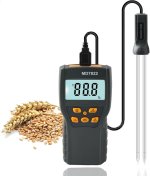
For tobacco, the difficulty with using any of the common varieties of moisture meters, which rely upon measuring the resistance between their probes, is twofold:
1- They won't provide an actual percentage of moisture, just a relative number.
2- Achieving consistency with #1 requires compressing the tobacco to some repeatable degree because the resistance is impacted by the density of the tobacco you are measuring. So, I doubt there's any way to meaningfully compare the readings of say, a flake and a shag. I also don't know how additives like PG or sugar or alcohols might impact the readings.
I used one from Harbor Freight to help my friend Mike Zicha and I write an article on the impact of moisture levels for The Pipe Collector more than five years ago. It kinda, sorta, helped us. We were separately testing the same tobacco at different moisture levels. The meter helped to ensure we were writing about roughly the same levels of moisture, but that's it. It's a relative reading and even at that, if Mike compressed his more than I did, it wouldn't be accurate.
I wouldn't overthink this, even though we used the meter for our article. With experience, you'll know by feel what will smoke best for you. The big takeaway from me in writing the article wasn't to use a meter... it was that it's worth experimenting with your favorite blends to find out how moist you really like them. You may be surprised by the results.
For our article, I wrote to a well-respected and well-known industry expert. Here's what he told me:
"Measuring moisture content IS difficult. The most accurate method is to weigh a sample, dehydrate it, weigh it again, and do the calculation. For greatest accuracy, the dehydration would take place in a vacuum oven, and the scales used for weight would be precision lab balances. You can get close enough with a toaster oven (or an electric home oven if you have one that can get down to 180˚F or lower) and a relatively accurate gram scale. The tobacco's post dehydration weight has to be taken quickly and while the tobacco is still warm, as it will quickly begin absorbing moisture from the air, equilibrating to the relative humidity. This is the way it's done in the industry when necessary, but for the pipe smoker, it's kind of a waste of good tobacco.
The meter you have is designed for measuring the moisture content of wood. Since it's dealing with a relatively small range of material densities, it can provide a fairly consistent reading. Not so with tobacco, as you've discovered. A plug with 47% moisture in it would be pretty much drenched. Anything over about 22% is very moist. I'd say that 19% is probably closer, but still may not be very accurate.
One way you could get more consistent results with the meter would be to measure out a fixed weight of the tobacco, compress it into a fixed volume, and take a reading with a consistent pressure provided by the probe. As you've probably already figured out, where the probe is, how much pressure you apply when reading will change the indicated measurement drastically. If you're not after actual numbers, just a consistent comparison, this may be a decent work-around.
Keep in mind that 9-10% moisture by weight (MBW) is very dry, 13-18% is the range of good smokability, depending on the blend, and much above that is relatively soggy.
In industry, it's not often necessary to make accurate measurements. The RH of the environment will hold tobaccos at a relatively constant MBW, and moisture can be added as necessary to bring it up to the "right" levels. In large operations, it's usually done during the "redrying" operation - leaf is moistened for cutting, lightly pressed into cakes called, run through the cutters, and then dried to the proper levels while tumbling in a heated cylinder. That's the way the cigarette industry works, where consistency over millions of pounds is essential. In smaller operations, it's generally more of a feel thing based on experience and known environmental conditions. "