







Antique Store Find

Log in

SmokingPipes.com Updates

2 Fresh Davide Iafisco Pipes
9 Fresh Radice Pipes
36 Fresh Erik Stokkebye 4th Generation Pipes
12 Fresh Claudio Cavicchi Pipes
3 Fresh J. Alan Pipes

PipesMagazine Approved Sponsor

PipesMagazine Approved Sponsor

PipesMagazine Approved Sponsor

Drucquers Banner

PipesMagazine Approved Sponsor

PipesMagazine Approved Sponsor

gamzultovah

Lifer
Aug 4, 2019
3,277
21,602
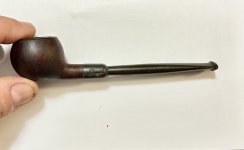
The wife and I haven’t been antiquing in a while so we hit the road. The first stop was uneventful, but the second stop turn up something quite unique. Down at the bottom of a glass showcase, piled on top of other trinkets was an very grungy, apple shaped pipe with a noticeable white spot. I asked the clerk to open the cabinet so that I could take a closer look. I could not make out the nomenclature in the dim light (and weak eyes) but I could make the initials “AD” inside of a diamond on the silver escutcheon, so I knew what I was holding in my hands. I bought the pipe, brought it home and under a magnifying glass, this is what I found:

LEFT SIDE:
Large “A” with a small “c”
“AD” inside of diamond on escutcheon

RIGHT SIDE:
317 (over)
MADE IN ENGLAND 2 (over)
INNER TUBE (over)
PATENTED (I think) MARCH 1915

BOTTOM:
Appears to be an “X”

Here are some pictures:
IMG_3859.jpeg
IMG_3858.jpeg
IMG_3857.jpeg
According to what I can glean from Pipephil, this Dunhill is either from 1915 or 1922 (the information on the pipe doesn’t match up exactly with the information on Pipephil). If anyone has any further information about this Dunhill, I would certainly appreciate it.

So, after years in seclusion, this pipe received a gentle cleaning and is being smoked as I type. She’s a joy.
 

Briarcutter

Lifer
Aug 17, 2023
2,092
11,691
U.S.A.
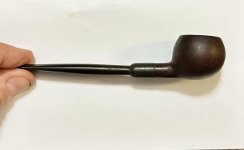
The wife and I haven’t been antiquing in a while so we hit the road. The first stop was uneventful, but the second stop turn up something quite unique. Down at the bottom of a glass showcase, piled on top of other trinkets was an very grungy, apple shaped pipe with a noticeable white spot. I asked the clerk to open the cabinet so that I could take a closer look. I could not make out the nomenclature in the dim light (and weak eyes) but I could make the initials “AD” inside of a diamond on the silver escutcheon, so I knew what I was holding in my hands. I bought the pipe, brought it home and under a magnifying glass, this is what I found:

LEFT SIDE:
Large “A” with a small “c”
“AD” inside of diamond on escutcheon

RIGHT SIDE:
317 (over)
MADE IN ENGLAND 2 (over)
INNER TUBE (over)
PATENTED (I think) MARCH 1915

BOTTOM:
Appears to be an “X”

Here are some pictures:
View attachment 402932
View attachment 402933
View attachment 402934
According to what I can glean from Pipephil, this Dunhill is either from 1915 or 1922 (the information on the pipe doesn’t match up exactly with the information on Pipephil). If anyone has any further information about this Dunhill, I would certainly appreciate it.

So, after years in seclusion, this pipe received a gentle cleaning and is being smoked as I type. She’s a joy.
Great find, congratulations!
 

gamzultovah

Lifer
Aug 4, 2019
3,277
21,602
Congrats!

That's as good as significantly smoked pipes get. No chewed stem, no sunken/carbonized/out-of-round chamber, no ashtray hammered rim.

Happy 4 U the me is. :) :) :)
Thank you, George. The only unfortunate thing is the previous owner (as careful as he was with this pipe) attacked the carbon with a sharp edged knife and put some scratches in the chamber and some nicks on the rim. Other than that and the lack of an actual Dunhill logo, she’s pretty sound.
 
  • Like
Reactions: Choatecav

burleyboy75

Starting to Get Obsessed
May 22, 2025
169
334
Ohio
This is the information that I could find:
  • “AD” inside a diamond -maker’s mark, particularly older Dunhills from the early 20th century. The diamond with “AD” was registered for Dunhill’s silverwork, usually on pipes with silver bands or mounts.
RIGHT SIDE:
  • “317-“shape number, referring to a billiard or dublin with a tapered stem in Dunhill’s numbering system. “3” series often denotes group size 3 (medium), and “17” is the specific shape.
  • Very similar to what’s now classified in Dunhill’s shape charts as a longer Canadian-like variation with a slightly different shank/stem proportion.
  • “MADE IN ENGLAND 2”-The number after “England” is often used as a date code, though it can vary by era. In this case, “2” likely means 1922
  • “INNER TUBE” -Refers to Dunhill’s patented removable metal inner tube. This was heavily advertised by Dunhill in the early 20th century.
  • “PATENTED MARCH 1915”- Refers to Dunhill’s 1915 patent for the inner tube system. This patent was commonly stamped on Dunhill pipes from 1915 through the 1920s. Dunhill used a trailing number after “England” during the early 1920s to denote the year.

BOTTOM:
  • An “X” -could be a grading mark, possibly denoting “X” quality briar, which would have been a higher grade (Dunhill graded pipes from Root, Bruyere, Shell, Tanshell, etc., sometimes using letters or numbers). However, this could also be a craftmans stamp
Copied and pasted/edited from a few different sources.

What a gem, wonderful find. congrats!
 

gamzultovah

Lifer
Aug 4, 2019
3,277
21,602
This is the information that I could find:
  • “AD” inside a diamond -maker’s mark, particularly older Dunhills from the early 20th century. The diamond with “AD” was registered for Dunhill’s silverwork, usually on pipes with silver bands or mounts.
RIGHT SIDE:
  • “317-“shape number, referring to a billiard or dublin with a tapered stem in Dunhill’s numbering system. “3” series often denotes group size 3 (medium), and “17” is the specific shape.
  • Very similar to what’s now classified in Dunhill’s shape charts as a longer Canadian-like variation with a slightly different shank/stem proportion.
  • “MADE IN ENGLAND 2”-The number after “England” is often used as a date code, though it can vary by era. In this case, “2” likely means 1922
  • “INNER TUBE” -Refers to Dunhill’s patented removable metal inner tube. This was heavily advertised by Dunhill in the early 20th century.
  • “PATENTED MARCH 1915”- Refers to Dunhill’s 1915 patent for the inner tube system. This patent was commonly stamped on Dunhill pipes from 1915 through the 1920s. Dunhill used a trailing number after “England” during the early 1920s to denote the year.

BOTTOM:
  • An “X” -could be a grading mark, possibly denoting “X” quality briar, which would have been a higher grade (Dunhill graded pipes from Root, Bruyere, Shell, Tanshell, etc., sometimes using letters or numbers). However, this could also be a craftmans stamp
Copied and pasted/edited from a few different sources.

What a gem, wonderful find. congrats!
Thank you for posting this information. Very much appreciated.
 

huntertrw

Lifer
Jul 23, 2014
6,929
11,976
The Lower Forty of Hill Country
  • An “X” -could be a grading mark, possibly denoting “X” quality briar, which would have been a higher grade (Dunhill graded pipes from Root, Bruyere, Shell, Tanshell, etc., sometimes using letters or numbers). However, this could also be a craftmans stamp

Regarding the "X" marking, the late John Loring, in his booklet titled "The Dunhill Briar Pipe - The Patent Years and After," wrote, "Prior to 1922 Dunhill marketed some "seconds" or as termed by the company "fallings" (sic) under the Dunhill brand name. Final examination in the Dunhill production process came after stamping and finishing and it appears from one example seen that pipes failing that examination were stamped with a large distinctive "X" over the DUNHILL stamping and then sold in the shop at a discount
 
Last edited:

gamzultovah

Lifer
Aug 4, 2019
3,277
21,602
Regarding the "X" marking, the late John Loring, in his booklet titled "The Dunhill Briar Pipe - The Patent Years and After," wrote, "Prior to 1922 Dunhill marketed some "seconds" or as termed by the company "fallings" (sic) under the Dunhill brand name. Final examination in the Dunhill production process came after stamping and finishing and it appears from one example seen that pipes failing that examination were stamped with a large distinctive "X" over the DUNHILL stamping and then sold in the shop at a discount
This would explain a few things, like why this pipe has no “Dunhill” nomenclature. On careful inspection (magnifying glass), this pipe (smooth finish) has what appears to be, three small pits on the front of the bowl.
 

andystewart

Lifer
Jan 21, 2014
3,984
56
Great find! The military mount is appropriate for an era when many British men were still in uniform, being reposted overseas or being waiting to be demobbed from the services. Could also be that the scratches in the chamber/nicks on the rim are down to use of a spark guard to avoid spillage when the stuffed pipe is in a pocket (something I do frequently when out and about).
 

burleyboy75

Starting to Get Obsessed
May 22, 2025
169
334
Ohio
Great find! The military mount is appropriate for an era when many British men were still in uniform, being reposted overseas or being waiting to be demobbed from the services. Could also be that the scratches in the chamber/nicks on the rim are down to use of a spark guard to avoid spillage when the stuffed pipe is in a pocket (something I do frequently when out and about).
i like those too for same reason. Have you noticed it can nick the bowl up a bit?
 
  • Like
Reactions: Choatecav

andystewart

Lifer
Jan 21, 2014
3,984
56
Yep - the briar of the bowl and the type of guard used will determine the nature of the scratches on the rim and their depth in the chamber. Guard arms tend to be relatively blunt and only go max 1cm into the bowl, so should be able to distinguish cuts created by a guard from those left by a sharp, longer tool.
 
  • Like
Reactions: burleyboy75
Dec 10, 2013
2,801
3,612
Nijmegen, the Netherlands
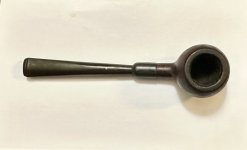
The wife and I haven’t been antiquing in a while so we hit the road. The first stop was uneventful, but the second stop turn up something quite unique. Down at the bottom of a glass showcase, piled on top of other trinkets was an very grungy, apple shaped pipe with a noticeable white spot. I asked the clerk to open the cabinet so that I could take a closer look. I could not make out the nomenclature in the dim light (and weak eyes) but I could make the initials “AD” inside of a diamond on the silver escutcheon, so I knew what I was holding in my hands. I bought the pipe, brought it home and under a magnifying glass, this is what I found:

LEFT SIDE:
Large “A” with a small “c”
“AD” inside of diamond on escutcheon

RIGHT SIDE:
317 (over)
MADE IN ENGLAND 2 (over)
INNER TUBE (over)
PATENTED (I think) MARCH 1915

BOTTOM:
Appears to be an “X”

Here are some pictures:
View attachment 402932
View attachment 402933
View attachment 402934
According to what I can glean from Pipephil, this Dunhill is either from 1915 or 1922 (the information on the pipe doesn’t match up exactly with the information on Pipephil). If anyone has any further information about this Dunhill, I would certainly appreciate it.

So, after years in seclusion, this pipe received a gentle cleaning and is being smoked as I type. She’s a joy.
Wonderful Dunnie, the shape is my favourite and I own a few Patent ones.
Can we see a picture of her now she is cleaned ?
Hunter is correct about the X stamp, but it is of no matter.
Wonderful example in fine condition, Dunhill's stem work was as good as it gets.
Was the price agreeable ?